Weight loss
How to lose weight: losing fat without losing muscle
Calorie deficit, rate of loss, protein, strength training, surplus and sleep: what studies show about losing fat and how CatLena does the math.
· 10 min read
Key points
- To lose fat you need to burn more energy than you eat: that is the calorie deficit.
- Losing about 0.5% to 1% of body weight per week preserves more muscle than faster rates.
- High protein and strength training protect lean mass during a deficit; very large deficits and short nights make you lose more muscle.
- In CatLena, the day’s calorie target is your expenditure (base plus workouts) plus the deficit or surplus you choose.
For people who train, losing weight is rarely just about "making the scale go down". The goal is to lose fat and keep (or even gain) muscle, without losing performance. Three things matter most: the size of the calorie deficit, protein and strength training. Sleep comes right after. This article shows what the studies say about each one and how CatLena turns it into daily targets.
The basis: burn more than you eat
Your body uses energy all the time. When you eat less than you burn, the difference comes from your reserves, mostly fat. That is the calorie deficit. When you eat more than you burn, there is energy left over to store: that is a surplus. The day’s expenditure has different parts:
| Part of expenditure | What it is | How CatLena estimates it |
|---|---|---|
| Basal | Energy to keep the body alive at rest | Mifflin-St Jeor equation (weight, height, age and sex) |
| Digestion | Energy to digest and process food (5% to 15% of expenditure) | Not calculated separately: it is part of the routine factor |
| Daily life | Walking, standing, working, climbing stairs | Routine factor: 1.2 to 1.7 × basal |
| Exercise | Your workouts | Calories from each run and strength workout |
The Mifflin-St Jeor equation was created in 1990 from resting energy measurements in 498 healthy adults aged 19 to 78 [1]. Digestion accounts for about 5% to 15% of daily expenditure on a mixed diet, and protein is the nutrient that costs the most energy to process, ahead of carbohydrate and fat [2]. Daily-life activity (walking, standing) varies a lot between people, which is why CatLena asks about your routine.
How big a deficit: the rate of loss
A bigger deficit makes weight drop faster, but a larger share of what you lose becomes lean mass. A 2014 review on contest preparation for natural bodybuilders sums it up: the larger the deficit, the larger the share of the loss that comes from lean mass, and the risk grows as the person gets leaner. The authors recommend setting calories to lose about 0.5% to 1% of body weight per week [3].
| Current weight | Loss per week (0.5% to 1%) |
|---|---|
| 60 kg | 0.3 to 0.6 kg |
| 70 kg | 0.35 to 0.7 kg |
| 80 kg | 0.4 to 0.8 kg |
| 90 kg | 0.45 to 0.9 kg |
A study with 24 elite athletes tested this directly [4]. All kept four strength sessions per week and were randomized to lose weight slowly (0.7% of body weight per week, eating about 19% less) or quickly (1.4% per week, eating about 30% less). Both groups lost about 5.5% of their weight. In the slow group, lean mass went up 2.1% and fat went down 31%. In the fast group, lean mass did not change and fat went down 21%. The price of the slow rate was time: 8.5 weeks versus 5.3.
| Garthe 2011 (elite athletes) | Slow loss | Fast loss |
|---|---|---|
| Rate | 0.7% of body weight per week | 1.4% of body weight per week |
| Intake reduction | about 19% | about 30% |
| Duration | 8.5 weeks | 5.3 weeks |
| Weight | −5.6% | −5.5% |
| Fat | −31% | −21% |
| Lean mass | +2.1% | no change (−0.2%) |
When the deficit is too big
- Muscle loss: as in the study above, fast rates preserve less lean mass [3][4].
- The body starts burning less: in people with overweight, the drop in expenditure beyond what weight loss would explain ranged from 79 to 504 kcal per day in the studies reviewed [3]. In the extreme case of contestants on the TV show "The Biggest Loser", who lost 58 kg on average, resting expenditure six years later was still about 500 kcal per day below what their body size would predict, even after regaining 41 kg on average [5].
- Hormones: in natural bodybuilders preparing for a contest, testosterone dropped in the first six weeks of dieting, and these changes seem linked to low energy availability [3].
- Health and performance: when the energy left after training stays too low for too long, Relative Energy Deficiency in Sport (REDs) appears. The International Olympic Committee describes it as a syndrome that harms health and performance, in women and in men, and that is also linked to mental health [6].
Protein and strength training
Strength training is the signal that tells the body to keep muscle; protein is the raw material. A meta-analysis of 49 randomized trials with 1,863 people doing strength training showed that more protein increased gains in strength and lean mass. On average, above about 1.6 g per kg of body weight per day there was no extra gain in lean mass [7]. These studies, however, were not in a deficit.
In a deficit, protein matters more. In a study of 40 young men, all eating about 40% less than they needed and doing strength training and hard intervals six days a week for four weeks, one group ate 2.4 g of protein per kg per day and the other 1.2 g. The higher-protein group gained 1.2 kg of lean mass (versus 0.1 kg) and lost 4.8 kg of fat (versus 3.5 kg) [8].
| Situation | Suggested protein | Source |
|---|---|---|
| Strength training, no deficit | about 1.6 g/kg of body weight per day (no extra gain above that, on average) | Morton 2018 [7] |
| Muscle gain (surplus) | 1.6 to 2.2 g/kg of body weight per day | Iraki 2019 [11] |
| Large deficit with hard training | 2.4 g/kg of body weight per day beat 1.2 g/kg | Longland 2016 [8] |
| Dieting athletes who are already lean | 2.3 to 3.1 g/kg of lean mass per day | Helms 2014 [3] |
Can you build muscle in a deficit?
Sometimes, but it gets harder. A 2022 meta-analysis pooled randomized trials of at least three weeks of strength training, comparing people in a deficit with people who were not [9]. In a deficit, lean mass gains were smaller, but strength gains were similar. According to the authors’ analysis, a deficit of about 500 kcal per day was already enough to prevent lean mass gains. Their conclusion: people training to build muscle should avoid long periods in a deficit, and people training to keep muscle while losing weight should avoid deficits above 500 kcal per day.
Losing fat and gaining muscle at the same time has a name: body recomposition. A 2020 review shows that it does not happen only in beginners or in people with overweight: there is plenty of evidence in people who already train, as long as strength training is progressive and nutrition follows the evidence, with attention to sleep as well [10].
Surplus: gaining mass with little fat
For those who want to gain mass, the logic flips, but the size of the surplus still matters. A review on bodybuilders in the off-season suggests eating about 10% to 20% above expenditure and aiming to gain about 0.25% to 0.5% of body weight per week, with 1.6 to 2.2 g of protein per kg per day [11]. Another review suggests starting conservatively, with a surplus of about 1,500 to 2,000 kJ per day (roughly 360 to 480 kcal), and tracking body composition to adjust [12]. It cites a study in which young lean men, after 100 days in a surplus, gained about 2 kg of fat for every 1 kg of lean mass: unchecked extra energy largely becomes fat.
| Goal | Suggested rate | Source |
|---|---|---|
| Lose fat | −0.5% to −1% of body weight per week | Helms 2014 [3] |
| Keep muscle in a deficit | deficit of up to about 500 kcal/day | Murphy and Koehler 2022 [9] |
| Gain mass | +0.25% to +0.5% of body weight per week (10% to 20% above expenditure) | Iraki 2019 [11] |
| Gain mass, cautious start | +1,500 to 2,000 kJ/day (about 360 to 480 kcal) | Slater 2019 [12] |
Sleep also counts
In a crossover study with 10 adults with overweight, each person did the same moderate-deficit diet twice for 14 days: once with 8.5 hours in bed per night and once with 5.5 hours [13]. With less sleep, fat loss fell from 1.4 to 0.6 kg and lean mass loss rose from 1.5 to 2.4 kg. People also felt hungrier. Sleeping well is part of the diet.
Hard training and glycogen
Glycogen is the carbohydrate stored in muscles and liver, and it is the simplest way to think about the energy available for training. The harder the effort, the larger the share of energy that comes from it: in trained cyclists, carbohydrate supplied 46% of energy at 44% of VO₂ max and 76% at 72% of VO₂ max [14]. In CatLena, this store appears on the Stamina card, as a % of your capacity.
Several days in a row of hard training with little carbohydrate drain the store. In a study of 7 trained runners, the same week of intensified training was done twice: eating 5.4 g of carbohydrate per kg per day and eating 8.5 g/kg. With less carbohydrate, 8 km got 155 s slower (61 s with more carbohydrate), 16 km got 8.2% slower (no change with more carbohydrate), fatigue was higher and mood worsened more [15].
- Strength and running sessions yield less for the same effort, and legs and arms feel weak.
- Tiredness also shows up outside training, at work and in daily tasks.
- Mood worsens, and keeping up the training routine gets harder.
How CatLena uses it
In Settings › Goal & targets, you choose your goal, your daily routine and the deficit or surplus, in kcal over the day’s expenditure. When you create your profile, the goal already suggests targets: Fat loss starts with a 500 kcal deficit and 2 g of protein per kg; Muscle gain, with a 300 kcal surplus and 2 g per kg; Maintenance, with no deficit and 1.6 g per kg. You can change these numbers at any time.
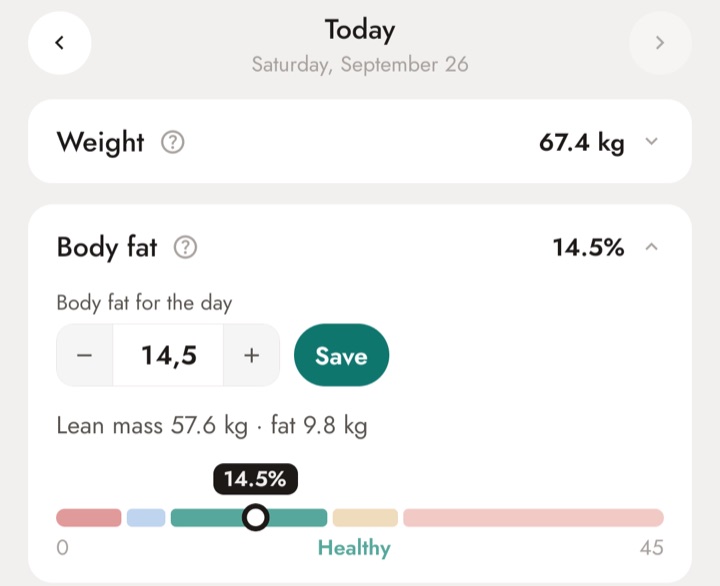
Example with the weight and the run in the screenshots below: a 35-year-old man, 1.75 m, 67.4 kg, Moderate routine (standing or walking for much of the day) and the Fat loss goal.
| Calculation | Day with a 10 km run | Rest day |
|---|---|---|
| Basal (Mifflin-St Jeor) | 10 × 67.4 + 6.25 × 175 − 5 × 35 + 5 = 1,598 kcal | 1,598 kcal |
| Base (basal × 1.5) | 2,397 kcal | 2,397 kcal |
| Workout (67.4 × 10 × 1) | 674 kcal | 0 |
| Day’s expenditure | 3,071 kcal | 2,397 kcal |
| Target (expenditure − 500) | 2,571 kcal | 1,897 kcal |
| Protein (67.4 × 2) | 135 g | 135 g |
| Fiber (14 g per 1,000 kcal of target) | 36 g | 27 g |
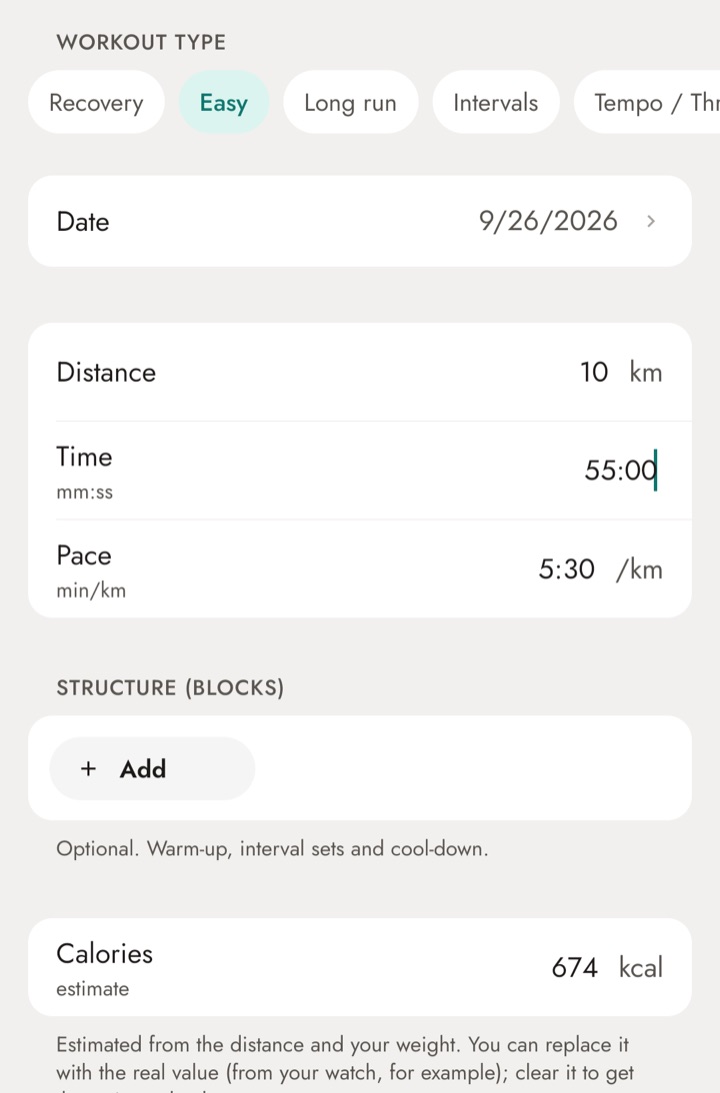
- On the Nutrition screen, the Energy block shows what you ate, the day’s expenditure (base plus workouts) and the balance, as a "deficit" or "surplus". Expanded, it shows the intake bar with the target line and how much is left.
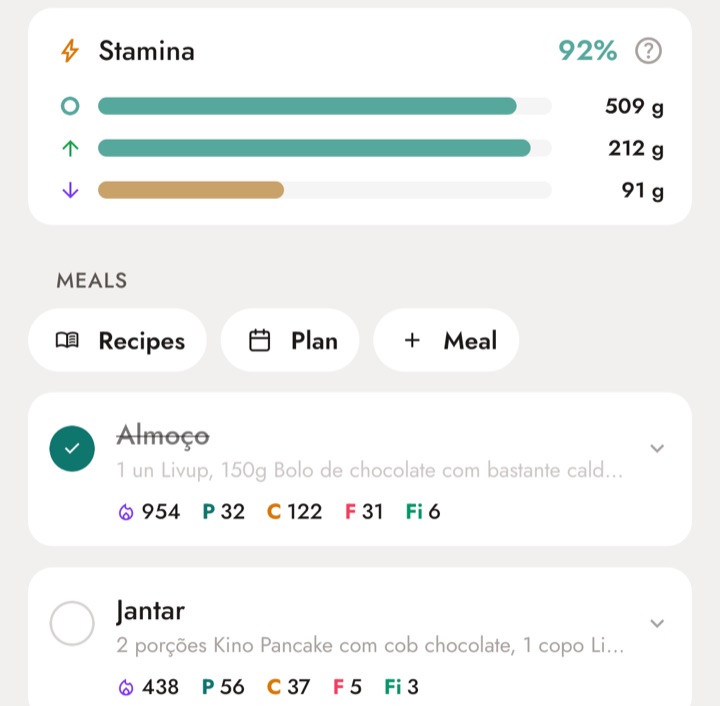
- The Protein, Carbs, Fat and Fiber blocks show the day’s total against the target. The protein target uses the weight logged for that day; carbs and fat only have a target if you set one.
- Workout calories come from your watch or Strava when available; otherwise they are estimated (see the article on workout calories).
- In Metrics, the intake, expenditure and calorie balance charts show each day and the period’s average balance, and the weight chart shows the trend and the average. That is where you check whether the rate is between 0.5% and 1% per week and adjust the deficit.
- On the Body screen, body fat splits your weight into lean mass and fat. If weight goes down and lean mass holds, the loss is coming from fat.
- Stamina shows whether glycogen is low before a hard workout, which is common on low-carbohydrate diets.
Limitations
- The day’s expenditure is an estimate: the basal equation, the routine factor and workout calories can be too high or too low. The scale confirms it: if after two or three weeks your weight does not follow the expected rate, adjust the deficit.
- Weight swings from day to day with water, salt and glycogen. Look at the average and the trend, not a single day.
- The studies cited were done in specific groups (elite athletes, bodybuilders, young men, people with severe obesity). The numbers are a guide, not an exact rule for each person.
References
- Mifflin MD, St Jeor ST, Hill LA, Scott BJ, Daugherty SA, Koh YO. A new predictive equation for resting energy expenditure in healthy individuals. American Journal of Clinical Nutrition, 1990;51(2):241–247. See the study
- Westerterp KR. Diet induced thermogenesis. Nutrition & Metabolism, 2004;1(1):5. See the study
- Helms ER, Aragon AA, Fitschen PJ. Evidence-based recommendations for natural bodybuilding contest preparation: nutrition and supplementation. Journal of the International Society of Sports Nutrition, 2014;11:20. See the study
- Garthe I, Raastad T, Refsnes PE, Koivisto A, Sundgot-Borgen J. Effect of two different weight-loss rates on body composition and strength and power-related performance in elite athletes. International Journal of Sport Nutrition and Exercise Metabolism, 2011;21(2):97–104. See the study
- Fothergill E, Guo J, Howard L, et al. Persistent metabolic adaptation 6 years after "The Biggest Loser" competition. Obesity, 2016;24(8):1612–1619. See the study
- Mountjoy M, Ackerman KE, Bailey DM, et al. 2023 International Olympic Committee's (IOC) consensus statement on Relative Energy Deficiency in Sport (REDs). British Journal of Sports Medicine, 2023;57(17):1073–1097. See the study
- Morton RW, Murphy KT, McKellar SR, et al. A systematic review, meta-analysis and meta-regression of the effect of protein supplementation on resistance training-induced gains in muscle mass and strength in healthy adults. British Journal of Sports Medicine, 2018;52(6):376–384. See the study
- Longland TM, Oikawa SY, Mitchell CJ, Devries MC, Phillips SM. Higher compared with lower dietary protein during an energy deficit combined with intense exercise promotes greater lean mass gain and fat mass loss: a randomized trial. American Journal of Clinical Nutrition, 2016;103(3):738–746. See the study
- Murphy C, Koehler K. Energy deficiency impairs resistance training gains in lean mass but not strength: a meta-analysis and meta-regression. Scandinavian Journal of Medicine & Science in Sports, 2022;32(1):125–137. See the study
- Barakat C, Pearson J, Escalante G, Campbell B, De Souza EO. Body recomposition: can trained individuals build muscle and lose fat at the same time? Strength and Conditioning Journal, 2020;42(5):7–21. See the study
- Iraki J, Fitschen P, Espinar S, Helms E. Nutrition recommendations for bodybuilders in the off-season: a narrative review. Sports, 2019;7(7):154. See the study
- Slater GJ, Dieter BP, Marsh DJ, Helms ER, Shaw G, Iraki J. Is an energy surplus required to maximize skeletal muscle hypertrophy associated with resistance training. Frontiers in Nutrition, 2019;6:131. See the study
- Nedeltcheva AV, Kilkus JM, Imperial J, Schoeller DA, Penev PD. Insufficient sleep undermines dietary efforts to reduce adiposity. Annals of Internal Medicine, 2010;153(7):435–441. See the study
- van Loon LJ, Greenhaff PL, Constantin-Teodosiu D, Saris WH, Wagenmakers AJ. The effects of increasing exercise intensity on muscle fuel utilisation in humans. Journal of Physiology, 2001;536(Pt 1):295–304. See the study
- Achten J, Halson SL, Moseley L, et al. Higher dietary carbohydrate content during intensified running training results in better maintenance of performance and mood state. Journal of Applied Physiology, 2004;96(4):1331–1340. See the study
See this math done for you
In CatLena, you log workouts, meals and measurements (or just chat with CatLena) and the app does this math for you, every day, on your computer and phone.
Get started