Sleep
Sleep: how many hours a night and what it does to training and fat loss
Why adults need at least 7 hours, what short sleep does to fat loss, hunger, muscle and performance, and how to read the CatLena sleep scale.
· 8 min read
Key points
- Adults: 7 hours or more a night, on a regular basis (7 to 9 h; from age 65, 7 to 8 h).
- On the same diet, sleeping 5.5 h instead of 8.5 h cut the share of weight lost as fat by 55% and increased lean mass loss by 60%.
- Short sleep raises hunger (high ghrelin, low leptin), lowers muscle protein synthesis and reduces strength in compound lifts.
- The CatLena scale follows the NSF ranges for your age; below 7 h, treat it as a warning.
Sleep does more than rest the mind. For people who train and want to change their body composition, it decides how much of the weight lost comes from fat, how hungry you feel, how much muscle the body can build and how well the next day's workout goes. This article brings together the recommended hours by age and the studies that measured these effects.
How many hours: 7 or more
In 2015, the American Academy of Sleep Medicine and the Sleep Research Society published a consensus for adults aged 18 to 60: sleep 7 or more hours a night, on a regular basis [3]. According to the statement, regularly sleeping less than 7 hours is associated with weight gain and obesity, diabetes, high blood pressure, heart disease, depression and a higher risk of death.
In the same year, the US National Sleep Foundation (NSF) brought together 18 experts from 12 organizations and split the hours for each age into three groups: recommended, may be appropriate for some people, and not recommended [1][2].
| Age | Recommended | May be appropriate | Not recommended |
|---|---|---|---|
| 14 to 17 years | 8 to 10 h | 7 h or 11 h | less than 7 h or more than 11 h |
| 18 to 25 years | 7 to 9 h | 6 h or 10 to 11 h | less than 6 h or more than 11 h |
| 26 to 64 years | 7 to 9 h | 6 h or 10 h | less than 6 h or more than 10 h |
| 65 years or older | 7 to 8 h | 5 to 6 h or 9 h | less than 5 h or more than 9 h |
The 6-hour "may be appropriate" describes individual variation, not a target. In a study of 48 adults, those who spent 14 days with 6 hours in bed built up attention and memory lapses equivalent to up to two full nights without sleep, and they did not notice how impaired they were: the sleepiness they reported rose only a little [4]. Among athletes, the 2021 expert consensus notes that habitual short sleep (less than 7 hours) is common and raises the risk of respiratory infections [5].
Short sleep hinders fat loss
The most cited study on the topic put 10 overweight adults on the same calorie-restricted diet for 14 days, twice, in random order: once with 8.5 hours in bed and once with 5.5 hours [6]. Weight loss was similar, but what was lost changed:
| On the same diet | Fat lost | Lean mass lost |
|---|---|---|
| 8.5 h in bed (slept 7 h 25 min) | 1.4 kg | 1.5 kg |
| 5.5 h in bed (slept 5 h 14 min) | 0.6 kg | 2.4 kg |
With short sleep, the share of weight lost as fat fell by 55%, and lean mass loss rose by 60%. Participants also reported more hunger, and ghrelin, the hormone that drives appetite, was higher [6]. In an 8-week diet study, a group randomly assigned to sleep about 1 hour less on 5 nights a week lost the same weight as the group with free sleep, but a smaller share of that weight was fat [7].
Hunger: ghrelin and leptin
Leptin signals fullness and ghrelin signals hunger. In 12 young men, two days of restricted sleep, compared with two days of long sleep, lowered leptin by 18% and raised ghrelin by 28%, hunger by 24% and appetite by 23% [8]. In a study of 1,024 people, those who slept 5 hours had on average 15.5% lower leptin and 14.9% higher ghrelin than those who slept 8 hours, and BMI was higher the shorter the sleep; this study shows an association, not a cause [9].
The effect shows up on the plate. After 5 nights with 4 hours in bed, participants gained 0.97 kg, against 0.11 kg in the group that slept normally, and ate about 550 kcal more between 10 pm and 4 am [10]. In another study, 5 days of insufficient sleep raised daily energy expenditure by about 5%, but intake, especially at night after dinner, exceeded what was needed, with an average gain of 0.82 kg [11].
Muscle and recovery
A single night without sleep lowered muscle protein synthesis by 18% in 13 adults (men and women), raised cortisol by 21% and lowered testosterone by 24% [12]. In young men, one week with 5 hours in bed lowered daytime testosterone by 10% to 15% [13].
In 24 young men split into three groups for 5 nights, muscle fiber protein synthesis was lower in the group with 4 hours in bed (1.24% per day) than in the group with 8 hours (1.53%). The third group slept 4 hours but did high-intensity interval training, and kept synthesis up (1.61%) [14]. Training protects some of the muscle, but it does not replace sleep.
Strength, performance and injuries
A systematic review of 17 studies concluded that consecutive nights of restricted sleep reduce strength in multi-joint exercises, such as squats and bench press, but not in single-joint ones [15]. In 10 trained women who did the same strength training with 9 nights of 5 hours in bed and, in another period, with 7 hours or more, short sleep made leg exercises up to 15% slower, raised cortisol by 42% and perceived effort by 11% [16].
The opposite has also been measured. College basketball players who spent at least 10 hours in bed for 5 to 7 weeks cut their sprint time from 16.2 to 15.5 seconds and raised their free throw accuracy by 9% [17]. In 112 adolescent athletes, those who slept less than 8 hours were 1.7 times more likely to have had an injury [18].
Same training, different sleep
There is still no large study that randomly assigned people to short sleep or 8 hours over months of the same training program. The closest ones are small. Over 10 weeks of the same strength training, the group that received sleep guidance lost 1.8 kg of fat, while the other group gained 0.8 kg; lean mass gain was similar (1.7 vs 1.3 kg) [19]. In another study, men who habitually slept about 1 to 2 hours less than recommended did 5 weeks of the same resistance band training and gained strength and muscle like those who slept the recommended amount [20].
The CatLena scale
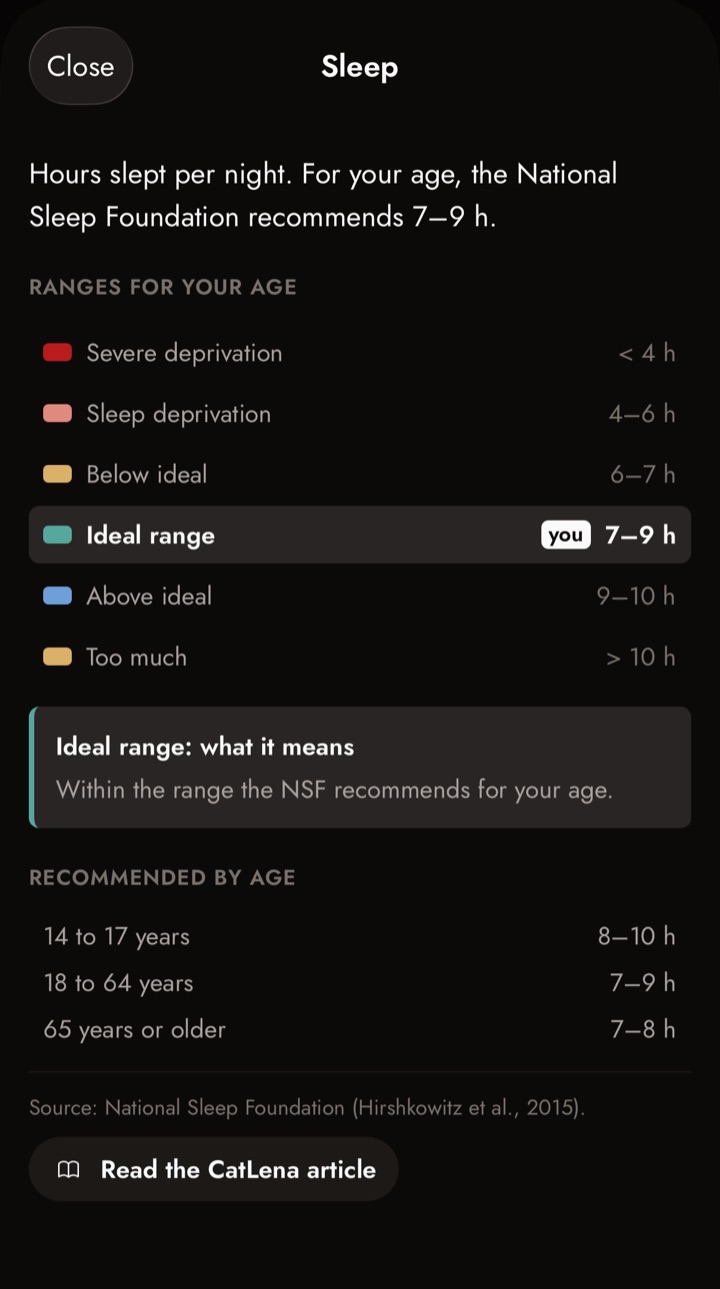
- Ideal range: the recommended hours for your age (7 to 9 h for adults aged 18 to 64).
- Below ideal: the range the NSF calls "may be appropriate for some people" (6 to 7 h for adults). If you train, treat it as a warning: the harms described above appear below 7 hours.
- Above ideal: hours above the recommended range that, for the NSF, may be appropriate for some people.
- Sleep deprivation and Excess: the hours the NSF does not recommend.
- Severe deprivation (less than 4 h): a CatLena split within "not recommended", to highlight very short nights.
How CatLena uses it
In the Sleep block, you log the night's hours and quality, and CatLena shows the range for your age and your 7-day average. The real example shows 8.5 hours with Great quality, in the Ideal range, and an 8-hour average for the week.
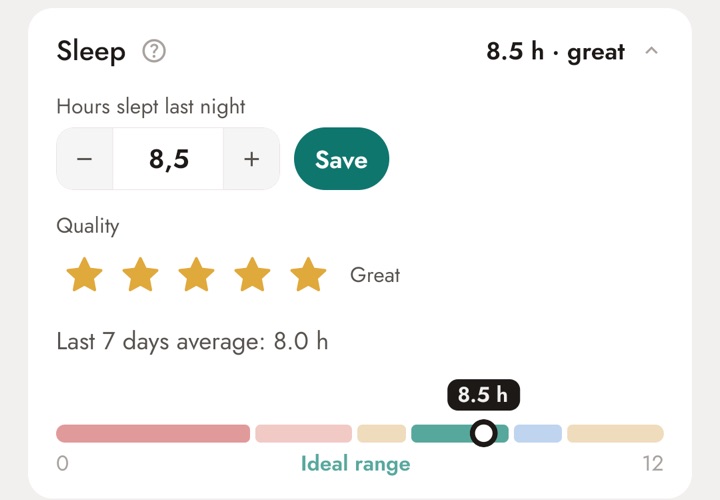
In the app, the question mark (?) next to the measure opens the sleep ranges for your age and the NSF recommendations table.
- In the Sleep card, you log the hours and the quality of the night (from Very poor to Great).
- The scale shows the ranges for your age, and the card shows the average of the last 7 days.
References
- Hirshkowitz M, Whiton K, Albert SM, et al. National Sleep Foundation's sleep time duration recommendations: methodology and results summary. Sleep Health, 2015;1(1):40–43. See the study
- Hirshkowitz M, Whiton K, Albert SM, et al. National Sleep Foundation's updated sleep duration recommendations: final report. Sleep Health, 2015;1(4):233–243. See the study
- Watson NF, Badr MS, Belenky G, et al. Recommended amount of sleep for a healthy adult: a joint consensus statement of the American Academy of Sleep Medicine and Sleep Research Society. Sleep, 2015;38(6):843–844. See the study
- Van Dongen HP, Maislin G, Mullington JM, et al. The cumulative cost of additional wakefulness: dose-response effects on neurobehavioral functions and sleep physiology from chronic sleep restriction and total sleep deprivation. Sleep, 2003;26(2):117–126. See the study
- Walsh NP, Halson SL, Sargent C, et al. Sleep and the athlete: narrative review and 2021 expert consensus recommendations. Br J Sports Med, 2021;55(7):356–368. See the study
- Nedeltcheva AV, Kilkus JM, Imperial J, et al. Insufficient sleep undermines dietary efforts to reduce adiposity. Ann Intern Med, 2010;153(7):435–441. See the study
- Wang X, Sparks JR, Bowyer KP, et al. Influence of sleep restriction on weight loss outcomes associated with caloric restriction. Sleep, 2018;41(5):zsy027. See the study
- Spiegel K, Tasali E, Penev P, et al. Brief communication: sleep curtailment in healthy young men is associated with decreased leptin levels, elevated ghrelin levels, and increased hunger and appetite. Ann Intern Med, 2004;141(11):846–850. See the study
- Taheri S, Lin L, Austin D, et al. Short sleep duration is associated with reduced leptin, elevated ghrelin, and increased body mass index. PLoS Med, 2004;1(3):e62. See the study
- Spaeth AM, Dinges DF, Goel N. Effects of experimental sleep restriction on weight gain, caloric intake, and meal timing in healthy adults. Sleep, 2013;36(7):981–990. See the study
- Markwald RR, Melanson EL, Smith MR, et al. Impact of insufficient sleep on total daily energy expenditure, food intake, and weight gain. Proc Natl Acad Sci U S A, 2013;110(14):5695–5700. See the study
- Lamon S, Morabito A, Arentson-Lantz E, et al. The effect of acute sleep deprivation on skeletal muscle protein synthesis and the hormonal environment. Physiol Rep, 2021;9(1):e14660. See the study
- Leproult R, Van Cauter E. Effect of 1 week of sleep restriction on testosterone levels in young healthy men. JAMA, 2011;305(21):2173–2174. See the study
- Saner NJ, Lee MJ, Pitchford NW, et al. The effect of sleep restriction, with or without high-intensity interval exercise, on myofibrillar protein synthesis in healthy young men. J Physiol, 2020;598(8):1523–1536. See the study
- Knowles OE, Drinkwater EJ, Urwin CS, et al. Inadequate sleep and muscle strength: implications for resistance training. J Sci Med Sport, 2018;21(9):959–968. See the study
- Knowles OE, Drinkwater EJ, Roberts SSH, et al. Sustained sleep restriction reduces resistance exercise quality and quantity in females. Med Sci Sports Exerc, 2022;54(12):2167–2177. See the study
- Mah CD, Mah KE, Kezirian EJ, et al. The effects of sleep extension on the athletic performance of collegiate basketball players. Sleep, 2011;34(7):943–950. See the study
- Milewski MD, Skaggs DL, Bishop GA, et al. Chronic lack of sleep is associated with increased sports injuries in adolescent athletes. J Pediatr Orthop, 2014;34(2):129–133. See the study
- Jåbekk P, Jensen RM, Sandell MB, et al. A randomized controlled pilot trial of sleep health education on body composition changes following 10 weeks' resistance exercise. J Sports Med Phys Fitness, 2020;60(5):743–748. See the study
- Borba DA, Facundo LA, Brant VM, et al. Could a habitual sleep restriction of one-two hours be detrimental to the benefits of resistance training? Sleep Sci, 2024;17(3):e244–e254. See the study
See this math done for you
In CatLena, you log workouts, meals and measurements (or just chat with CatLena) and the app does this math for you, every day, on your computer and phone.
Get started