Training
Workout calories: how CatLena estimates runs and strength
How CatLena estimates the calories of a run (weight × km) and a strength workout (MET × weight × time), with examples and the studies behind them.
· 4 min read
Key points
- Running burns about 1 kcal per kg of body weight per km, at almost any pace.
- For strength training, the math uses METs: intensity × weight × time.
- When your watch reports calories, CatLena uses them; you can replace the estimate at any time.
Watches and Strava calculate workout calories from your heart rate and other data about your body. When that number does not exist (a planned workout, or one logged without a watch), CatLena estimates it with two simple, well-studied formulas. Their values are in Settings › Calculation parameters, where you can adjust them.
Running: weight × distance
In 1963, Rodolfo Margaria and colleagues measured the oxygen used by athletes running on a treadmill at speeds up to 22 km/h, uphill and downhill [1]. The result became a reference: on flat ground, running costs about 1 kcal per kg of body weight per km, and that cost barely changes with speed. Walking at 4 km/h costs roughly half as much per kilometer.
| Person | Workout | Math | Estimate |
|---|---|---|---|
| 55 kg | 8 km | 55 × 8 × 1 | 440 kcal |
| 70 kg | 5 km | 70 × 5 × 1 | 350 kcal |
| 70 kg | 10 km | 70 × 10 × 1 | 700 kcal |
| 85 kg | 5 km | 85 × 5 × 1 | 425 kcal |
Pace is not part of the math: 5 km in 25 or in 35 minutes burns almost the same. Running faster burns the same energy in less time. A 2015 review showed that the cost varies by about 20% from person to person, and that speed only starts to matter at very fast paces [2]. That is why the factor can be adjusted.
Strength: MET × weight × time
For activities without a distance, the scientific standard is the Compendium of Physical Activities, a list that gives each activity a MET value [3][4].
For weight training, the 2024 Compendium lists these values:
| Type of strength training (2024 Compendium) | MET |
|---|---|
| Multiple exercises, 8 to 15 reps, varied loads | 3.5 |
| Circuit training, moderate effort | 5.0 |
| Squats, deadlifts, slow or explosive effort | 5.0 |
| Circuit or supersets | 5.8 |
| Power lifting or body building, vigorous effort | 6.0 |
| Person | Workout | MET | Estimate |
|---|---|---|---|
| 70 kg | 60 min | 5 | 368 kcal |
| 70 kg | 45 min | 5 | 276 kcal |
| 70 kg | 60 min | 3.5 | 257 kcal |
| 85 kg | 60 min | 6 | 536 kcal |
When to adjust the values
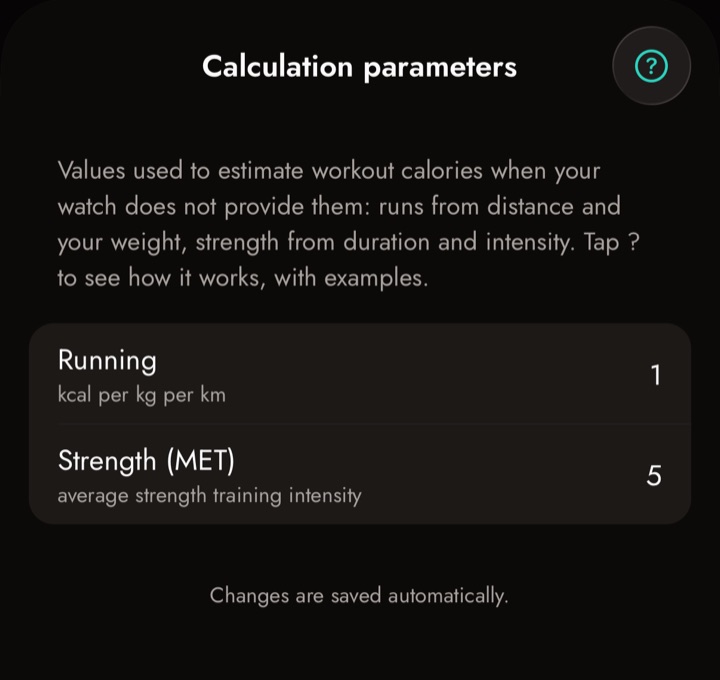
- Running: if your watch always shows a different number, divide its calories by weight × distance. For example, 630 kcal over 10 km at 70 kg gives 630 ÷ (70 × 10) = 0.9, so use 0.9 as your factor.
- Strength: light workouts with many reps are close to 3.5; heavy squats and deadlifts, close to 5; intense max-strength or body-building sessions, close to 6.
- Trails and hills burn more than flat ground. On those days, type in the calories from your watch.
Limits of the estimate
- The running value is the net cost of the exercise, without what the body would burn at rest in the same time.
- The 1963 study measured only two athletes; later reviews confirmed the average and showed differences of about 20% between people.
- The Compendium itself says METs are a starting point and do not measure each person’s exact energy use.
How CatLena uses it
When you create a run, you type the distance and time: the pace is worked out for you and the calories are already estimated. In the real example, 10 km in 55 minutes gives a 5:30 per km pace and 674 kcal for 67.4 kg (67.4 × 10 × 1).
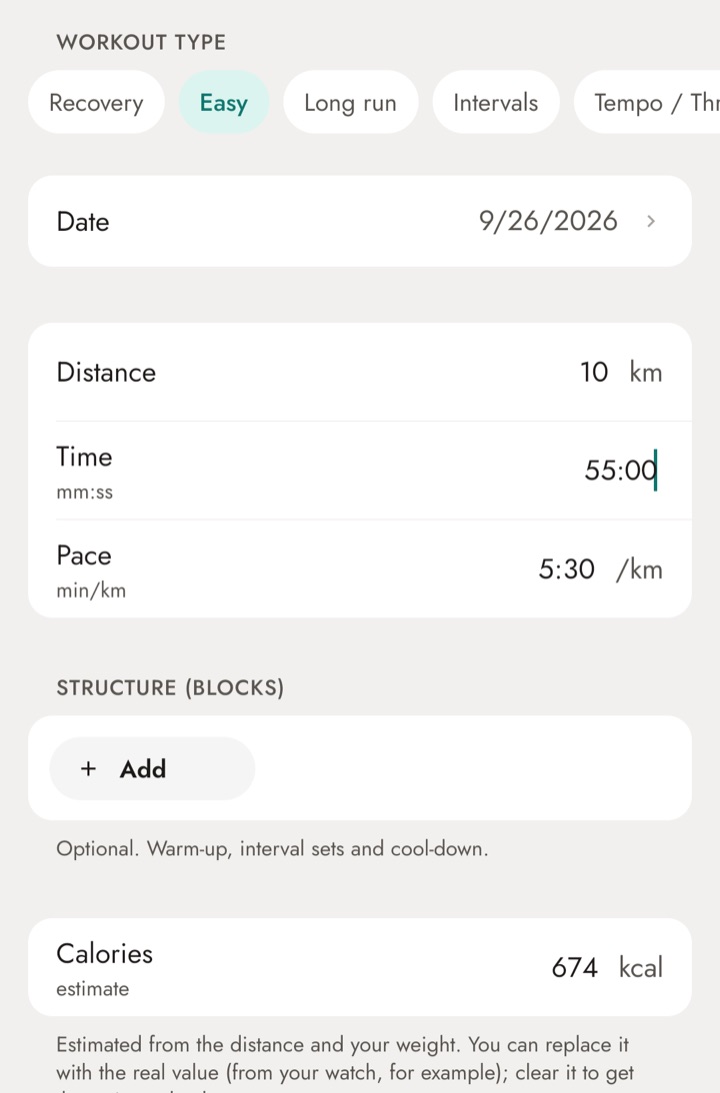
- In the app (iPhone and Android), when you create a run or a strength workout, the Calories field is already filled with the estimate and updates as you change the distance or duration.
- If you type another number (from your watch, for example), that one counts. Clear the field to get the estimate back.
- Strava workouts use Strava’s calories when available.
- These calories go into your daily energy use on the Nutrition screen. Stamina uses the saved calories of runs and walks, and calculates strength workouts from the number of sets.
References
- Margaria R, Cerretelli P, Aghemo P, Sassi G. Energy cost of running. Journal of Applied Physiology, 1963;18(2):367–370. See the study
- Lacour JR, Bourdin M. Factors affecting the energy cost of level running at submaximal speed. European Journal of Applied Physiology, 2015;115(4):651–673. See the study
- Herrmann SD, Willis EA, Ainsworth BE, et al. 2024 Adult Compendium of Physical Activities: a third update of the energy costs of human activities. Journal of Sport and Health Science, 2024;13(1):6–12. See the study
- Ainsworth BE, Haskell WL, Herrmann SD, et al. 2011 Compendium of Physical Activities: a second update of codes and MET values. Medicine & Science in Sports & Exercise, 2011;43(8):1575–1581. See the study
- Jetté M, Sidney K, Blümchen G. Metabolic equivalents (METS) in exercise testing, exercise prescription, and evaluation of functional capacity. Clinical Cardiology, 1990;13(8):555–565. See the study
See this math done for you
In CatLena, you log workouts, meals and measurements (or just chat with CatLena) and the app does this math for you, every day, on your computer and phone.
Get started