Fitness
VO₂ max: the size of your aerobic engine
What VO₂ max is, how to compare yours with people of the same sex and age, what it says about health and the equivalent 5 km time.
· 5 min read
Key points
- VO₂ max measures the size of your aerobic engine.
- Compared with people of the same sex and age, it says a lot about health: the higher, the lower the risk.
- CatLena turns the value into a 5 km time.
VO₂ max is the maximum amount of oxygen your body can take in and use per minute at peak effort, measured in milliliters per kilogram of body weight per minute (ml/kg·min). It is the size of your aerobic engine: the higher it is, the faster and longer you can run, ride or swim.
Comparing with people like you
VO₂ max drops with age and is, on average, higher in men. So the fair comparison is with people of the same sex and age group. CatLena uses the reference table from the FRIEND registry: 7,783 maximal treadmill tests with gas analysis, done in eight labs in the United States, in adults aged 20 to 79 without cardiovascular disease [1]. The table gives the 5th, 10th, 25th, 50th, 75th, 90th and 95th percentiles for each sex and decade of age.
The ranges and what they say about health
Mandsager and colleagues followed 122,007 people who took a treadmill test at the Cleveland Clinic, for a median of 8.4 years [2]. They were grouped by fitness for their age and sex. The risk of death fell with each higher group, with no point at which the benefit stopped: the fittest group had an 80% lower risk than the least fit. CatLena uses the same percentile cut-offs (25th, 50th, 75th), applied to the FRIEND table:
| Range in CatLena | Percentile (sex and age) | Group in Mandsager's study |
|---|---|---|
| Low | the least fit 25% (below the 25th percentile) | low |
| Fair | 25th to 50th percentile | below average |
| Good | 50th to 75th percentile | above average |
| Very good | 75th to 95th percentile | high |
| Elite | the fittest 5% (95th percentile or higher) | high / elite |
The ranges in ml/kg·min
The percentile is your position among people of the same sex and age, not your VO₂ max value. These are the values for each range, from table 3 of the FRIEND study (7,783 treadmill tests, 4,611 men and 3,172 women, in eight US labs) [1]. They are the same numbers CatLena uses. Each cut-off starts the next range.
Men (ml/kg·min):
| Age | Low | Fair | Good | Very good | Elite |
|---|---|---|---|---|---|
| 20 to 29 | < 40.1 | 40.1–48.0 | 48.0–55.2 | 55.2–66.3 | ≥ 66.3 |
| 30 to 39 | < 35.9 | 35.9–42.4 | 42.4–49.2 | 49.2–59.8 | ≥ 59.8 |
| 40 to 49 | < 31.9 | 31.9–37.8 | 37.8–45.0 | 45.0–55.6 | ≥ 55.6 |
| 50 to 59 | < 27.1 | 27.1–32.6 | 32.6–39.7 | 39.7–50.7 | ≥ 50.7 |
| 60 to 69 | < 23.7 | 23.7–28.2 | 28.2–34.5 | 34.5–43.0 | ≥ 43.0 |
| 70 to 79 | < 20.4 | 20.4–24.4 | 24.4–30.4 | 30.4–39.7 | ≥ 39.7 |
Women (ml/kg·min):
| Age | Low | Fair | Good | Very good | Elite |
|---|---|---|---|---|---|
| 20 to 29 | < 30.5 | 30.5–37.6 | 37.6–44.7 | 44.7–56.0 | ≥ 56.0 |
| 30 to 39 | < 25.3 | 25.3–30.2 | 30.2–36.1 | 36.1–45.8 | ≥ 45.8 |
| 40 to 49 | < 22.1 | 22.1–26.7 | 26.7–32.4 | 32.4–41.7 | ≥ 41.7 |
| 50 to 59 | < 19.9 | 19.9–23.4 | 23.4–27.6 | 27.6–35.9 | ≥ 35.9 |
| 60 to 69 | < 17.2 | 17.2–20.0 | 20.0–23.8 | 23.8–29.4 | ≥ 29.4 |
| 70 to 79 | < 15.6 | 15.6–18.3 | 18.3–20.8 | 20.8–24.1 | ≥ 24.1 |
The equivalent 5 km time
To turn VO₂ max into performance, CatLena uses Jack Daniels and Jimmy Gilbert's formulas, which relate oxygen use to running speed and to how long each intensity can be held [3]. They are the formulas behind the VDOT tables, widely used by running coaches. Using your VO₂ max in place of VDOT gives the matching 5 km time. For example: 40 gives about 24 min, 50 about 20 min and 60 about 17 min.
It is an estimate for people who train running. The actual time also depends on running economy, specific training, course and weather.
VO₂ max from a watch
The reference values come from lab tests with breath gas analysis. Sports watches estimate VO₂ max from heart rate and pace during runs. The estimate is useful for tracking your progress, but your position in the table should be read as approximate.
How CatLena uses it
In the VO₂ max block, you log the value from a test or your watch, and CatLena shows your position among people of the same sex and age and the equivalent 5 km time. In the real example, 42 ml/kg·min for a man aged 30 to 39: better than about 48% of them, Fair range, equivalent to running 5 km in about 23 minutes.
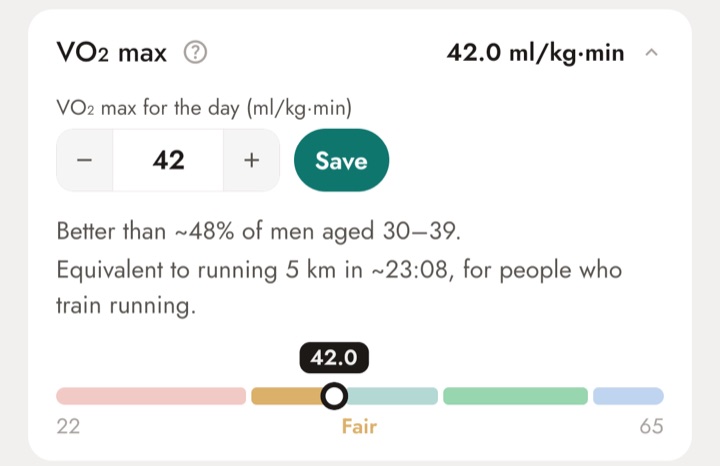
The question mark (?) next to the measure opens the ranges in ml/kg·min for your sex and age in the app, with your range highlighted and the equivalent 5 km time.
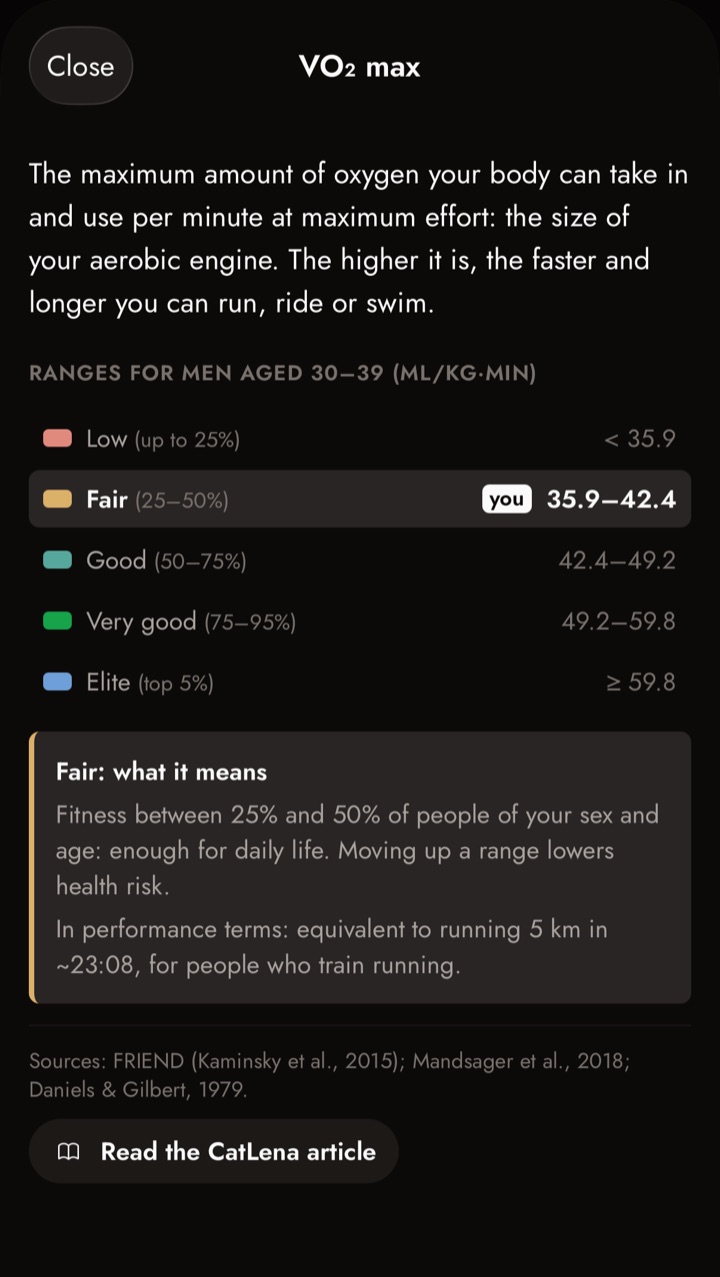
- In the VO₂ max card, you see how many people of your sex and age are less fit than you and the equivalent 5 km time.
- The scale shows the five ranges calculated for your sex and age.
References
- Kaminsky LA, Arena R, Myers J. Reference standards for cardiorespiratory fitness measured with cardiopulmonary exercise testing: data from the Fitness Registry and the Importance of Exercise National Database (FRIEND). Mayo Clinic Proceedings, 2015;90(11):1515–1523. See the study
- Mandsager K, Harb S, Cremer P, Phelan D, Nissen SE, Jaber W. Association of cardiorespiratory fitness with long-term mortality among adults undergoing exercise treadmill testing. JAMA Network Open, 2018;1(6):e183605. See the study
- Daniels J, Gilbert J. Oxygen Power: Performance Tables for Distance Runners. Tempe, 1979. The same formulas appear in Daniels J. Daniels' Running Formula. Human Kinetics.
See this math done for you
In CatLena, you log workouts, meals and measurements (or just chat with CatLena) and the app does this math for you, every day, on your computer and phone.
Get started