Sleep
Coffee, training and sleep: caffeine by drink, cutoff times and weekend sleep
How much caffeine is in each drink, how much studies used for training, the cutoff time for each bedtime and why sleeping in on Saturday does not pay back the week.
· 10 min read
Key points
- A mug of coffee with about 107 mg of caffeine calls for about 8.8 hours before bed to avoid losing sleep; a pre-workout, 13.2 hours.
- For training, studies used 3 mg to 6 mg of caffeine per kilogram of body weight, about 1 hour before; lower doses may be enough.
- Sleeping more on the weekend gave back only about 1 hour of more than 12 lost during the week.
- Moving bedtime earlier on a few weeknights helps more than waiting for Saturday.
Caffeine helps training and can disrupt sleep, and sleep lost during the week usually gets paid back on Saturday. This guide shows how much caffeine is in each drink, how much studies used, when to have your last coffee for each bedtime and how to recover sleep without relying on days off.
When to have your last coffee: caffeine by drink
| Drink or food | Serving | Caffeine |
|---|---|---|
| Drip coffee | 240 mL | 95 mg |
| Instant coffee | 240 mL | 60 mg |
| Decaf coffee | 240 mL | 4 mg |
| Espresso | 45 mL | 65 mg |
| Black tea | 240 mL | 47 mg |
| Green tea | 240 mL | 28 mg |
| Cola | 350 mL | 40 mg |
| Energy drink | 240 mL | 85 mg |
| Dark chocolate | 28 g | 24 mg |
| Pre-workout | 1 serving | About 218 mg |
Values are approximate and vary with brand and preparation [1]. In 12 adults, 400 mg of caffeine 6 hours before bed cut more than 1 hour of sleep on the monitor, without them noticing in the morning [2]. Dose changes the response: in 23 young men, 100 mg did not change sleep even 4 hours before bed, while 400 mg disrupted it up to 12 hours before [3]. An analysis of 24 studies suggests stopping coffee, at 107 mg, at least 8.8 hours before bed, and pre-workout 13.2 hours before [4].
Other habits matter too. Even about 2 alcoholic drinks reduce REM sleep [5]. In 26 adults, more fiber during the day was associated with deeper sleep, and more sugar with more awakenings [6]. Eating dinner 1 hour before bed did not worsen sleep in one study [7] and came with less sleep in another [8].
- Week 1: keep your routine and note the time of your last caffeinated drink, your hours of sleep and how you feel in the morning, from 1 to 5.
- Week 2: move your last caffeinated drink 3 hours earlier or more, without changing anything else.
- Compare the averages of the two weeks.
Caffeine for training: dose by weight and cutoff time
A review points to 3 mg to 6 mg per kilogram of body weight as the doses with the most consistent exercise benefit, and 2 mg as a possible minimum, about 60 minutes before; at 9 mg per kilogram, side effects are common [9]. The table below is our calculation, with 250 mL mugs at 107 mg.
| Weight | 2 mg/kg | 3 mg/kg | 6 mg/kg |
|---|---|---|---|
| 50 kg | 100 mg (1 mug) | 150 mg (1.5) | 300 mg (3) |
| 60 kg | 120 mg (1) | 180 mg (1.5) | 360 mg (3.5) |
| 70 kg | 140 mg (1.5) | 210 mg (2) | 420 mg (4) |
| 80 kg | 160 mg (1.5) | 240 mg (2) | 480 mg (4.5) |
| 90 kg | 180 mg (1.5) | 270 mg (2.5) | 540 mg (5) |
| Bedtime | Last mug of coffee | Last pre-workout |
|---|---|---|
| 9 pm | 12:12 pm | 7:48 am |
| 10 pm | 1:12 pm | 8:48 am |
| 11 pm | 2:12 pm | 9:48 am |
| Midnight | 3:12 pm | 10:48 am |
The times are our calculation from the 8.8 and 13.2 hours in the sleep analysis [4]. If your workout falls after the cutoff, try the lowest dose for a week or train without caffeine on those days. Expectations matter too: cyclists produced 3.1% more power with caffeine-free capsules when they believed they had taken a high dose [10]. On daily use, studies disagree: the benefit disappeared within 28 days in one study [11], faded over about 15 days in another [12] and did not change with habitual intake in a third [13].
Weekend sleep: bedtime for each wake-up time
In 36 young adults in a lab, those with a free weekend lost more than 12 hours of sleep over 5 short nights and, across 3 nights off, slept only 1.1 hours beyond normal; sleeping in also delayed their internal rhythm by about 1.4 hours [14]. In 159 adults, one night of up to 10 hours after 5 short nights did not fully restore attention [15]. Days off are not useless: in Sweden, people under 65 who caught up on days off did not have different mortality from those sleeping 6 to 7 hours, in an observational study [16]. The recommendation for adults is 7 hours or more per night [17].
| Wake-up time | For 7 hours | For 8 hours |
|---|---|---|
| 5:30 am | 10:15 pm | 9:15 pm |
| 6:00 am | 10:45 pm | 9:45 pm |
| 6:30 am | 11:15 pm | 10:15 pm |
| 7:00 am | 11:45 pm | 10:45 pm |
| 7:30 am | 12:15 am | 11:15 pm |
| 8:00 am | 12:45 am | 11:45 pm |
- Week 1: move your bedtime 30 minutes earlier on 3 nights.
- Week 2: move to 5 nights and, on days off, try to wake no more than 1 hour after your usual time.
- Log when you went to bed, when you woke up and how you felt in the afternoon.
How CatLena uses it
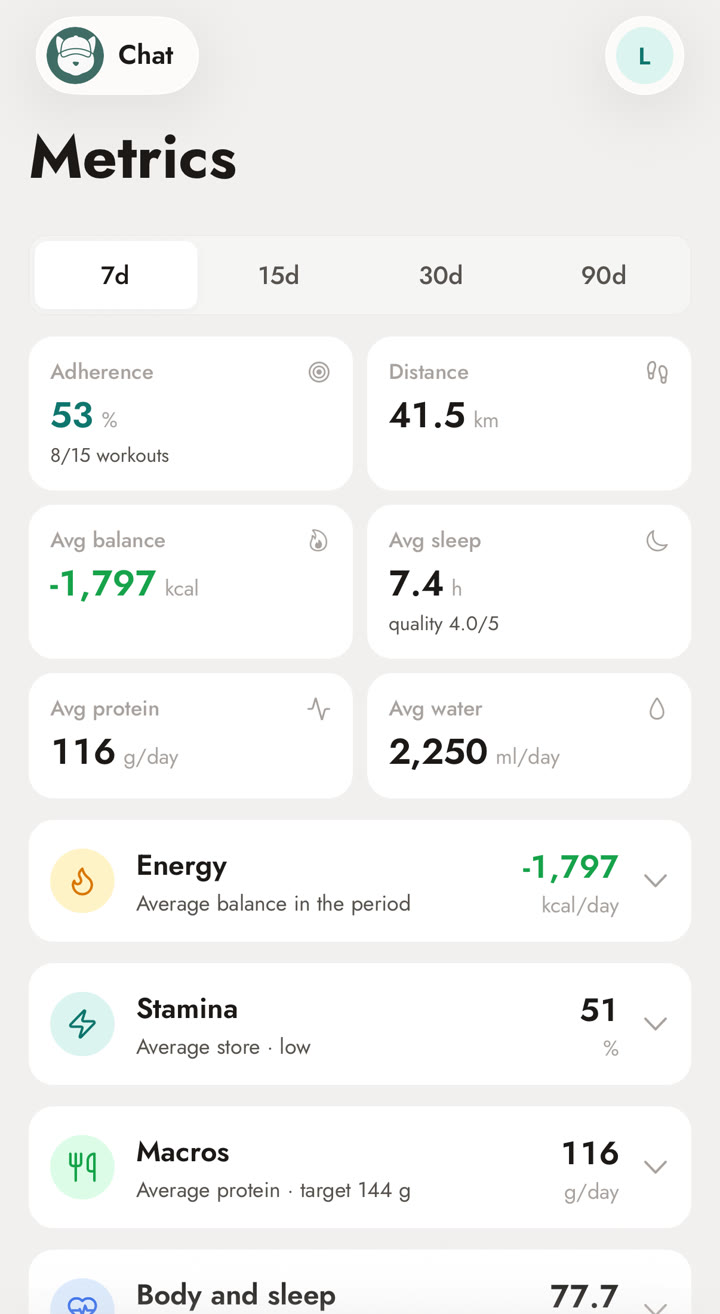
On the Metrics screen, average sleep for the period appears next to the energy balance, protein and workouts. In the example below, the average was 7.4 hours per night, with a quality of 4.0 out of 5. Comparing this average between the week you moved your coffee earlier and the week before shows whether the change worked for you.
When to see a professional
References
- Harvard T.H. Chan School of Public Health. The Nutrition Source: caffeine. See the study
- Drake C, Roehrs T, Shambroom J, Roth T. Caffeine effects on sleep taken 0, 3, or 6 hours before going to bed. Journal of clinical sleep medicine : JCSM : official publication of the American Academy of Sleep Medicine, 2013;9(11):1195-200. See the study
- Gardiner CL, Weakley J, Burke LM, Fernandez F, Johnston RD, Leota J, et al. Dose and timing effects of caffeine on subsequent sleep: a randomized clinical crossover trial. Sleep, 2025;48(4). See the study
- Gardiner C, Weakley J, Burke LM, Roach GD, Sargent C, Maniar N, et al. The effect of caffeine on subsequent sleep: A systematic review and meta-analysis. Sleep medicine reviews, 2023;69:101764. See the study
- Gardiner C, Weakley J, Burke LM, Roach GD, Sargent C, Maniar N, et al. The effect of alcohol on subsequent sleep in healthy adults: A systematic review and meta-analysis. Sleep medicine reviews, 2025;80:102030. See the study
- St-Onge MP, Roberts A, Shechter A, Choudhury AR. Fiber and Saturated Fat Are Associated with Sleep Arousals and Slow Wave Sleep. Journal of clinical sleep medicine : JCSM : official publication of the American Academy of Sleep Medicine, 2016;12(1):19-24. See the study
- Duan D, Gu C, Polotsky VY, Jun JC, Pham LV. Effects of Dinner Timing on Sleep Stage Distribution and EEG Power Spectrum in Healthy Volunteers. Nature and science of sleep, 2021;13:601-612. See the study
- Enomoto M, Kitamura S, Kunieda T, Eto T. Effects of later dinner timing on subsequent metabolic function and nocturnal sleep in healthy young women. Journal of physiological anthropology, 2026;45(1). See the study
- Guest NS, VanDusseldorp TA, Nelson MT, Grgic J, Schoenfeld BJ, Jenkins NDM, et al. International society of sports nutrition position stand: caffeine and exercise performance. Journal of the International Society of Sports Nutrition, 2021;18(1):1. See the study
- Beedie CJ, Stuart EM, Coleman DA, Foad AJ. Placebo effects of caffeine on cycling performance. Medicine and science in sports and exercise, 2006;38(12):2159-64. See the study
- Beaumont R, Cordery P, Funnell M, Mears S, James L, Watson P. Chronic ingestion of a low dose of caffeine induces tolerance to the performance benefits of caffeine. Journal of sports sciences, 2017;35(19):1920-1927. See the study
- Lara B, Ruiz-Moreno C, Salinero JJ, Del Coso J. Time course of tolerance to the performance benefits of caffeine. PloS one, 2019;14(1):e0210275. See the study
- Gonçalves LS, Painelli VS, Yamaguchi G, Oliveira LF, Saunders B, da Silva RP, et al. Dispelling the myth that habitual caffeine consumption influences the performance response to acute caffeine supplementation. Journal of applied physiology (Bethesda, Md. : 1985), 2017;123(1):213-220. See the study
- Depner CM, Melanson EL, Eckel RH, Snell-Bergeon JK, Perreault L, Bergman BC, et al. Ad libitum Weekend Recovery Sleep Fails to Prevent Metabolic Dysregulation during a Repeating Pattern of Insufficient Sleep and Weekend Recovery Sleep. Current biology : CB, 2019;29(6):957-967.e4. See the study
- Banks S, Van Dongen HP, Maislin G, Dinges DF. Neurobehavioral dynamics following chronic sleep restriction: dose-response effects of one night for recovery. Sleep, 2010;33(8):1013-26. See the study
- Åkerstedt T, Ghilotti F, Grotta A, Zhao H, Adami HO, Trolle-Lagerros Y, et al. Sleep duration and mortality - Does weekend sleep matter?. Journal of sleep research, 2019;28(1):e12712. See the study
- Watson NF, Badr MS, Belenky G, Bliwise DL, Buxton OM, Buysse D, et al. Recommended Amount of Sleep for a Healthy Adult: A Joint Consensus Statement of the American Academy of Sleep Medicine and Sleep Research Society. Sleep, 2015;38(6):843-4. See the study
See this math done for you
In CatLena, you log workouts, meals and measurements (or just chat with CatLena) and the app does this math for you, every day, on your computer and phone.
Get started