Nutrition
Everyday eating: fiber, meal timing, the freezer, eggs and walking after meals
How to increase fiber gradually, 4 daily templates with 2 to 5 meals, what to keep in the freezer, eggs and cholesterol and 5 ways to walk after eating.
· 12 min read
Key points
- More than 10 g of fiber per day, for 4 weeks or more, helped many people with constipation.
- Eating 3 or 6 times a day, with the same calories, led to the same energy expenditure: the number of meals can follow your routine.
- Frozen vegetables and fruit retained the measured vitamins as well as fresh produce stored for 5 days.
- Up to 1 egg a day was not associated with more heart disease in the general population; walking 10 minutes after meals reduced the rise in blood sugar.
Small everyday decisions add up over the weeks: how much fiber to eat, how many meals to have, what to buy frozen, how many eggs fit and what to do right after eating. This guide brings together what studies show about each one, with practical suggestions to try.
Fiber and constipation: how to increase it gradually
In a review of 16 studies with 1,251 adults with constipation, 66% of those who used fiber supplements improved, versus 41% of comparison groups. Improvement appeared with more than 10 g of fiber per day and 4 weeks or more, and psyllium and pectin had the best results [1]. Water may add to this: with about 25 g of fiber per day, those who drank about 2 liters of fluid improved more than those who drank 1 liter [2]. Among foods, there is some evidence for fruit, especially kiwi, and rye bread, from few studies [3].
| Food | Fiber per 100 g |
|---|---|
| Cooked pinto beans | 8.5 g |
| Cooked black beans | 8.4 g |
| Cooked lentils | 7.9 g |
| Whole-grain sandwich bread | 6.9 g |
| Red guava with skin | 6.2 g |
| Cooked broccoli | 3.4 g |
| Cooked brown rice | 2.7 g |
| Silk banana | 2.0 g |
A sample day: 30 g of oats, 1 banana, 100 g of beans, 100 g of brown rice and 1 guava add up to about 22 g of fiber. As a general health reference, the best outcomes were associated with 25 g to 29 g per day [4]. Add one food at a time, with a few days in between, since fiber increases gas, drink water through the day and keep it up for at least 4 weeks before drawing conclusions.
4 daily templates, with 2 to 5 meals
The number of meals does not switch your body off or speed it up. In 15 adults who ate the same amount in 3 or 6 meals, daily energy expenditure was about 2,080 and 2,055 kcal, with no difference, and hunger was higher with 6 meals [5]. With 14 meals, resting expenditure was slightly lower and hunger higher [6]. Over 8 weeks of calorie restriction, 3 meals or 3 meals plus 3 snacks gave the same result [7], and reviews found no difference in daily expenditure [8][9].
| Template | Who it suits |
|---|---|
| 2 larger meals | Not hungry early and short on time; full lunch and dinner |
| 3 meals | Fixed work hours; about 5 hours between them |
| 3 meals and 1 snack | Long gaps or training in the late afternoon |
| 5 smaller meals | People who prefer small portions and have time to eat |
Choose the template closest to the week you already have and test it for 2 weeks. If a meeting runs late, eat when you can: a missed time does not undo the day.
Freezer guide: what to keep and what to check on the label
In 8 fruits and vegetables measured fresh, stored for 5 days in the fridge and frozen, most comparisons of vitamin C, provitamin A and folate showed no difference, and when there was one, frozen beat stored fresh more often [10]. In another study, vitamin C tied in 5 of 8 foods and was higher in frozen produce in the other 3; the exception was beta-carotene, lower in frozen peas and carrots [11]. Both studies were funded in partnership with the frozen food industry and measured the food, not the health of people eating it.
- Worth keeping in the freezer: broccoli, cauliflower, green beans, peas, spinach, corn, strawberries and blueberries.
- On the label, ideally only the food itself; sugar in fruit and salt or sauce in vegetables change what you are buying.
- Buy fresh what you will eat in the next few days and rely on frozen for the end of the week.
Eggs and cholesterol: 6 questions for your appointment
An analysis of 1.7 million people found no association between each extra egg per day and more heart disease [12]. In 29,615 adults followed for 17 years, half an egg more per day was associated with 6% higher risk, an association that disappeared after accounting for total dietary cholesterol [13]. In controlled trials, LDL was on average 5.55 mg/dL higher with eggs, and HDL 2.13 mg/dL higher [14]. In 40 adults with high cholesterol, 2 eggs a day for 6 weeks did not worsen their lab results [15]. The American Heart Association advises looking at the overall eating pattern and urges caution for people with abnormal cholesterol [16].
- What is my LDL target, considering my age and personal and family history?
- Could my high cholesterol have a genetic cause?
- In my situation, how many eggs per week fit? Does that change if I have diabetes?
- What weighs more on my lab results today: eggs or the rest of my diet?
- If I change my diet, when should I repeat the test?
- Do I or will I take cholesterol medication? What changes in my diet then?
Seven breakfasts to rotate: boiled egg with whole-grain bread and fruit; omelet with tomato and spinach; scrambled eggs with vegetables and tapioca; poached egg on whole-grain bread with avocado; oats with yogurt, fruit and nuts; whole-grain bread with chickpea spread; yogurt with banana, oats and seeds.
Walking after meals: 5 ways to fit it in
In 41 adults with type 2 diabetes, walking 10 minutes after each main meal reduced the rise in blood sugar over the next 3 hours by 12%, and by 22% after dinner, compared with 30 minutes at once [17]. Breaking up sitting with 2-minute walks every 20 minutes reduced the rise by about 30% [18], and trials favor exercise after meals, with a high risk of bias [19]. Standing already helped, and walking helped more [20]; older adults also had lower blood sugar after dinner [21]. The exact timing is not settled: in healthy adults, the effect appeared when starting 45 minutes after the start of the meal [22].
- At work: get coffee from across the block, or have lunch a little farther away and walk back.
- In the rain: walk the hallways, take a flight of stairs slowly or simply stand.
- With children: go together to the corner, the playground or the bakery.
- Short on time: 5 minutes already gets you out of the chair.
- In the evening: leave your shoes by the door and go right after dinner, on a well-lit route.
How CatLena uses it
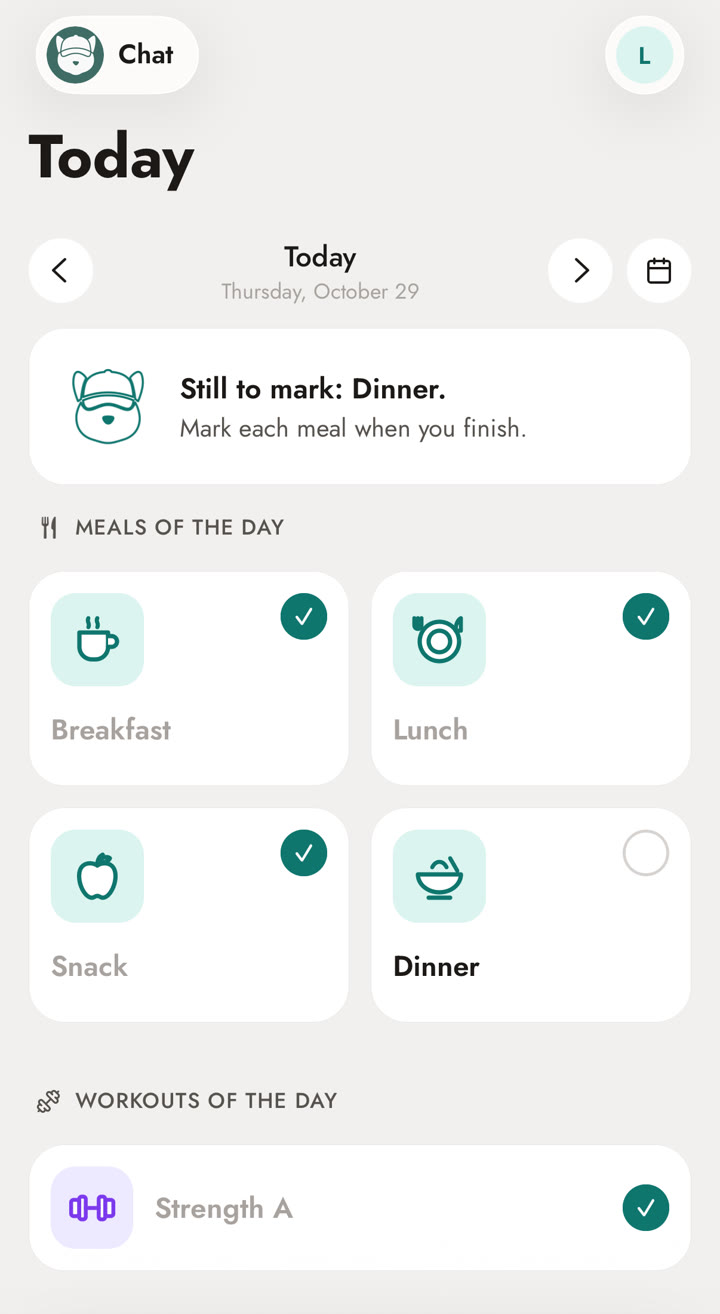
On the Today screen, the day’s meals appear as a checklist next to your workouts. In the example below, breakfast, lunch and snack were already checked, and a reminder said dinner was still to be marked. With your chosen template, this list shows whether your routine is on track.
When to see a professional
References
- van der Schoot A, Drysdale C, Whelan K, Dimidi E. The Effect of Fiber Supplementation on Chronic Constipation in Adults: An Updated Systematic Review and Meta-Analysis of Randomized Controlled Trials. The American journal of clinical nutrition, 2022;116(4):953-969. See the study
- Anti M, Pignataro G, Armuzzi A, Valenti A, Iascone E, Marmo R, et al. Water supplementation enhances the effect of high-fiber diet on stool frequency and laxative consumption in adult patients with functional constipation. Hepato-gastroenterology, 1998;45(21):727-32. See the study
- Van Der Schoot A, Katsirma Z, Whelan K, Dimidi E. Systematic review and meta-analysis: Foods, drinks and diets and their effect on chronic constipation in adults. Alimentary pharmacology & therapeutics, 2024;59(2):157-174. See the study
- Reynolds A, Mann J, Cummings J, Winter N, Mete E, Te Morenga L. Carbohydrate quality and human health: a series of systematic reviews and meta-analyses. Lancet (London, England), 2019;393(10170):434-445. See the study
- Ohkawara K, Cornier MA, Kohrt WM, Melanson EL. Effects of increased meal frequency on fat oxidation and perceived hunger. Obesity (Silver Spring, Md.), 2013;21(2):336-43. See the study
- Munsters MJ, Saris WH. Effects of meal frequency on metabolic profiles and substrate partitioning in lean healthy males. PloS one, 2012;7(6):e38632. See the study
- Cameron JD, Cyr MJ, Doucet E. Increased meal frequency does not promote greater weight loss in subjects who were prescribed an 8-week equi-energetic energy-restricted diet. The British journal of nutrition, 2010;103(8):1098-101. See the study
- Schoenfeld BJ, Aragon AA, Krieger JW. Effects of meal frequency on weight loss and body composition: a meta-analysis. Nutrition reviews, 2015;73(2):69-82. See the study
- Bellisle F, McDevitt R, Prentice AM. Meal frequency and energy balance. The British journal of nutrition, 1997;77 Suppl 1:S57-70. See the study
- Li L, Pegg RB, Eitenmiller RR, Chun JY, Kerrihard AL. Selected nutrient analyses of fresh, fresh-stored, and frozen fruits and vegetables. Journal of Food Composition and Analysis, 2017;59:8–17. See the study
- Bouzari A, Holstege D, Barrett DM. Vitamin retention in eight fruits and vegetables: a comparison of refrigerated and frozen storage. Journal of agricultural and food chemistry, 2015;63(3):957-62. See the study
- Drouin-Chartier JP, Chen S, Li Y, Schwab AL, Stampfer MJ, Sacks FM, et al. Egg consumption and risk of cardiovascular disease: three large prospective US cohort studies, systematic review, and updated meta-analysis. BMJ (Clinical research ed.), 2020;368:m513. See the study
- Zhong VW, Van Horn L, Cornelis MC, Wilkins JT, Ning H, Carnethon MR, et al. Associations of Dietary Cholesterol or Egg Consumption With Incident Cardiovascular Disease and Mortality. JAMA, 2019;321(11):1081-1095. See the study
- Rouhani MH, Rashidi-Pourfard N, Salehi-Abargouei A, Karimi M, Haghighatdoost F. Effects of Egg Consumption on Blood Lipids: A Systematic Review and Meta-Analysis of Randomized Clinical Trials. Journal of the American College of Nutrition, 2018;37(2):99-110. See the study
- Njike V, Faridi Z, Dutta S, Gonzalez-Simon AL, Katz DL. Daily egg consumption in hyperlipidemic adults--effects on endothelial function and cardiovascular risk. Nutrition journal, 2010;9:28. See the study
- Carson JAS, Lichtenstein AH, Anderson CAM, Appel LJ, Kris-Etherton PM, Meyer KA, et al. Dietary Cholesterol and Cardiovascular Risk: A Science Advisory From the American Heart Association. Circulation, 2020;141(3):e39-e53. See the study
- Reynolds AN, Mann JI, Williams S, Venn BJ. Advice to walk after meals is more effective for lowering postprandial glycaemia in type 2 diabetes mellitus than advice that does not specify timing: a randomised crossover study. Diabetologia, 2016;59(12):2572-2578. See the study
- Dunstan DW, Kingwell BA, Larsen R, Healy GN, Cerin E, Hamilton MT, et al. Breaking up prolonged sitting reduces postprandial glucose and insulin responses. Diabetes care, 2012;35(5):976-83. See the study
- Engeroff T, Groneberg DA, Wilke J. After Dinner Rest a While, After Supper Walk a Mile? A Systematic Review with Meta-analysis on the Acute Postprandial Glycemic Response to Exercise Before and After Meal Ingestion in Healthy Subjects and Patients with Impaired Glucose Tolerance. Sports medicine (Auckland, N.Z.), 2023;53(4):849-869. See the study
- Buffey AJ, Herring MP, Langley CK, Donnelly AE, Carson BP. The Acute Effects of Interrupting Prolonged Sitting Time in Adults with Standing and Light-Intensity Walking on Biomarkers of Cardiometabolic Health in Adults: A Systematic Review and Meta-analysis. Sports medicine (Auckland, N.Z.), 2022;52(8):1765-1787. See the study
- DiPietro L, Gribok A, Stevens MS, Hamm LF, Rumpler W. Three 15-min bouts of moderate postmeal walking significantly improves 24-h glycemic control in older people at risk for impaired glucose tolerance. Diabetes care, 2013;36(10):3262-8. See the study
- Reynolds AN, Venn BJ. The Timing of Activity after Eating Affects the Glycaemic Response of Healthy Adults: A Randomised Controlled Trial. Nutrients, 2018;10(11). See the study
See this math done for you
In CatLena, you log workouts, meals and measurements (or just chat with CatLena) and the app does this math for you, every day, on your computer and phone.
Get started