Nutrition
Reading the label: sweeteners, glutamate and gluten
The names of sweeteners and glutamate on labels, how to work out the aspartame limit for your weight and a 14-day diary to bring to your doctor before cutting gluten.
· 11 min read
Key points
- The daily aspartame limit is 40 mg per kilogram of body weight: a 70 kg adult would need 9 to 14 cans of soda a day to exceed it.
- Swapping sugary drinks for sweetened versions led to about 1 kg less in trials; replacing water, it did not change weight.
- Glutamate appears as a flavor enhancer or E621, and also in ingredients such as yeast extract and hydrolyzed protein.
- Celiac disease is a medical diagnosis: cutting gluten before testing can change the results.
Some words on labels raise more doubt than they should: sweetener, flavor enhancer, gluten. This guide shows how each one appears on the package, what trials in people showed and what to bring to your appointment when symptoms worry you. It does not tell you to remove or add any food.
Sweeteners: label names and the aspartame math
The World Health Organization review lists acesulfame K, aspartame, advantame, cyclamate, neotame, saccharin, sucralose and stevia as non-sugar sweeteners [1]. On imported products, they may appear by code: aspartame is E951, acesulfame K is E950 and sucralose is E955. Sorbitol, xylitol and others ending in "-ol" are a different category, with calories.
The FAO and WHO expert committee kept the daily limit of 40 mg of aspartame per kilogram of body weight in 2023. In the WHO example, a can contains 200 to 300 mg, and a 70 kg adult would need more than 9 to 14 cans a day to reach the limit. That same year, the WHO cancer agency classified aspartame as possibly carcinogenic, with limited evidence; that classification measures the strength of evidence, not the risk at a given amount [2].
| Your weight | Daily aspartame limit |
|---|---|
| 50 kg | 2,000 mg |
| 60 kg | 2,400 mg |
| 70 kg | 2,800 mg |
| 80 kg | 3,200 mg |
| 90 kg | 3,600 mg |
The most useful question is: instead of what? Swapping sugary soda or juice for a sweetened version led to about 1 kg less in trials [3][4], analyses whose authors declare ties to industry. Instead of water, sweeteners did not change weight, and if you already drink water there is no reason to sweeten it. Trials are short; long-term studies link use to more diabetes and cardiovascular disease [5], without knowing whether sweeteners cause it or whether people already at higher risk started using them [1].
Glutamate on the label and on the plate
Glutamate gives the taste called umami, the flavor of broth and meat. In Brazil, it appears as a flavor enhancer, monosodium or sodium glutamate, or as INS 621 [13]. It also comes from ingredients such as hydrolyzed vegetable protein, autolyzed yeast, yeast extract, soy extracts, soy sauce, tomatoes and cheese [10][11].
The scare began with a 1968 letter that mentioned salt, wine and glutamate as possible causes of feeling unwell after Chinese dishes [6], and with glutamate injections in newborn mice, which are not the same as eating seasoning [7]. In 130 people who said they reacted, 38.5% had symptoms only with 5 g of glutamate without food and 13.1% only with the drink without it, and the response did not repeat consistently [8]. With food, only 1 of 6 studies found a difference in headache [9].
| Amount | Value |
|---|---|
| Glutamate from protein in food | About 13 g per day |
| Added glutamate, on average | About 0.55 g per day |
| Typical serving with added glutamate | Less than 0.5 g |
| European limit for added glutamate | 30 mg per kilogram, 2.1 g for 70 kg |
Mild, short-lived symptoms have been described in sensitive people at 3 g or more, without food [10]. The European limit is disputed by a review that argues glutamate should first be assessed as a nutrient [12]. Also check the sodium on the nutrition table: monosodium glutamate has 12.28 g of sodium per 100 g, versus 39.34 g in table salt.
Before cutting gluten: a 14-day diary
Celiac disease is a permanent immune response to gluten from wheat, barley and rye, diagnosed with a blood test and, in most cases, an intestinal biopsy [14]; about 0.7% of people worldwide have a confirmed diagnosis [15]. Doctors do not recommend starting a gluten-free diet before testing, because it can change the results [19].
About 10% of adults report sensitivity to gluten or wheat, and in blinded tests 16% to 30% of them have symptoms caused specifically by gluten, with no test to confirm it [16]. In 10 trials, 38 of 231 people with suspected sensitivity had gluten-specific symptoms [17], and in 59 adults symptoms were greater with fructan, a carbohydrate in wheat, than with gluten [18].
For 14 days, without changing what you eat, write one line per meal. Example:
| Day and time | What you ate | Symptom (0 to 10) | Other factors |
|---|---|---|---|
| Mon, 1 pm | Pasta with sauce | Bloating, 4 | Poor night’s sleep |
| Mon, 8 pm | Rice, beans and chicken | None | |
| Tue, 8 am | Bread with egg | None | Coffee first |
- Based on my symptoms, should I be tested for celiac disease?
- How should I eat until the tests?
- I already cut gluten for a while. Does that change what we should do?
- Are there other causes to look into, such as wheat allergy or irritable bowel?
- If the tests are normal, what do we do about the symptoms I logged?
- Would it help to work with a dietitian to adjust my diet?
How CatLena uses it
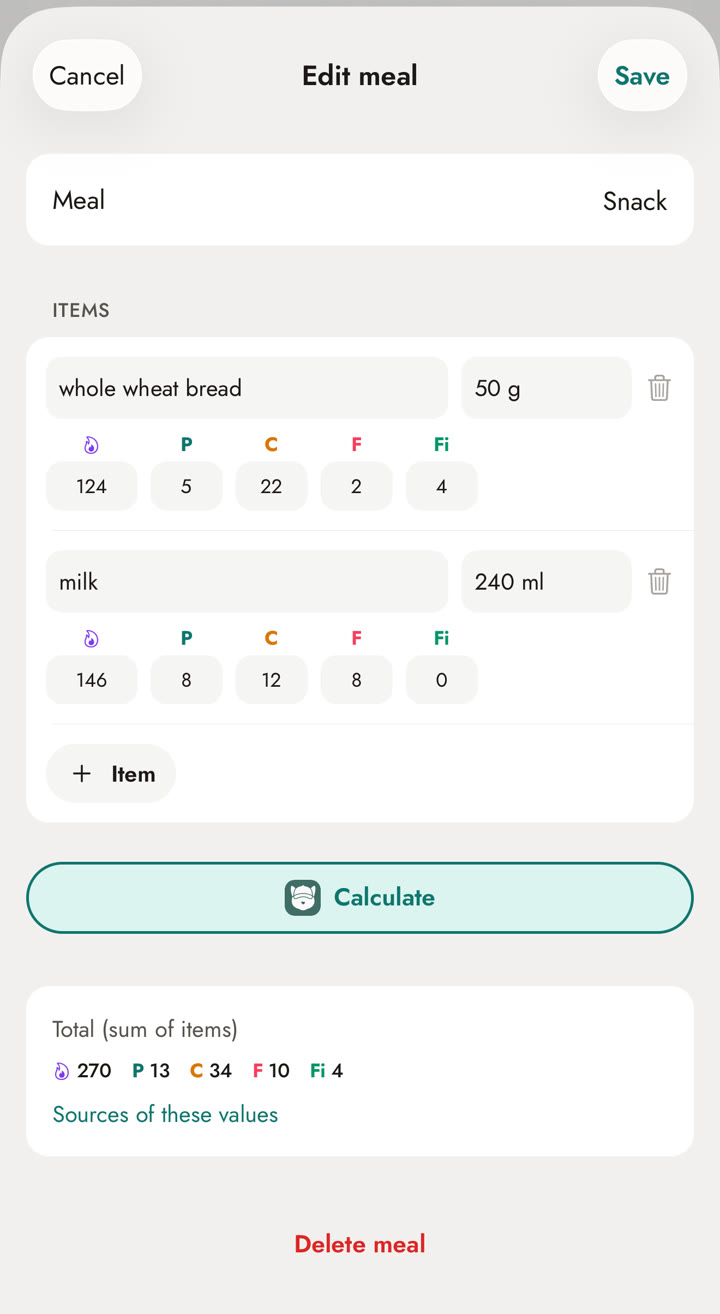
When you log a meal, each item shows calories, protein, carbohydrate, fat and fiber, and the Sources of values link shows where each number comes from. In the example below, a snack of 1 apple and 15 g of Brazil nuts added up to 170 kcal. The day’s log also works as a diary to bring to your appointment.
When to see a professional
References
- Rios-Leyvraz M, Montez J. Health effects of the use of non-sugar sweeteners: a systematic review and meta-analysis. Geneva: World Health Organization, 2022. See the study
- World Health Organization. Aspartame hazard and risk assessment results released. Geneva: WHO, 2023. See the study
- Rogers PJ, Appleton KM. The effects of low-calorie sweeteners on energy intake and body weight: a systematic review and meta-analyses of sustained intervention studies. International journal of obesity (2005), 2021;45(3):464-478. See the study
- McGlynn ND, Khan TA, Wang L, Zhang R, Chiavaroli L, Au-Yeung F, et al. Association of Low- and No-Calorie Sweetened Beverages as a Replacement for Sugar-Sweetened Beverages With Body Weight and Cardiometabolic Risk: A Systematic Review and Meta-analysis. JAMA network open, 2022;5(3):e222092. See the study
- Debras C, Chazelas E, Srour B, Druesne-Pecollo N, Esseddik Y, Szabo de Edelenyi F, et al. Artificial sweeteners and cancer risk: Results from the NutriNet-Santé population-based cohort study. PLoS medicine, 2022;19(3):e1003950. See the study
- Kwok RH. Chinese-restaurant syndrome. The New England journal of medicine, 1968;278(14):796. See the study
- Olney JW. Brain lesions, obesity, and other disturbances in mice treated with monosodium glutamate. Science (New York, N.Y.), 1969;164(3880):719-21. See the study
- Geha RS, Beiser A, Ren C, Patterson R, Greenberger PA, Grammer LC, et al. Multicenter, double-blind, placebo-controlled, multiple-challenge evaluation of reported reactions to monosodium glutamate. The Journal of allergy and clinical immunology, 2000;106(5):973-80. See the study
- Obayashi Y, Nagamura Y. Does monosodium glutamate really cause headache? : a systematic review of human studies. The journal of headache and pain, 2016;17:54. See the study
- U.S. Food and Drug Administration. Questions and answers on monosodium glutamate (MSG). See the study
- European Food Safety Authority. Glutamate and glutamic acid: re-evaluation of their safety as food additives, 2017. See the study
- Loï C, Cynober L. Glutamate: A Safe Nutrient, Not Just a Simple Additive. Annals of nutrition & metabolism, 2022;78(3):133-146. See the study
- Agência Nacional de Vigilância Sanitária. Resolução RDC nº 272, de 14 de março de 2019. See the study
- Rubio-Tapia A, Hill ID, Semrad C, Kelly CP, Greer KB, Limketkai BN, et al. American College of Gastroenterology Guidelines Update: Diagnosis and Management of Celiac Disease. The American journal of gastroenterology, 2023;118(1):59-76. See the study
- Singh P, Arora A, Strand TA, Leffler DA, Catassi C, Green PH, et al. Global Prevalence of Celiac Disease: Systematic Review and Meta-analysis. Clinical gastroenterology and hepatology : the official clinical practice journal of the American Gastroenterological Association, 2018;16(6):823-836.e2. See the study
- Biesiekierski JR, Jonkers D, Ciacci C, Aziz I. Non-coeliac gluten sensitivity. Lancet (London, England), 2025;406(10518):2494-2508. See the study
- Molina-Infante J, Carroccio A. Suspected Nonceliac Gluten Sensitivity Confirmed in Few Patients After Gluten Challenge in Double-Blind, Placebo-Controlled Trials. Clinical gastroenterology and hepatology : the official clinical practice journal of the American Gastroenterological Association, 2017;15(3):339-348. See the study
- Skodje GI, Sarna VK, Minelle IH, Rolfsen KL, Muir JG, Gibson PR, et al. Fructan, Rather Than Gluten, Induces Symptoms in Patients With Self-Reported Non-Celiac Gluten Sensitivity. Gastroenterology, 2018;154(3):529-539.e2. See the study
- National Institute of Diabetes and Digestive and Kidney Diseases. Diagnosis of celiac disease. See the study
See this math done for you
In CatLena, you log workouts, meals and measurements (or just chat with CatLena) and the app does this math for you, every day, on your computer and phone.
Get started