Training
Building a strength program: reps, weekly split and progression
How many reps and how much rest for each goal, splits for 2 to 5 days, 20- and 40-minute programs, what to do when time is short and when to add weight.
· 11 min read
Key points
- For muscle gain, 8 to 25 reps taken close to the limit produced similar results; for lifting heavier, high loads have the edge.
- With the same total sets per week, splitting by muscle group or training the full body gave similar results.
- On days without time, cut sets and keep the load: a few sets still maintain and even increase strength.
- Adding weight when you reach the top of your rep range is the simplest way to track progress.
A strength program answers four questions: how many reps to do, how long to rest, how to spread workouts across the week and when to add weight. This guide brings together what studies show about each one and includes ready-made programs to adapt, including for weeks when time is short.
Reps, load and rest for each goal
For muscle gain, the rep range is wide. An analysis of 28 studies with 747 adults compared up to 8, 9 to 15 and more than 15 reps, always to the limit, and found no difference in muscle growth [1]. In 49 trained men, 12 weeks of 20 to 25 or 8 to 12 reps increased lean mass with no difference between groups [2].
For lifting heavier, high loads have the edge. In 18 trained men, squat strength rose 19.6% with 8 to 12 reps and 8.8% with 25 to 35 reps [3], and a review of 21 studies confirmed greater maximum strength gains with high loads [4]. Rest also matters: in 21 trained men, 3 minutes between sets produced more strength and muscle than 1 minute [5].
| Goal | Reps | Rest |
|---|---|---|
| Lift heavier | Up to 8, heavy load | About 3 min |
| Build muscle | 8 to 25, close to the limit | About 3 min |
| Endurance with light weight | More than 20 | Whatever is comfortable |
The limit is the point at which you could not do another rep with good technique. Very light loads tend to cause more discomfort and take more time, and very heavy loads require more sets for the same muscle gain and add stress to the joints [6]. The studies lasted 6 to 12 weeks and mostly included young men.
Ready-made splits for 2, 3, 4 and 5 days
With the same total sets per week, frequency changes little. An analysis of 25 studies found no meaningful difference between training a muscle more or fewer times when the total was equal; without matching the total, more frequent training had a modest advantage, probably because it adds up to more sets [7]. Another analysis of 14 studies and 392 people found similar strength and muscle between splitting the workout by muscle groups and training the full body [8]. Individual studies do not always agree [9][10].
| Days per week | Suggested split |
|---|---|
| 2 | Full body, full body |
| 3 | Full body on all 3 days |
| 4 | Upper body, lower body, upper, lower |
| 5 | Chest and shoulders, back and arms, legs, upper, lower |
- Count how many training days actually fit in your last 4 weeks.
- Choose the split with that number of days.
- Add up the sets for each muscle in your current week and keep the same total in the new split.
- If you miss a day, move its sets to the next workout.
20- and 40-minute programs
For beginners, one set can be enough to start: in 15 young men, one side of the chest did 1 set and the other did 3, and both grew similarly over 12 weeks [11]. Across studies, however, multiple sets per exercise had a 40% larger effect on muscle size, with the biggest jump from 1 to 2 or 3 sets [12], and legs seem to need more: the thigh grew 11% with 3 sets and 7% with 1 [13].
A review on time-efficient training suggests at least 4 sets per week for each muscle, at 6 to 15 reps, prioritizing multi-joint exercises [14]. For people who have trained for a year or more, the general recommendation rises to 12 to 20 sets per week [15]. The programs below follow that minimum, with about 2 minutes between sets, twice a week.
| Exercise | 20 min | 40 min |
|---|---|---|
| Squat or leg press | 3 sets | 3 sets |
| Romanian deadlift or leg curl | – | 2 sets |
| Row or pulldown | 2 sets | 3 sets |
| Bench press or push-up | 2 sets | 3 sets |
| Shoulder press | – | 2 sets |
Choose a load that lets you do 6 to 15 reps and finish close to the limit. When you have extra time, add a set to the first exercise you cut.
Half a workout: what to prioritize when time runs out
Doing only part of the program is not the same as skipping training. In trained men, one set per exercise, 1 to 3 times a week, still increased squat and bench press strength, although below the optimum [16]. Young people maintained strength and muscle for up to 32 weeks with 1 session and 1 set per exercise per week, as long as the load did not drop; older people may need 2 sessions with 2 to 3 sets [17][18].
More volume usually builds more strength [19], so reduced training is for getting through a busy phase, not a permanent goal. Short breaks may not erase results either: in 14 young men doing the bench press, 6-week cycles with 3-week breaks produced, over 24 weeks, growth similar to continuous training [20].
- Decide before you start what fits in the time you have.
- Start with the exercises that use the most muscles, such as squat, bench press and row.
- Cut sets and keep the load: in maintenance studies, keeping the load was the most important condition.
- Do not double the next workout; follow your normal program.
12-week log: when to add weight
The hormonal difference between men and women is real: after puberty, men’s blood testosterone is more than 15 times women’s [21]. Even so, in 29 studies of adults aged 18 to 45 on the same program, relative muscle gain was similar between sexes, with a 0.69% difference [22], and relative upper-body strength rose more in women [23]. Individual response varies widely: in 585 adults, 12 weeks of arm training changed muscle size by –2% to +59% [24]. That is why the best comparison is with yourself.
- Choose 4 to 6 exercises and repeat the same workout 2 to 3 times a week.
- Set a rep range for each exercise, for example 8 to 12.
- When you reach the top of the range in all sets, in two workouts in a row, add the smallest available increment.
- At the end of 12 weeks, compare week 12 with week 1 of the same exercise.
A filled-in example for the bench press, with an 8 to 12 rep range:
| Week | Load | Reps | Add weight? |
|---|---|---|---|
| 1 | 20 kg | 10, 9, 8 | No |
| 2 | 20 kg | 12, 11, 10 | No |
| 3 | 20 kg | 12, 12, 12 | If repeated |
| 4 | 20 kg | 12, 12, 12 | Yes |
| 5 | 22 kg | 9, 8, 8 | No |
How CatLena uses it
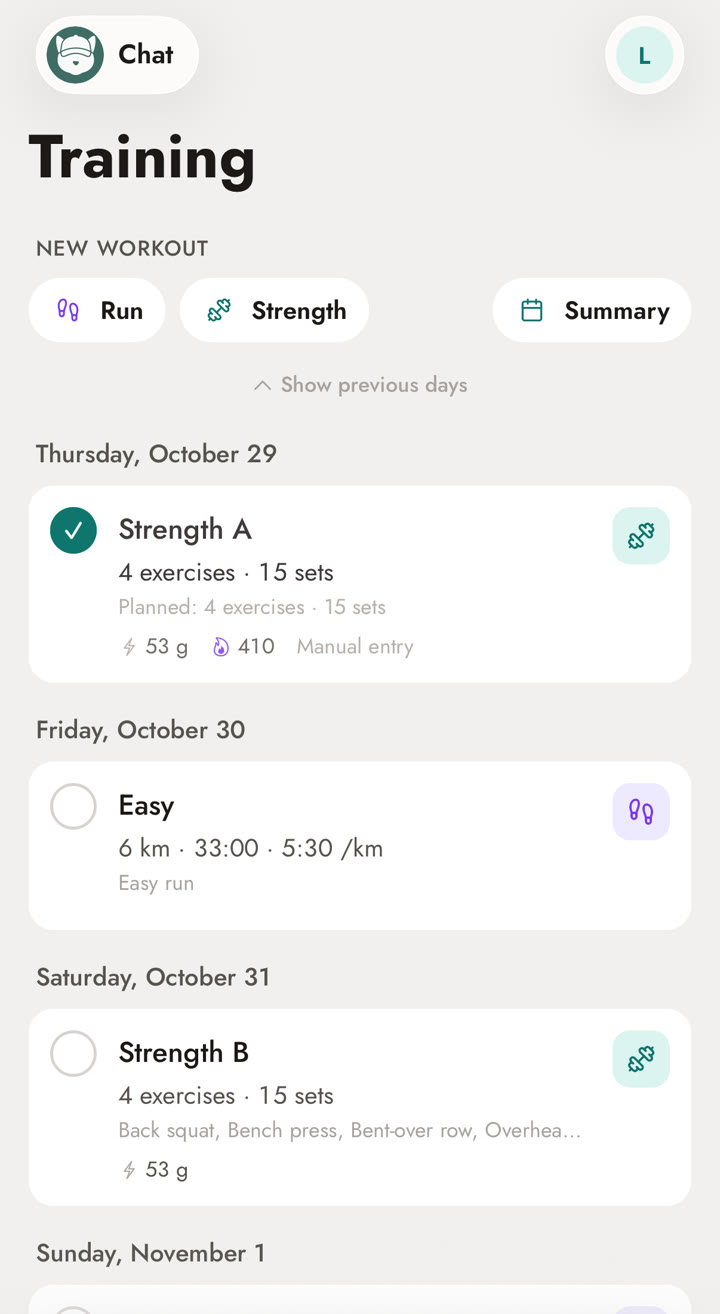
On the Training screen, the week shows completed and planned workouts. In the example below, Thursday’s Strength workout A was completed with 4 exercises and 15 sets, as planned, and Strength workout B is already scheduled for Saturday with back squat, bench press and bent-over row. The load and reps of each set stay in the log, so you can follow the progression rule week by week.
When to see a professional
References
- Lopez P, Radaelli R, Taaffe DR, Newton RU, Galvão DA, Trajano GS, et al. Resistance Training Load Effects on Muscle Hypertrophy and Strength Gain: Systematic Review and Network Meta-analysis. Medicine and science in sports and exercise, 2021;53(6):1206-1216. See the study
- Morton RW, Oikawa SY, Wavell CG, Mazara N, McGlory C, Quadrilatero J, et al. Neither load nor systemic hormones determine resistance training-mediated hypertrophy or strength gains in resistance-trained young men. Journal of applied physiology (Bethesda, Md. : 1985), 2016;121(1):129-38. See the study
- Schoenfeld BJ, Peterson MD, Ogborn D, Contreras B, Sonmez GT. Effects of Low- vs. High-Load Resistance Training on Muscle Strength and Hypertrophy in Well-Trained Men. Journal of strength and conditioning research, 2015;29(10):2954-63. See the study
- Schoenfeld BJ, Grgic J, Ogborn D, Krieger JW. Strength and Hypertrophy Adaptations Between Low- vs. High-Load Resistance Training: A Systematic Review and Meta-analysis. Journal of strength and conditioning research, 2017;31(12):3508-3523. See the study
- Schoenfeld BJ, Pope ZK, Benik FM, Hester GM, Sellers J, Nooner JL, et al. Longer Interset Rest Periods Enhance Muscle Strength and Hypertrophy in Resistance-Trained Men. Journal of strength and conditioning research, 2016;30(7):1805-12. See the study
- Schoenfeld BJ, Grgic J, Van Every DW, Plotkin DL. Loading Recommendations for Muscle Strength, Hypertrophy, and Local Endurance: A Re-Examination of the Repetition Continuum. Sports (Basel, Switzerland), 2021;9(2). See the study
- Schoenfeld BJ, Grgic J, Krieger J. How many times per week should a muscle be trained to maximize muscle hypertrophy? A systematic review and meta-analysis of studies examining the effects of resistance training frequency. Journal of sports sciences, 2019;37(11):1286-1295. See the study
- Ramos-Campo DJ, Benito-Peinado PJ, Andreu-Caravaca L, Rojo-Tirado MA, Rubio-Arias JÁ. Efficacy of Split Versus Full-Body Resistance Training on Strength and Muscle Growth: A Systematic Review With Meta-Analysis. Journal of strength and conditioning research, 2024;38(7):1330-1340. See the study
- Gomes GK, Franco CM, Nunes PRP, Orsatti FL. High-Frequency Resistance Training Is Not More Effective Than Low-Frequency Resistance Training in Increasing Muscle Mass and Strength in Well-Trained Men. Journal of strength and conditioning research, 2019;33 Suppl 1:S130-S139. See the study
- Zaroni RS, Brigatto FA, Schoenfeld BJ, Braz TV, Benvenutti JC, Germano MD, et al. High Resistance-Training Frequency Enhances Muscle Thickness in Resistance-Trained Men. Journal of strength and conditioning research, 2019;33 Suppl 1:S140-S151. See the study
- Pinto MD, Ughini C, Nunes JP, Cadore EL, Pinto RS. Pectoralis Clavicular and Sternocostal Thicknesses Increase Similarly in Response to One and Three Sets of Pec Deck Resistance Training in Untrained Young Men. Journal of strength and conditioning research, 2025;39(5):523-530. See the study
- Krieger JW. Single vs. multiple sets of resistance exercise for muscle hypertrophy: a meta-analysis. Journal of strength and conditioning research, 2010;24(4):1150-9. See the study
- Rønnestad BR, Egeland W, Kvamme NH, Refsnes PE, Kadi F, Raastad T. Dissimilar effects of one- and three-set strength training on strength and muscle mass gains in upper and lower body in untrained subjects. Journal of strength and conditioning research, 2007;21(1):157-63. See the study
- Iversen VM, Norum M, Schoenfeld BJ, Fimland MS. No Time to Lift? Designing Time-Efficient Training Programs for Strength and Hypertrophy: A Narrative Review. Sports medicine (Auckland, N.Z.), 2021;51(10):2079-2095. See the study
- Baz-Valle E, Balsalobre-Fernández C, Alix-Fages C, Santos-Concejero J. A Systematic Review of The Effects of Different Resistance Training Volumes on Muscle Hypertrophy. Journal of human kinetics, 2022;81:199-210. See the study
- Androulakis-Korakakis P, Fisher JP, Steele J. The Minimum Effective Training Dose Required to Increase 1RM Strength in Resistance-Trained Men: A Systematic Review and Meta-Analysis. Sports medicine (Auckland, N.Z.), 2020;50(4):751-765. See the study
- Spiering BA, Mujika I, Sharp MA, Foulis SA. Maintaining Physical Performance: The Minimal Dose of Exercise Needed to Preserve Endurance and Strength Over Time. Journal of strength and conditioning research, 2021;35(5):1449-1458. See the study
- Bickel CS, Cross JM, Bamman MM. Exercise dosing to retain resistance training adaptations in young and older adults. Medicine and science in sports and exercise, 2011;43(7):1177-87. See the study
- Ralston GW, Kilgore L, Wyatt FB, Baker JS. The Effect of Weekly Set Volume on Strength Gain: A Meta-Analysis. Sports medicine (Auckland, N.Z.), 2017;47(12):2585-2601. See the study
- Ogasawara R, Yasuda T, Ishii N, Abe T. Comparison of muscle hypertrophy following 6-month of continuous and periodic strength training. European journal of applied physiology, 2013;113(4):975-85. See the study
- Handelsman DJ, Hirschberg AL, Bermon S. Circulating Testosterone as the Hormonal Basis of Sex Differences in Athletic Performance. Endocrine reviews, 2018;39(5):803-829. See the study
- Refalo MC, Nuckols G, Galpin AJ, Gallagher IJ, Hamilton DL, Fyfe JJ. Sex differences in absolute and relative changes in muscle size following resistance training in healthy adults: a systematic review with Bayesian meta-analysis. PeerJ, 2025;13:e19042. See the study
- Roberts BM, Nuckols G, Krieger JW. Sex Differences in Resistance Training: A Systematic Review and Meta-Analysis. Journal of strength and conditioning research, 2020;34(5):1448-1460. See the study
- Hubal MJ, Gordish-Dressman H, Thompson PD, Price TB, Hoffman EP, Angelopoulos TJ, et al. Variability in muscle size and strength gain after unilateral resistance training. Medicine and science in sports and exercise, 2005;37(6):964-72. See the study
See this math done for you
In CatLena, you log workouts, meals and measurements (or just chat with CatLena) and the app does this math for you, every day, on your computer and phone.
Get started