Training
Effort in each set: reps in reserve, drop sets, lowering speed and soreness
How close to failure to take a set, when drop sets help, whether slow lowering builds more muscle and why next-day soreness does not measure a workout.
· 9 min read
Key points
- Ending sets with 1 to 2 reps in reserve built muscle similar to training to failure in trained people.
- Drop sets did not build more muscle than regular sets, but they shorten the time of an exercise.
- Lowering the weight in 1 or 4 seconds led to similar gains; repetition speed has a small effect.
- Next-day soreness drops within a few weeks while the muscle keeps growing: load, reps and consistency track progress better.
In strength training, the effort of each set is what varies most from one person to another. A set can end far from the limit, close to it or at failure, when the next rep does not go up. This guide brings together what studies show about four common questions: how far to take a set, drop sets, lowering speed and next-day soreness. Each one includes a practical way to test it in your own training.
Reps in reserve: how far to take a set
Reps in reserve are the reps you could still do when you end a set. If you stopped and could do 2 more, you left 2 in reserve. If you could not do any more, you left 0, which is the same as reaching failure.
Over 8 weeks, 18 trained people did leg exercises either to failure or stopping with 1 to 2 reps in reserve. The increase in thigh thickness was practically the same: 0.181 cm and 0.182 cm [1]. The study is small and assessed a single muscle group.
An analysis that pooled several studies found similar strength gains across a wide range of reps in reserve and a trend toward more muscle growth the closer sets got to failure [2]. The authors urge caution, because reps in reserve were estimated from each study’s description. With a single set per exercise, in 42 trained people, both approaches produced gains; some muscle measures favored failure by modest margins, and strength was similar [3].
Your estimate does not need to be perfect. A review with 414 participants found an average error of 0.95 rep, and people tended to predict fewer reps than they could actually do [4]. The guess gets more accurate near failure: in long squat sets, the error was about 2 reps when the person thought 1 was left, and about 5 when they thought 5 were left [5].
- When you finish each set, name a number: how many more reps you could do.
- Write that number next to the load and the reps.
- Once in a while, on a safe exercise such as a machine, keep going until you cannot do more and compare with your prediction.
Drop sets: when to use them and how much to reduce the weight
In a drop set, when you get close to failure, you reduce the weight and keep the set going without resting. A review of 12 studies and 274 people found no clear difference between drop sets and regular sets in muscle or strength gains [6]. Another review, of 6 studies, reached the same conclusion about muscle and rated the results as preliminary [7].
The advantage is time. In two studies that timed a single exercise, the drop set took about 2.4 minutes versus 5.3 minutes in one, and 2.1 minutes versus 6.8 minutes in the other [7]. On the other hand, perceived effort and lactate, a marker of muscle effort, were higher with drop sets, and the authors recommend paying attention to recovery [6].
| Starting weight | 1st drop | 2nd drop |
|---|---|---|
| 20 kg | 15 kg | 12 kg |
| 40 kg | 30 kg | 24 kg |
| 60 kg | 45 kg | 36 kg |
In the table, the 1st drop is about 25% and the 2nd about 20%. The typical format described in the literature is 1 to 3 drops of 20% to 25% of the weight [8]; in one of the studies, there were 3 drops of 20% [9]. Prefer machines, cables and dumbbells, where changing the weight is quick and stopping the set is safe. To shorten a workout, keep regular sets for the first, heaviest exercises and use drop sets only on the last two.
Slow lowering: a log to compare 2 speeds
Lowering the weight over 4 seconds makes the set much harder, but studies do not show more muscle because of it. In 18 people without recent training, 7 weeks of squats with a 1- or 4-second lowering increased the front-thigh area by 0.58 cm² and 0.64 cm², with no confirmed difference [10]. In 13 trained men, 1- and 3-second lowering on the leg extension produced similar muscle and strength gains over 8 weeks [12].
Strength does not point one way either. In soccer players, lowering in 2 seconds led to a larger gain in maximum squat than lowering in 4 seconds [11]. Overall, a review of 14 studies found a minimal effect of repetition speed on muscle growth [13], and an older review saw similar gains with repetitions of 0.5 to 8 seconds, with signs that going beyond 10 seconds may be worse [14].
To choose based on numbers, compare both speeds in your own training: 2 weeks with your usual lowering and 2 weeks lowering over 3 or 4 seconds, on the same exercise and with the same sets. With slow lowering, expect fewer reps and reduce the load if your technique gets worse.
A filled-in example for the squat:
| Week | Lowering | Load and reps | Control (1 to 5) |
|---|---|---|---|
| 1 | Usual | 40 kg × 10, 10, 9 | 4 |
| 2 | Usual | 42 kg × 10, 9, 9 | 4 |
| 3 | 3 to 4 s | 36 kg × 9, 8, 8 | 5 |
| 4 | 3 to 4 s | 38 kg × 9, 8, 8 | 5 |
If both produced similar results, keep the speed you can sustain and that gives you the most control over the movement.
Next-day soreness: 4 signs that measure training better
In a Brazilian study, 10 men who had not trained their legs for 6 months did leg press and leg extension twice a week for 10 weeks. Soreness two days after training averaged 61 out of 100 in the first week and 8 out of 100 in weeks 3 and 10. Even so, muscle fibers grew by about 14%, clearly only by week 10 [15].
In another study, one group started training at full intensity and had soreness and signs of muscle damage; the other increased the load gradually and had no such signs. After 8 weeks, both gained the same amount of muscle, and strength rose by 25% and 26% [16]. A review concluded that damage is not what makes muscle grow: in the first sessions, much of the protein the body builds goes into repair [17].
| Sign | What to log | Progress |
|---|---|---|
| Load | Weight of each exercise | Went up |
| Reps | Reps in each set | More with the same weight |
| Effort | Reps in reserve | Hard set, even without soreness |
| Consistency | Workouts done in the week | Weeks in a row |
Compare these signs every 2 to 4 weeks, not from one workout to the next.
How CatLena uses it
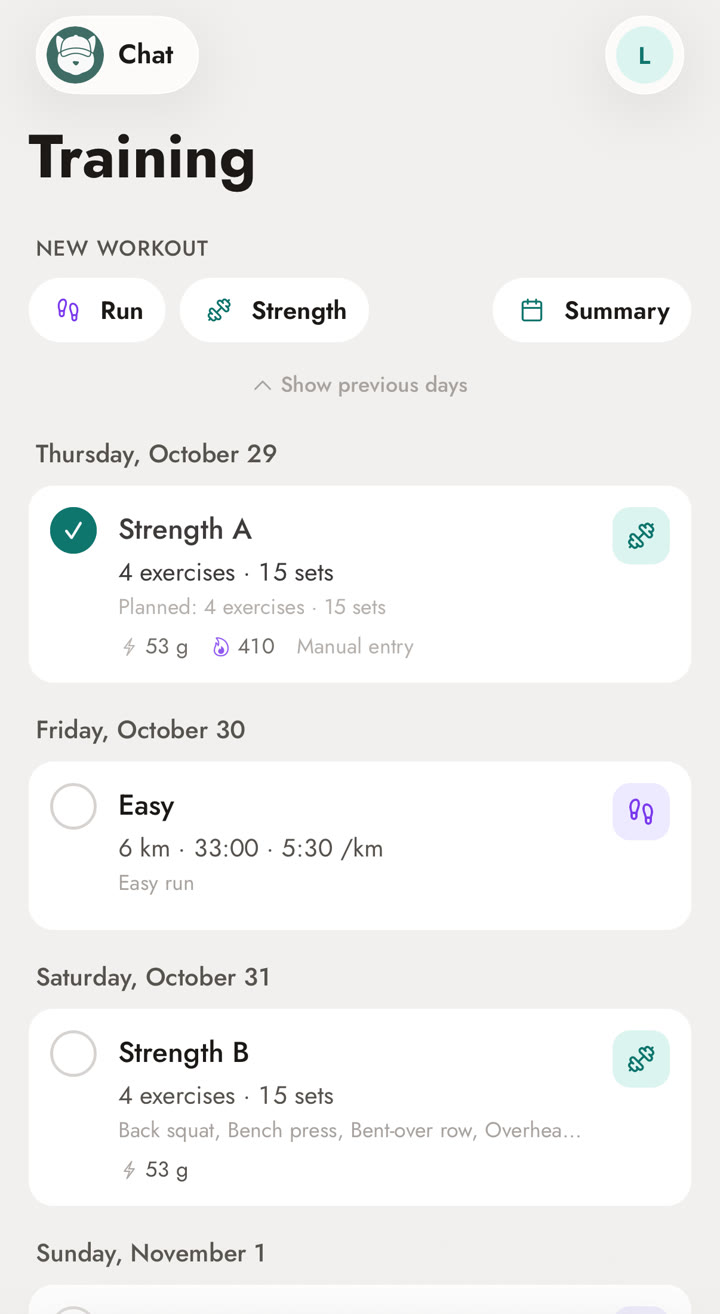
On the Training screen, each strength workout is logged with its exercises, sets and calories. In the example below, Strength workout A had 4 exercises and 15 sets, as planned, burned 410 kcal and used about 53 g of the carbohydrate store. The load and reps of each set stay in the workout log, so you can compare weeks using the signs above instead of relying on soreness.
When to see a professional
References
- Refalo MC, Helms ER, Robinson ZP, Hamilton DL, Fyfe JJ. Similar muscle hypertrophy following eight weeks of resistance training to momentary muscular failure or with repetitions-in-reserve in resistance-trained individuals. Journal of Sports Sciences, 2024;42(1):85–101. See the study
- Robinson ZP, Pelland JC, Remmert JF, Refalo MC, Jukic I, Steele J, et al. Exploring the dose-response relationship between estimated resistance training proximity to failure, strength gain, and muscle hypertrophy: a series of meta-regressions. Sports Medicine, 2024;54(9):2209–2231. See the study
- Hermann T, Mohan AE, Enes A, Sapuppo M, Piñero A, Zamanzadeh A, et al. Without fail: muscular adaptations in single-set resistance training performed to failure or with repetitions-in-reserve. Medicine and Science in Sports and Exercise, 2025;57(9):2021–2031. See the study
- Halperin I, Malleron T, Har-Nir I, Androulakis-Korakakis P, Wolf M, Fisher J, et al. Accuracy in predicting repetitions to task failure in resistance exercise: a scoping review and exploratory meta-analysis. Sports Medicine, 2022;52(2):377–390. See the study
- Zourdos MC, Goldsmith JA, Helms ER, Trepeck C, Halle JL, Mendez KM, et al. Proximity to failure and total repetitions performed in a set influences accuracy of intraset repetitions in reserve-based rating of perceived exertion. Journal of Strength and Conditioning Research, 2021;35(Suppl 1):S158–S165. See the study
- Havers T, Micke F, Geisler S, Held S. Acute and chronic effects of drop-set training: a meta-analysis and systematic review. Sports Medicine – Open, 2026;12(1). See the study
- Sødal LK, Kristiansen E, Larsen S, van den Tillaar R. Effects of drop sets on skeletal muscle hypertrophy: a systematic review and meta-analysis. Sports Medicine – Open, 2023;9(1):66. See the study
- Iversen VM, Norum M, Schoenfeld BJ, Fimland MS. No time to lift? Designing time-efficient training programs for strength and hypertrophy: a narrative review. Sports Medicine, 2021;51(10):2079–2095. See the study
- Fink J, Schoenfeld BJ, Kikuchi N, Nakazato K. Effects of drop set resistance training on acute stress indicators and long-term muscle hypertrophy and strength. Journal of Sports Medicine and Physical Fitness, 2018;58(5):597–605. See the study
- Kojic F, Mandic D, Duric S. The effects of eccentric phase tempo in squats on hypertrophy, strength, and contractile properties of the quadriceps femoris muscle. Frontiers in Physiology, 2024;15:1531926. See the study
- Shibata K, Takizawa K, Nosaka K, Mizuno M. Effects of prolonging eccentric phase duration in parallel back-squat training to momentary failure on muscle cross-sectional area, squat one repetition maximum, and performance tests in university soccer players. Journal of Strength and Conditioning Research, 2021;35(3):668–674. See the study
- Pearson J, Wadhi T, Barakat C, Aube D, Schoenfeld BJ, Andersen JC, et al. Does varying repetition tempo in a single-joint lower body exercise augment muscle size and strength in resistance-trained men? Journal of Strength and Conditioning Research, 2022;36(8):2162–2168. See the study
- Enes A, Piñero A, Hermann T, Zamanzadeh A, Hennessy T, Montenegro D, et al. How slow should you go? A systematic review with meta-analysis of the effect of resistance training repetition tempo on muscle hypertrophy. Journal of Strength and Conditioning Research, 2025;39(12):1331–1339. See the study
- Schoenfeld BJ, Ogborn DI, Krieger JW. Effect of repetition duration during resistance training on muscle hypertrophy: a systematic review and meta-analysis. Sports Medicine, 2015;45(4):577–585. See the study
- Damas F, Phillips SM, Libardi CA, Vechin FC, Lixandrão ME, Jannig PR, et al. Resistance training-induced changes in integrated myofibrillar protein synthesis are related to hypertrophy only after attenuation of muscle damage. Journal of Physiology, 2016;594(18):5209–5222. See the study
- Flann KL, LaStayo PC, McClain DA, Hazel M, Lindstedt SL. Muscle damage and muscle remodeling: no pain, no gain? Journal of Experimental Biology, 2011;214(Pt 4):674–679. See the study
- Damas F, Libardi CA, Ugrinowitsch C. The development of skeletal muscle hypertrophy through resistance training: the role of muscle damage and muscle protein synthesis. European Journal of Applied Physiology, 2018;118(3):485–500. See the study
See this math done for you
In CatLena, you log workouts, meals and measurements (or just chat with CatLena) and the app does this math for you, every day, on your computer and phone.
Get started