Nutrition
Protein every day: per meal, at the store, at dinner and for building muscle
How much protein per meal for your weight, a shopping list without weighing, 8 quick dinners, how much to gain per week and how to build muscle while losing fat.
· 12 min read
Key points
- For strength training, 0.4 g to 0.55 g of protein per kilogram at each meal, across at least 4 meals, adds up to 1.6 g to 2.2 g per kilogram per day.
- Going beyond 30 g in one meal is not wasted: the larger dose was used by muscle for longer.
- Eggs, beans, tuna and chicken all count toward the same total; when the total is right, the source matters little.
- To build muscle, gaining 0.25% to 0.5% of body weight per week is usually enough; eating much more does not speed it up.
Daily protein comes down to simple choices: how much to put in each meal, what to buy, what to eat on busy nights and how much to eat when the goal is building muscle. This guide brings together what studies show and turns it into tables for your weight.
How much protein per meal for your weight
For people doing strength training who want to build muscle, a review suggests 0.4 g to 0.55 g of protein per kilogram of body weight at each meal, across at least 4 meals, adding up to 1.6 g to 2.2 g per kilogram per day [1]. The authors themselves say more research is needed to set a per-meal limit.
| Your weight | Per meal | Per day |
|---|---|---|
| 50 kg | 20 to 27 g | 80 to 110 g |
| 60 kg | 24 to 33 g | 96 to 132 g |
| 70 kg | 28 to 38 g | 112 to 154 g |
| 80 kg | 32 to 44 g | 128 to 176 g |
| 90 kg | 36 to 49 g | 144 to 198 g |
| 100 kg | 40 to 55 g | 160 to 220 g |
Going beyond 30 g is not wasted. In 36 young men who trained and took 25 g or 100 g of milk protein, the larger dose increased muscle protein production by about 20% in the first 4 hours and about 40% between 4 and 12 hours, and only a small part was used as energy [2]. The study followed one workout and one dose, without women or solid food: it does not say that one huge meal works as well as several.
These each add up to about 30 g: 100 g of grilled chicken breast; 115 g of canned tuna; 190 g of canned sardines; or 100 g of boiled egg with 350 g of cooked pinto beans. The math is ours, using food composition tables.
Protein at the store without weighing
An analysis of 49 studies with 1,863 people doing strength training found lean mass gains leveling off around 1.62 g of protein per kilogram per day, counting food and supplements, with a range of 1.03 g to 2.2 g [3]. For 70 kg, that is about 113 g per day, a reference for strength training, not a target for everyone.
When the total is right, the source matters less than it seems. In Brazil, 38 young men eating about 1.6 g per kilogram per day, from plants only or a mixed diet, had similar strength and muscle gains over 12 weeks [4]. A review found a small advantage for animal protein in lean mass among adults under 50 [5].
| Food | Protein per 100 g |
|---|---|
| Skinless chicken breast, grilled | 32 g |
| Canned tuna in oil | 26 g |
| Canned sardines in oil | 16 g |
| Whole boiled egg | 13 g |
| Cooked lentils | 6 g |
| Cooked pinto beans | 5 g |
| Plain yogurt | 4 g |
| Cooked white rice | 2.5 g |
- Choose a source for each meal: eggs, tuna, sardines, chicken, beans or lentils.
- Compare prices on the day: the best swap changes with them.
- Add up your day once to see where you stand.
8 dinners in 10 minutes or less, with protein and fiber
A shake covers protein, but dinner usually brings more than that. A lower risk of several diseases was associated with 25 g to 29 g of fiber per day, in a series of reviews [6], and chewing matters too: in 10 men, solid chicken left less hunger than the same chicken blended with water [7], although in another study whey as a drink or a gel made no difference [8]. Whey protein works; after training, trained adults had a similar muscle response with various protein-rich foods [9].
| Dinner | Protein | Fiber |
|---|---|---|
| 100 g tuna, 150 g beans, 100 g tomato | 34.5 g | 13.9 g |
| 100 g shredded chicken, 150 g sweet potato, 50 g carrot | 33.0 g | 4.9 g |
| Sandwich: 50 g whole-grain bread, 80 g tuna, carrot and lettuce | 26.7 g | 5.6 g |
| 2 boiled eggs, 150 g beans, 100 g tomato | 21.6 g | 13.9 g |
| 100 g sardines, 100 g rice, 100 g broccoli | 20.5 g | 5.0 g |
| 2 boiled eggs, 100 g broccoli, 50 g whole-grain bread | 20.1 g | 6.8 g |
| 150 g lentils, 1 boiled egg, 100 g rice | 18.6 g | 13.4 g |
| Whey shake with 100 g banana and 30 g oats | 5.5 g plus the whey | 4.7 g |
Beans, lentils, rice, broccoli and chicken already cooked, from the fridge or freezer, make 10 minutes realistic. When you cook beans or lentils, set aside 2 portions in containers.
How much to gain per week to build muscle
Eating much more does not speed up muscle gain. In an 8-week study, groups targeting 5% and 15% extra calories ended up gaining the same average weight, 3.3 kg, and the authors cautiously suggest gaining 0.25% to 0.5% of body weight per week, closer to the lower end the longer you have trained [10]. The study is small, with 17 people at the end.
| Your weight | Gain per week |
|---|---|
| 50 kg | 125 to 250 g |
| 60 kg | 150 to 300 g |
| 70 kg | 175 to 350 g |
| 80 kg | 200 to 400 g |
| 90 kg | 225 to 450 g |
| 100 kg | 250 to 500 g |
- Weigh yourself in the morning, after using the bathroom and before eating, 3 to 7 times a week, and take the average.
- Gained more than the table for 2 weeks: cut back a little on one meal’s portion.
- No gain for 2 or 3 weeks and your training loads stalled: add a little food, such as a piece of fruit or more rice.
As a starting point, a review suggests 1,500 to 2,000 kJ extra per day, about 360 to 480 kcal by our math, a value that has never been validated in trained people [11].
Building muscle and losing fat at the same time
Both can happen together, but not by chance. In young men doing 4 weeks of strength and sprint training 6 days a week with a calorie cut, the group eating 2.4 g of protein per kilogram gained lean mass and the 1.2 g group did not [12]. In women with 16 weeks of daily exercise and dairy, lean mass also rose [13], and in trained people, 3.4 g per kilogram with a heavy new program reduced fat [14]. Across studies, however, a cut of about 500 kcal per day prevented lean mass gains on average [15].
| Protein per day | Total for 70 kg | Which study |
|---|---|---|
| 1.2 g/kg | 84 g | Longland, 2016, lower protein |
| 2.4 g/kg | 168 g | Longland, 2016, higher protein |
| 3.4 g/kg | 238 g | Antonio, 2015, higher protein |
Start with a small calorie cut, choose a strength program that fits your week and increase the load gradually. Since your weight may barely change, track each week your average weight, waist measurement, load on your main lift and average daily protein, and look at the trend after at least 4 weeks. Lean mass includes muscle and water; the studies are short and the results are averages.
How CatLena uses it
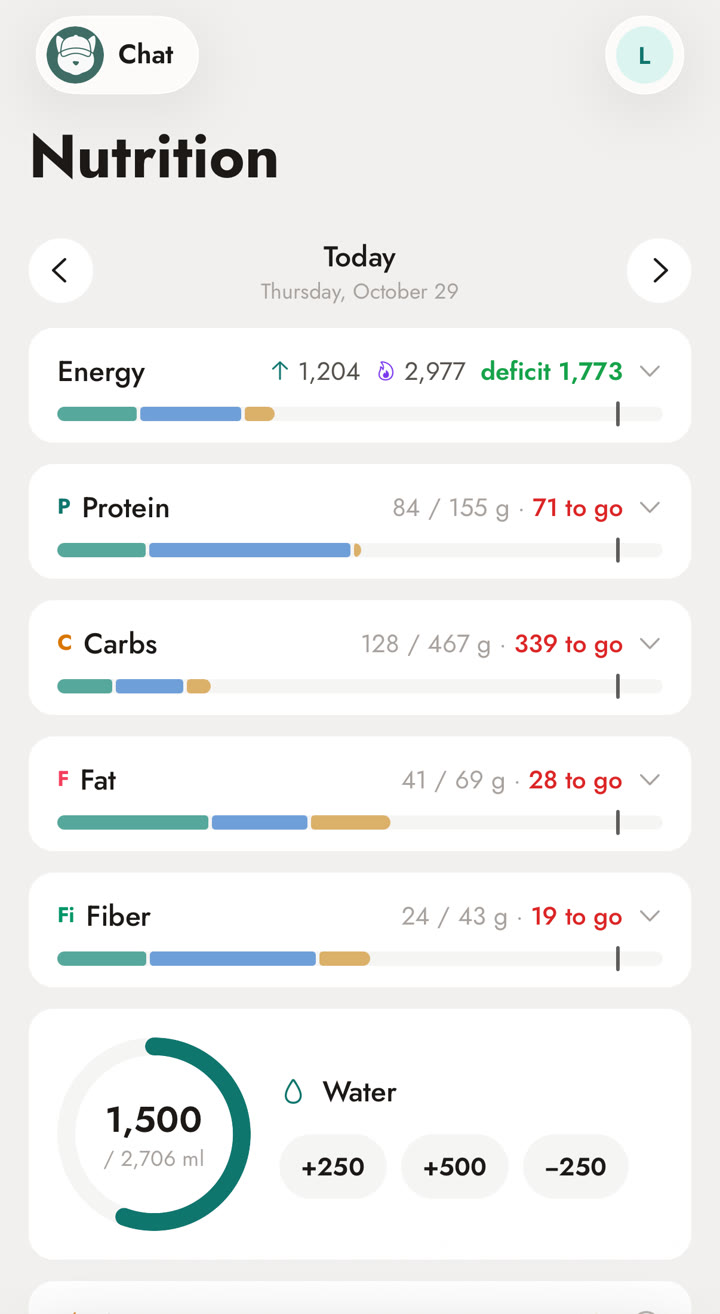
On the Nutrition screen, the day’s protein appears with its target and how much is left. In the example below, the person had eaten 84 g of a 155 g target, with 71 g to go, about 2 meals with the amounts in the first table. Fiber appears just below, at 24 g of 43 g.
When to see a professional
References
- Schoenfeld BJ, Aragon AA. How much protein can the body use in a single meal for muscle-building? Implications for daily protein distribution. Journal of the International Society of Sports Nutrition, 2018;15:10. See the study
- Trommelen J, van Lieshout GAA, Nyakayiru J, Holwerda AM, Smeets JSJ, Hendriks FK, et al. The anabolic response to protein ingestion during recovery from exercise has no upper limit in magnitude and duration in vivo in humans. Cell reports. Medicine, 2023;4(12):101324. See the study
- Morton RW, Murphy KT, McKellar SR, Schoenfeld BJ, Henselmans M, Helms E, et al. A systematic review, meta-analysis and meta-regression of the effect of protein supplementation on resistance training-induced gains in muscle mass and strength in healthy adults. British journal of sports medicine, 2018;52(6):376-384. See the study
- Hevia-Larraín V, Gualano B, Longobardi I, Gil S, Fernandes AL, Costa LAR, et al. High-Protein Plant-Based Diet Versus a Protein-Matched Omnivorous Diet to Support Resistance Training Adaptations: A Comparison Between Habitual Vegans and Omnivores. Sports medicine (Auckland, N.Z.), 2021;51(6):1317-1330. See the study
- Lim MT, Pan BJ, Toh DWK, Sutanto CN, Kim JE. Animal Protein versus Plant Protein in Supporting Lean Mass and Muscle Strength: A Systematic Review and Meta-Analysis of Randomized Controlled Trials. Nutrients, 2021;13(2). See the study
- Reynolds A, Mann J, Cummings J, Winter N, Mete E, Te Morenga L. Carbohydrate quality and human health: a series of systematic reviews and meta-analyses. Lancet (London, England), 2019;393(10170):434-445. See the study
- Martens MJ, Lemmens SG, Born JM, Westerterp-Plantenga MS. A solid high-protein meal evokes stronger hunger suppression than a liquefied high-protein meal. Obesity (Silver Spring, Md.), 2011;19(3):522-7. See the study
- Zhang S, Leidy HJ, Vardhanabhuti B. Protein Beverage vs. Protein Gel on Appetite Control and Subsequent Food Intake in Healthy Adults. Nutrients, 2015;7(10):8700-11. See the study
- Haigh FA, Monteyne AJ, Abdelrahman DR, Murton AJ, Finnigan TJ, Theobald HE, et al. Ingestion of diverse protein-rich whole-foods result in similar post exercise whole body and myofibrillar protein synthesis rates compared with a more isolated protein source in young adults. The American journal of clinical nutrition, 2026;123(4):101231. See the study
- Helms ER, Spence AJ, Sousa C, Kreiger J, Taylor S, Oranchuk DJ, et al. Effect of Small and Large Energy Surpluses on Strength, Muscle, and Skinfold Thickness in Resistance-Trained Individuals: A Parallel Groups Design. Sports medicine - open, 2023;9(1):102. See the study
- Slater GJ, Dieter BP, Marsh DJ, Helms ER, Shaw G, Iraki J. Is an Energy Surplus Required to Maximize Skeletal Muscle Hypertrophy Associated With Resistance Training. Frontiers in nutrition, 2019;6:131. See the study
- Longland TM, Oikawa SY, Mitchell CJ, Devries MC, Phillips SM. Higher compared with lower dietary protein during an energy deficit combined with intense exercise promotes greater lean mass gain and fat mass loss: a randomized trial. The American journal of clinical nutrition, 2016;103(3):738-46. See the study
- Josse AR, Atkinson SA, Tarnopolsky MA, Phillips SM. Increased consumption of dairy foods and protein during diet- and exercise-induced weight loss promotes fat mass loss and lean mass gain in overweight and obese premenopausal women. The Journal of nutrition, 2011;141(9):1626-34. See the study
- Antonio J, Ellerbroek A, Silver T, Orris S, Scheiner M, Gonzalez A, et al. A high protein diet (3.4 g/kg/d) combined with a heavy resistance training program improves body composition in healthy trained men and women--a follow-up investigation. Journal of the International Society of Sports Nutrition, 2015;12:39. See the study
- Murphy C, Koehler K. Energy deficiency impairs resistance training gains in lean mass but not strength: A meta-analysis and meta-regression. Scandinavian journal of medicine & science in sports, 2022;32(1):125-137. See the study
See this math done for you
In CatLena, you log workouts, meals and measurements (or just chat with CatLena) and the app does this math for you, every day, on your computer and phone.
Get started