Running
Fueling for race day: the night before, race morning, long runs and cramps
How much carbohydrate to eat the day before and the morning of a race for your weight, how much to carry on a long run and what to do when a cramp hits.
· 11 min read
Key points
- Carbohydrate loading helps in races longer than 90 minutes; below that, your usual dinner tends to be enough.
- For long races, start with 7 g of carbohydrate per kilogram of body weight the day before and eat about 4 hours before the start.
- On long runs, up to about 60 g of carbohydrate per hour, starting lower and testing in training, never on race day.
- Cramps usually come from several factors combined, such as a faster pace than trained and fatigue; gentle stretching is the most recommended response.
What you eat the day before, the morning of and during a long race can change the result, and the answer depends more on how long the race lasts than on its distance. This guide shows how much carbohydrate to eat for your weight, how much to carry on a long run and what to do about cramps, in the moment and at your next race.
The day before and race morning: how much to eat for your weight
A review showed that carbohydrate loading in the days before delayed fatigue by about 20% in endurance exercise and improved performance by 2% to 3% in fixed-distance events longer than 90 minutes; below that, there was no clear gain [1]. In practice, 5 km and 10 km races usually fall below that line, a half marathon depends on your pace and a marathon almost always goes beyond it.
At the London Marathon, runners who ate more than 7 g of carbohydrate per kilogram of body weight the day before ran faster, in an observational study [2]. For well-trained athletes, a review cites 10 g to 12 g per kilogram 36 to 48 hours before [3]. Start at the lower end.
| Your weight | 7 g per kilogram | If it were only cooked rice |
|---|---|---|
| 50 kg | 350 g | About 1.2 kg |
| 60 kg | 420 g | About 1.5 kg |
| 70 kg | 490 g | About 1.7 kg |
| 80 kg | 560 g | About 2.0 kg |
A sample day for 60 kg, with 50 g bread rolls and bananas of about 80 g peeled: at breakfast, 2 rolls, 1 banana and 1 spoon of honey (about 95 g of carbohydrate); at lunch, 300 g of rice and 200 g of boiled cassava (about 145 g); as a snack, 200 g of corn couscous and 1 banana (about 70 g); at dinner, 250 g of rice, 1 roll and 1 banana (about 120 g). Total of about 430 g. For one day, cut back on foods very high in fiber and fat.
On race morning, eat about 4 hours before: in one study, 312 g of carbohydrate at that time improved performance by 15%, while 45 g and 156 g did not change the result [4]. With a very early start, eat less and closer to it; a review found no harm in eating carbohydrate at least 60 minutes before [5]. Choose what usually sits well, such as bread with banana, tapioca and couscous: there is no clear benefit in seeking special low-glycemic-index foods [6]. In races with a swim, avoid eating in the 30 minutes before the start [7].
In a small study, women stored more muscle carbohydrate only when they also ate more total calories [8], and a review recommends going above 8 g per kilogram, with attention to the day’s calories [9]. In 7 cyclists who ate carbohydrate during 100 km, loading did not change their time [10], and the 1-day load was tested in only 8 athletes at rest [11].
Long runs: how much carbohydrate to carry per hour
The amount depends first on how long the session lasts. A review of 136 studies found a larger effect in tests to exhaustion and in less-trained people [12], and general recommendations rise with duration [13].
| Duration | Carbohydrate per hour | In bananas per hour |
|---|---|---|
| 1 hour | Little, or just a carbohydrate drink mouth rinse | None or few |
| 2 to 3 hours | Up to about 60 g, starting lower | Up to 2 to 3 |
| Very long events | About 90 g, with a mix of sugars | Hard with bananas alone |
The banana math is ours: in one study, 794 g of banana added up to 150 g of carbohydrate, about 23 g per fruit [14]. For gels and drinks, check the carbohydrate line on the label. Liquids, gels or solids low in fat, protein and fiber all work [13]; over 75 km of cycling, bananas and a sports drink gave similar times, but with bananas the cyclists felt fuller [14]. In real-world races, conclusions apply mainly to trained male cyclists in events over 90 minutes [15].
- Note the duration of your next long run and check the table.
- Start below the ceiling, spreading the amount across the session, and drink water with it.
- Watch your stomach and performance; test in training, never for the first time on race day.
Cramps: what to do in the moment and at your next race
In the moment, slow down or stop and gently stretch the muscle until the cramp passes, the measure with the strongest recommendation in a 2022 review [16]. Afterward, rest a little before resuming, because it can come back. Bananas are not a quick fix: in 9 men, blood potassium only rose after 1 hour and stayed in the normal range [17]. A small amount of acidic liquid, such as pickle juice, shortened a lab-induced cramp by 49 seconds [18], but race tests are lacking.
For prevention, pace matters more than the bottle. In a 56 km race, runners who cramped covered the first 28 km 13 minutes faster, with similar personal bests [19]. Cramps usually come from several factors combined, such as muscle fatigue and intensity above what was trained [20], and drinking more did not guarantee protection [21].
| What happened | What to adjust |
|---|---|
| Started faster than I train | Realistic goal and planned pace from the start |
| Race longer or harder than training | Train at similar intensity and conditions |
| Trained too much in the days before or slept badly | Easy days and rest before the race |
| Ate or drank less than planned | Carbohydrate and drinks with salts, without overdoing water |
How CatLena uses it
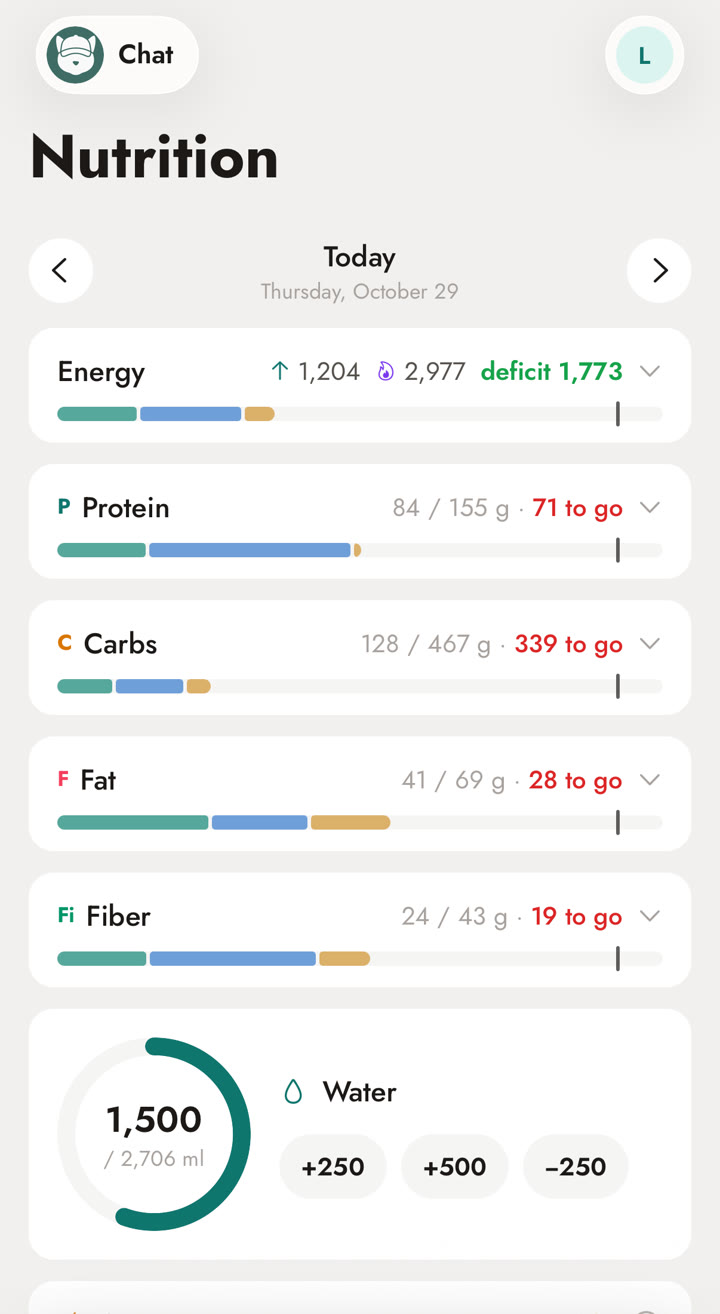
On the Nutrition screen, the day’s carbohydrate appears with its target and how much is left. In the example below, the person had eaten 128 g of a 467 g target, with 339 g to go. The day before a long race, this bar shows whether the planned load is on track, meal by meal.
When to see a professional
References
- Hawley JA, Schabort EJ, Noakes TD, Dennis SC. Carbohydrate-loading and exercise performance. An update. Sports medicine (Auckland, N.Z.), 1997;24(2):73-81. See the study
- Atkinson G, Taylor CE, Morgan N, Ormond LR, Wallis GA. Pre-race dietary carbohydrate intake can independently influence sub-elite marathon running performance. International journal of sports medicine, 2011;32(8):611-7. See the study
- Burke LM, Jeukendrup AE, Jones AM, Mooses M. Contemporary Nutrition Strategies to Optimize Performance in Distance Runners and Race Walkers. International journal of sport nutrition and exercise metabolism, 2019;29(2):117-129. See the study
- Sherman WM, Brodowicz G, Wright DA, Allen WK, Simonsen J, Dernbach A. Effects of 4 h preexercise carbohydrate feedings on cycling performance. Medicine and science in sports and exercise, 1989;21(5):598-604. See the study
- Kerksick CM, Arent S, Schoenfeld BJ, Stout JR, Campbell B, Wilborn CD, et al. International society of sports nutrition position stand: nutrient timing. Journal of the International Society of Sports Nutrition, 2017;14:33. See the study
- Burdon CA, Spronk I, Cheng HL, O’Connor HT. Effect of Glycemic Index of a Pre-exercise Meal on Endurance Exercise Performance: A Systematic Review and Meta-analysis. Sports medicine (Auckland, N.Z.), 2017;47(6):1087-1101. See the study
- Rehrer NJ, van Kemenade M, Meester W, Brouns F, Saris WH. Gastrointestinal complaints in relation to dietary intake in triathletes. International journal of sport nutrition, 1992;2(1):48-59. See the study
- Tarnopolsky MA, Zawada C, Richmond LB, Carter S, Shearer J, Graham T, et al. Gender differences in carbohydrate loading are related to energy intake. Journal of applied physiology (Bethesda, Md. : 1985), 2001;91(1):225-30. See the study
- Sedlock DA. The latest on carbohydrate loading: a practical approach. Current sports medicine reports, 2008;7(4):209-13. See the study
- Burke LM, Hawley JA, Schabort EJ, St Clair Gibson A, Mujika I, Noakes TD. Carbohydrate loading failed to improve 100-km cycling performance in a placebo-controlled trial. Journal of applied physiology (Bethesda, Md. : 1985), 2000;88(4):1284-90. See the study
- Bussau VA, Fairchild TJ, Rao A, Steele P, Fournier PA. Carbohydrate loading in human muscle: an improved 1 day protocol. European journal of applied physiology, 2002;87(3):290-5. See the study
- Ramos-Campo DJ, Clemente-Suárez VJ, Cupeiro R, Benítez-Muñoz JA, Andreu Caravaca L, Rubio-Arias JÁ. The ergogenic effects of acute carbohydrate feeding on endurance performance: a systematic review, meta-analysis and meta-regression. Critical reviews in food science and nutrition, 2024;64(30):11196-11205. See the study
- Jeukendrup A. A step towards personalized sports nutrition: carbohydrate intake during exercise. Sports medicine (Auckland, N.Z.), 2014;44 Suppl 1(Suppl 1):S25-33. See the study
- Nieman DC, Gillitt ND, Henson DA, Sha W, Shanely RA, Knab AM, et al. Bananas as an energy source during exercise: a metabolomics approach. PloS one, 2012;7(5):e37479. See the study
- Pöchmüller M, Schwingshackl L, Colombani PC, Hoffmann G. A systematic review and meta-analysis of carbohydrate benefits associated with randomized controlled competition-based performance trials. Journal of the International Society of Sports Nutrition, 2016;13:27. See the study
- Miller KC, McDermott BP, Yeargin SW, Fiol A, Schwellnus MP. An Evidence-Based Review of the Pathophysiology, Treatment, and Prevention of Exercise-Associated Muscle Cramps. Journal of athletic training, 2022;57(1):5-15. See the study
- Miller KC. Plasma potassium concentration and content changes after banana ingestion in exercised men. Journal of athletic training, 2012;47(6):648-54. See the study
- Miller KC, Mack GW, Knight KL, Hopkins JT, Draper DO, Fields PJ, et al. Reflex inhibition of electrically induced muscle cramps in hypohydrated humans. Medicine and science in sports and exercise, 2010;42(5):953-61. See the study
- Schwellnus MP, Allie S, Derman W, Collins M. Increased running speed and pre-race muscle damage as risk factors for exercise-associated muscle cramps in a 56 km ultra-marathon: a prospective cohort study. British journal of sports medicine, 2011;45(14):1132-6. See the study
- Schwellnus MP. Cause of exercise associated muscle cramps (EAMC)--altered neuromuscular control, dehydration or electrolyte depletion?. British journal of sports medicine, 2009;43(6):401-8. See the study
- Jung AP, Bishop PA, Al-Nawwas A, Dale RB. Influence of Hydration and Electrolyte Supplementation on Incidence and Time to Onset of Exercise-Associated Muscle Cramps. Journal of athletic training, 2005;40(2):71-75. See the study
See this math done for you
In CatLena, you log workouts, meals and measurements (or just chat with CatLena) and the app does this math for you, every day, on your computer and phone.
Get started