Training
Your training week: strength with cardio, deload weeks and coming back after a break
How to combine strength and cardio in the same week, why strength training helps runners, when to deload and how to return after a break.
· 11 min read
Key points
- Adding cardio to strength training showed no clear difference in muscle size or maximum strength; explosive strength grows less when both are in the same session.
- For runners, heavy strength training improves running economy without changing body weight.
- Deload weeks are common among athletes and did not hurt gains in the few studies that tested them.
- After a break, strength and muscle come back quickly: the return can start at about 60% of the load.
Organizing a training week involves recurring choices: fitting in cardio without hurting strength training, deciding whether strength work belongs in a runner’s routine, knowing when to ease off and how to return after weeks off. This guide brings together what studies show about each one, with sample weeks to adapt.
Strength and cardio in the same week: 3 sample weeks
In 43 studies with 1,090 healthy adults, adding cardio to the same strength program showed no clear difference in muscle size or maximum strength [1]. Explosive strength, for jumping or sprinting, grew less, especially with both workouts in the same session; with at least 3 hours between them, the difference did not clearly appear. In 15 studies, cardio slightly reduced muscle fiber growth, more with running than with cycling, a finding that is still preliminary [2].
In 59 studies with 1,346 adults, there was a small loss in leg strength gains in men, but not in women [3]. A summary of 17 reviews concluded that combining both improved aerobic fitness more than strength training alone, with comparable strength and muscle, and the order of workouts within a session made no significant difference [4].
| Day | 3 days | 4 days | 5 days |
|---|---|---|---|
| Mon | Full body and 20 min of easy cardio | Upper body | Upper body |
| Tue | Cardio, 30 to 40 min | Moderate cardio | |
| Wed | Full body | Legs | |
| Thu | Legs | ||
| Fri | Full body and 20 min of easy cardio | Full body | |
| Sat | Cardio or full body | Long, easy cardio |
When your goal includes jumping or sprinting, leave at least 3 hours between the two workouts. Avoiding hard cardio right before a heavy leg session is practical advice, not a study result.
Strength training for runners: how to start
Strength training does not usually change how much oxygen you can use at most, but it can reduce the energy spent at the same pace, which is called running economy. A summary of 17 reviews found moderate to large effects on economy, with no change in maximum oxygen uptake and low confidence in most reviews [5].
The type of training matters. In 31 studies with 652 runners, heavy loads of 80% of maximum or more and mixed methods improved economy; moderate loads and isometric exercises alone did not [6]. In 38 studies with 894 runners, heavy loads had a moderate effect on performance, and jumps alone had no significant effect [7]. Over 40 weeks, runners who did strength training gained strength and economy with no significant change in weight, fat or lean mass [8].
- Set aside 1 or 2 sessions a week; the programs studied lasted 6 weeks or more.
- Start with leg exercises you already perform with good technique, such as leg press and squat.
- Increase the load gradually: heavy loads only make sense after you have learned the movement.
Deload week: a template and a signs log
In a survey of 246 strength and physique athletes, a deload lasted about 6.4 days and came every 5.6 weeks. The most cited reasons were the program scheduling it (65.4%), muscle or joint pain (62.6%) and stalled or falling performance (54.1%) [9]. Coaches interviewed recommend 5 to 7 days every 4 to 6 weeks and say there is no single right way [10].
Tests are still few. In 39 trained young adults, stopping for one week in the middle of 9 weeks did not reduce leg muscle gain; in the squat, the average rose 13 kg with the break and 16.4 kg without it, an uncertain difference [11]. In 19 beginners, cutting to 2 sets in weeks 4 and 8 did not hurt muscle or strength [12]. An expert consensus agrees that more studies are needed [13].
- Keep the same days and exercises for about a week.
- Do roughly half your usual sets.
- Use a little less weight if your joints bother you, and end each set with 3 or 4 reps to spare.
- The following week, return to your usual training.
A sample signs log, filled in once a week:
| Week | Load dropped? | Joint pain? | Motivation (0 to 10) | Decision |
|---|---|---|---|---|
| 1 | No | No | 8 | Continue |
| 2 | Yes | Mild | 5 | Watch |
| 3 | Yes | Mild | 4 | Deload |
Coming back after a break: the first 4 weeks
Stopping has a cost: in 7 beginners, leg lean mass rose 6.5% in 7 weeks of training and fell 4.6% after 7 weeks off [14]. The return, however, tends to be fast. In Finland, 42 beginners trained for 10 weeks, stopped for 10 and returned for 10 more, while another group trained 20 weeks straight; in the end, strength and muscle showed no difference, and in the first 5 weeks back the break group improved more [15]. In 14 young men doing the bench press, alternating 6 weeks of training with 3 weeks off produced gains similar to continuous training over 24 weeks [16].
The reason is still open. Trained muscle keeps more nuclei in its cells after a break, but in two studies the arm or leg with previous training did not grow more on return [17][18]. Almost all of this was measured in beginners; for people who have trained for years and after very long breaks, the response may differ.
| Week | Load | Reps to spare at the end of the set |
|---|---|---|
| 1 | About 60% of your previous load | 4 or 5 reps |
| 2 | About 70% | 3 or 4 reps |
| 3 | About 80% | 2 or 3 reps |
| 4 | Whatever your technique allows | 1 or 2 reps |
After a short break of 2 or 3 weeks, you can start a little higher. After a long break, repeat week 1 before moving on.
How CatLena uses it
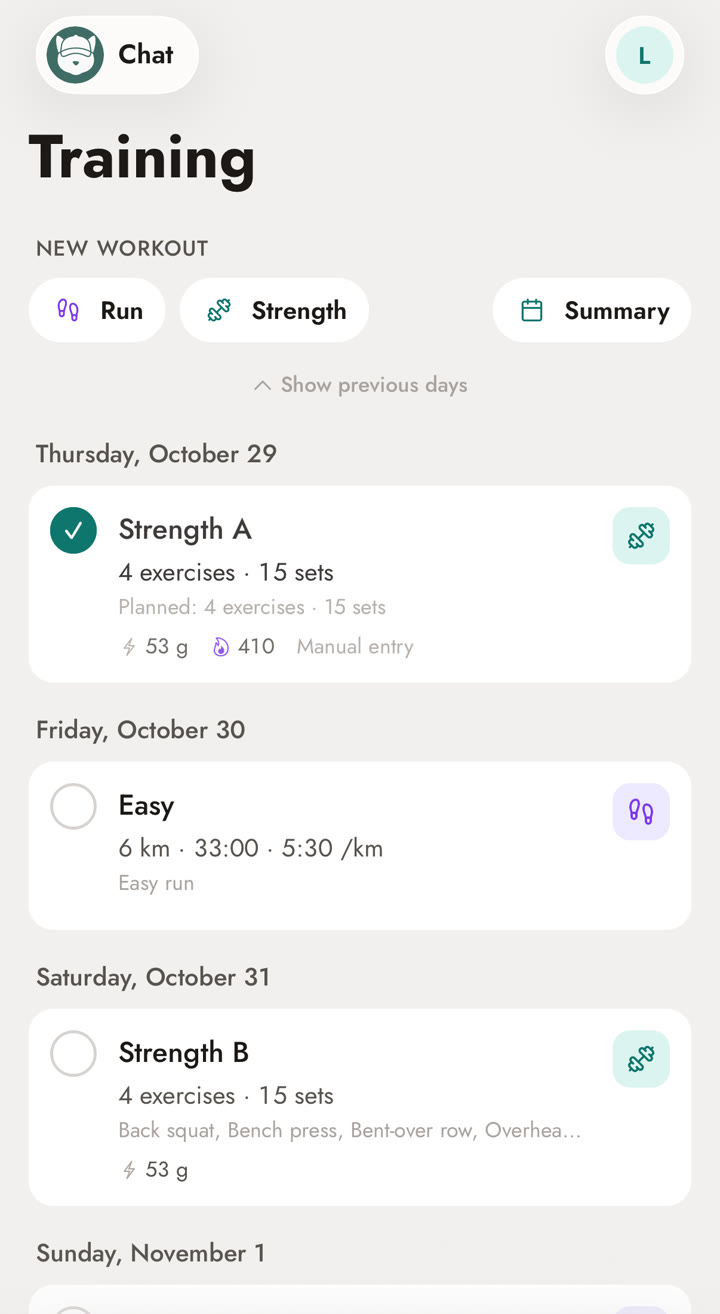
On the Training screen, running and strength training appear in the same week. In the example below, Thursday’s Strength workout A, with 4 exercises and 15 sets, is followed by an easy 6 km run in 33 minutes, at 5:30 per kilometer, on Friday, and Strength workout B on Saturday. Seeing both types of training together helps you keep time between them and notice when the week calls for easing off.
When to see a professional
References
- Schumann M, Feuerbacher JF, Sünkeler M, Freitag N, Rønnestad BR, Doma K, et al. Compatibility of Concurrent Aerobic and Strength Training for Skeletal Muscle Size and Function: An Updated Systematic Review and Meta-Analysis. Sports medicine (Auckland, N.Z.), 2022;52(3):601-612. See the study
- Lundberg TR, Feuerbacher JF, Sünkeler M, Schumann M. The Effects of Concurrent Aerobic and Strength Training on Muscle Fiber Hypertrophy: A Systematic Review and Meta-Analysis. Sports medicine (Auckland, N.Z.), 2022;52(10):2391-2403. See the study
- Huiberts RO, Wüst RCI, van der Zwaard S. Concurrent Strength and Endurance Training: A Systematic Review and Meta-Analysis on the Impact of Sex and Training Status. Sports medicine (Auckland, N.Z.), 2024;54(2):485-503. See the study
- Held S, Wolf L, Rappelt L, Bloch W, Donath L, Micke F, et al. Maximizing Adaptations in Concurrent Training: An Umbrella Review of Meta-analyses. Sports medicine (Auckland, N.Z.), 2026;56(6):1489-1512. See the study
- Ramos-Campo DJ, Andreu-Caravaca L, Clemente-Suárez VJ, Rubio-Arias JÁ. The Effect of Strength Training on Endurance Performance Determinants in Middle- and Long-Distance Endurance Athletes: An Umbrella Review of Systematic Reviews and Meta-Analysis. Journal of strength and conditioning research, 2025;39(4):492-506. See the study
- Llanos-Lagos C, Ramirez-Campillo R, Moran J, Sáez de Villarreal E. Effect of Strength Training Programs in Middle- and Long-Distance Runners’ Economy at Different Running Speeds: A Systematic Review with Meta-analysis. Sports medicine (Auckland, N.Z.), 2024;54(4):895-932. See the study
- Llanos-Lagos C, Ramirez-Campillo R, Moran J, Sáez de Villarreal E. The Effect of Strength Training Methods on Middle-Distance and Long-Distance Runners’ Athletic Performance: A Systematic Review with Meta-analysis. Sports medicine (Auckland, N.Z.), 2024;54(7):1801-1833. See the study
- Beattie K, Carson BP, Lyons M, Rossiter A, Kenny IC. The Effect of Strength Training on Performance Indicators in Distance Runners. Journal of strength and conditioning research, 2017;31(1):9-23. See the study
- Rogerson D, Nolan D, Androulakis Korakakis P, Immonen V, Wolf M, Bell L. Deloading Practices in Strength and Physique Sports: A Cross-sectional Survey. Sports medicine - open, 2024;10(1):26. See the study
- Bell L, Nolan D, Immonen V, Helms E, Dallamore J, Wolf M, et al. "You can’t shoot another bullet until you’ve reloaded the gun": Coaches’ perceptions, practices and experiences of deloading in strength and physique sports. Frontiers in sports and active living, 2022;4:1073223. See the study
- Coleman M, Burke R, Augustin F, Piñero A, Maldonado J, Fisher JP, et al. Gaining more from doing less? The effects of a one-week deload period during supervised resistance training on muscular adaptations. PeerJ, 2024;12:e16777. See the study
- Pancar Z, Ilhan MT, Darendeli MK, Karaca B, Ikidag MA, Tasdogan AM, et al. Effects of deload periods in resistance training on muscle hypertrophy and strength endurance in untrained young men using a randomized within subject design. Scientific reports, 2026;16(1). See the study
- Bell L, Strafford BW, Coleman M, Androulakis Korakakis P, Nolan D. Integrating Deloading into Strength and Physique Sports Training Programmes: An International Delphi Consensus Approach. Sports medicine - open, 2023;9(1):87. See the study
- Seaborne RA, Strauss J, Cocks M, Shepherd S, O’Brien TD, van Someren KA, et al. Human Skeletal Muscle Possesses an Epigenetic Memory of Hypertrophy. Scientific reports, 2018;8(1):1898. See the study
- Halonen EJ, Gabriel I, Kelahaara MM, Ahtiainen JP, Hulmi JJ. Does Taking a Break Matter-Adaptations in Muscle Strength and Size Between Continuous and Periodic Resistance Training. Scandinavian journal of medicine & science in sports, 2024;34(10):e14739. See the study
- Ogasawara R, Yasuda T, Ishii N, Abe T. Comparison of muscle hypertrophy following 6-month of continuous and periodic strength training. European journal of applied physiology, 2013;113(4):975-85. See the study
- Cumming KT, Reitzner SM, Hanslien M, Skilnand K, Seynnes OR, Horwath O, et al. Muscle memory in humans: evidence for myonuclear permanence and long-term transcriptional regulation after strength training. The Journal of physiology, 2024;602(17):4171-4193. See the study
- Psilander N, Eftestøl E, Cumming KT, Juvkam I, Ekblom MM, Sunding K, et al. Effects of training, detraining, and retraining on strength, hypertrophy, and myonuclear number in human skeletal muscle. Journal of applied physiology (Bethesda, Md. : 1985), 2019;126(6):1636-1645. See the study
See this math done for you
In CatLena, you log workouts, meals and measurements (or just chat with CatLena) and the app does this math for you, every day, on your computer and phone.
Get started