Energy
Daily energy: watch calories, hours of sitting and a stalled scale
How much to trust your watch’s calories, a plan to add 30 minutes of movement to a desk day and 4 checks before cutting more food.
· 10 min read
Key points
- Watches overestimated strength-training calories by more than 100% in some models; heart rate is more reliable.
- About 30 to 40 minutes of moderate movement per day reduced the association between long hours of sitting and risk of death.
- The body saves energy during weight loss, but the brake is usually small and shrinks once weight is stable.
- Before cutting more food, check the observation period, how you log food, your daily movement and protein with strength training.
Your daily energy expenditure combines what the body uses at rest, everyday movement and workouts. This guide shows how much to trust the calories your watch reports, how to add movement to a desk day and what to check when your weight stops dropping, before taking more food off your plate.
Watch calories: how much to trust them
A watch has no calorie sensor: it combines heart rate, movement, age and weight in a calculation. In 62 young men, 34 minutes of strength training burned 141 kcal measured in the lab, and 4 watches showed on average 146, 258, 299 and 305 kcal; on the treadmill, watches were 9% to 30% above the lab [1]. Heart rate did better, with an average difference of up to 4 beats per minute, although right after a set two models read 20 to 26 beats lower [2].
This is not new: in 2017, none of 7 watches had less than 20% error in calories [3]. In strength training, the lab measurement itself may miss part of the energy used during sets [4].
- Read workout calories as an estimate, especially for strength training.
- Do not decide how much extra to eat from that number alone; watch your hunger and weight over the weeks.
- Use heart rate to track effort and wait a few moments after a set before checking.
- Use the watch to compare movement between weeks.
A desk day, hour by hour: 30 minutes of movement
In more than 1 million adults, those who sat over 8 hours a day but did the equivalent of 60 to 75 minutes of moderate activity daily had no higher risk of death than those who sat under 4 hours [5]. With sensors in 44,370 people, about 30 to 40 minutes per day of moderate or vigorous movement already reduced that association [6]. In a one-day test, 2-minute walks every 20 minutes of sitting reduced the blood sugar rise by 24% to 30% [7], and light movement was also associated with lower risk [8].
| When | What to do | Minutes |
|---|---|---|
| Commute | Get off a stop early or park farther away, at a brisk pace | 10 |
| Mid-morning | Climb a flight of stairs or get water on another floor | 2 |
| After lunch | Walk briskly before going back to your desk | 10 |
| Early afternoon | Take a phone call while walking | 2 |
| Mid-afternoon | Go talk to someone instead of messaging | 2 |
| Late afternoon | Stairs again | 2 |
| Going home | Get off a stop early | 2 |
That is 20 minutes of brisk walking and 10 of breaks, 30 in total. A brisk pace is one where you can still talk but not sing. Pick one line per week, tie the break to something that already happens, such as the end of a meeting, and if a break every 20 minutes does not fit, start with one per hour.
When the scale stalls: 4 things to check before cutting more
The body saves energy, but it does not shut down. In 71 adults who ate 1,000 kcal a day for 8 weeks, resting expenditure was 92 kcal below predicted; with stable weight for 4 weeks, 38 kcal; at 1 year, 7 kcal, with no clear difference [9]. The brake may be larger after losing a lot of weight, 300 to 400 kcal per day according to a review [10], and 499 kcal in participants of a TV program six years later, an extreme case [11].
Counting in your head also misleads: in 10 people who said they ate under 1,200 kcal without losing weight, expenditure was as expected, and reported intake was 47% below actual [12]. It is not a lack of willpower: measuring is hard.
| Check | What to do |
|---|---|
| Time | Compare 2- to 4-week averages, not one day with another |
| Logging | For 7 days, log everything with amounts, including oil, sauces and drinks |
| Movement | Compare steps and workouts now with those at the start |
| Strength and protein | Keep strength training and protein, with small cuts and a slow pace |
Eating less tends to reduce daily movement without people noticing, and a review recommends strength training and protein with small cuts rather than large ones [13].
How CatLena uses it
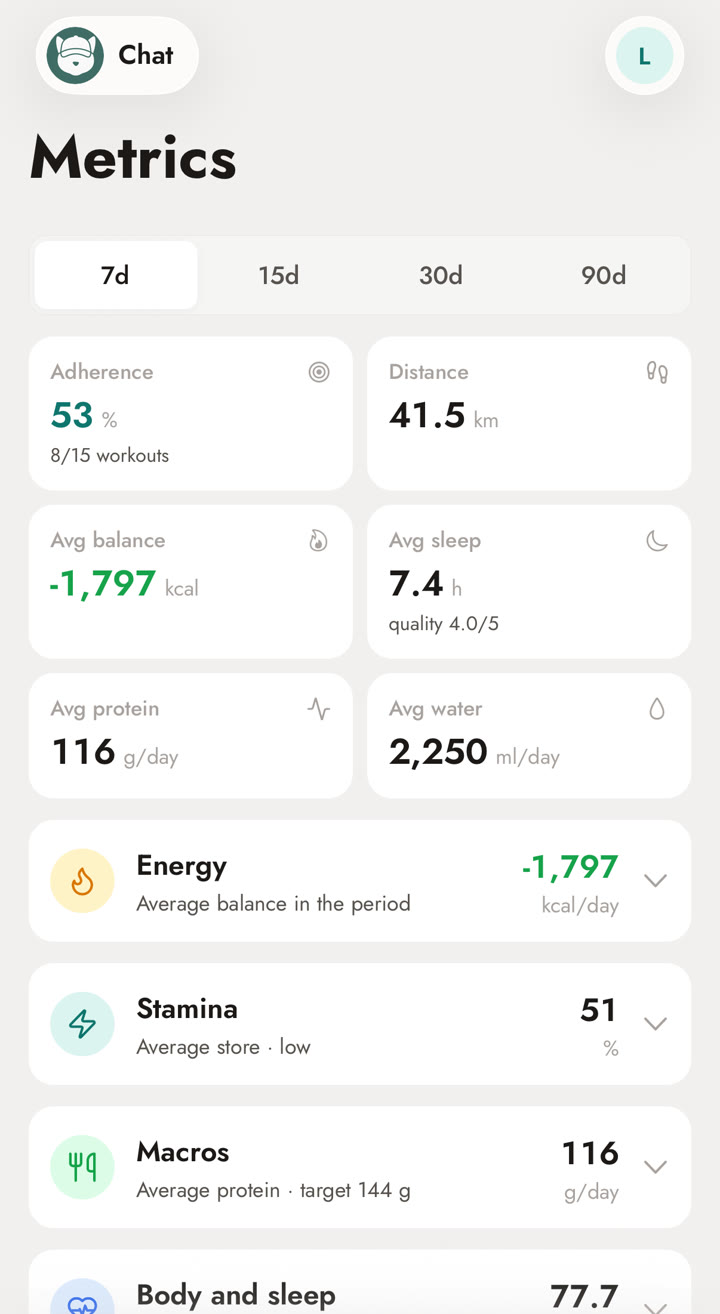
On the Metrics screen, the average energy balance for the period combines what you ate and what you burned, with steps and workouts. In the example below, the average balance was –1,797 kcal per day over 7 days, with 41.5 km run. Looking at the weekly average, not a single day, is the first of the checks above.
When to see a professional
References
- Lee TH, Jun DU, Bae JY, Roh HT, Cho SY. Comparative Validity of Smartwatch-Derived Heart Rate and Energy Expenditure During Endurance and Resistance Exercise. Sensors (Basel, Switzerland), 2026;26(8). See the study
- Yun JH, Ko JM, Lee TH. Criterion Validity of Smartwatches for Measuring Heart Rate and Energy Expenditure During Resistance Exercise. Bioengineering (Basel, Switzerland), 2026;13(10). See the study
- Shcherbina A, Mattsson CM, Waggott D, Salisbury H, Christle JW, Hastie T, et al. Accuracy in Wrist-Worn, Sensor-Based Measurements of Heart Rate and Energy Expenditure in a Diverse Cohort. Journal of personalized medicine, 2017;7(2). See the study
- Frazer R, Askew CD, Bowler AL, Burke LM, Condo D, Cox GR, et al. Individual Calibration of a Multiinput Wearable Device Improves Exercise Energy Expenditure Estimation During Intermittent High-Intensity but Not Resistance Exercise in an Athletic Female Population. International journal of sport nutrition and exercise metabolism, 2026;:1-13. See the study
- Ekelund U, Steene-Johannessen J, Brown WJ, Fagerland MW, Owen N, Powell KE, et al. Does physical activity attenuate, or even eliminate, the detrimental association of sitting time with mortality? A harmonised meta-analysis of data from more than 1 million men and women. Lancet (London, England), 2016;388(10051):1302-10. See the study
- Ekelund U, Tarp J, Fagerland MW, Johannessen JS, Hansen BH, Jefferis BJ, et al. Joint associations of accelero-meter measured physical activity and sedentary time with all-cause mortality: a harmonised meta-analysis in more than 44 000 middle-aged and older individuals. British journal of sports medicine, 2020;54(24):1499-1506. See the study
- Dunstan DW, Kingwell BA, Larsen R, Healy GN, Cerin E, Hamilton MT, et al. Breaking up prolonged sitting reduces postprandial glucose and insulin responses. Diabetes care, 2012;35(5):976-83. See the study
- Ekelund U, Tarp J, Steene-Johannessen J, Hansen BH, Jefferis B, Fagerland MW, et al. Dose-response associations between accelerometry measured physical activity and sedentary time and all cause mortality: systematic review and harmonised meta-analysis. BMJ (Clinical research ed.), 2019;366:l4570. See the study
- Martins C, Roekenes J, Salamati S, Gower BA, Hunter GR. Metabolic adaptation is an illusion, only present when participants are in negative energy balance. The American journal of clinical nutrition, 2020;112(5):1212-1218. See the study
- Rosenbaum M, Leibel RL. Adaptive thermogenesis in humans. International journal of obesity (2005), 2010;34 Suppl 1(0 1):S47-55. See the study
- Fothergill E, Guo J, Howard L, Kerns JC, Knuth ND, Brychta R, et al. Persistent metabolic adaptation 6 years after "The Biggest Loser" competition. Obesity (Silver Spring, Md.), 2016;24(8):1612-9. See the study
- Lichtman SW, Pisarska K, Berman ER, Pestone M, Dowling H, Offenbacher E, et al. Discrepancy between self-reported and actual caloric intake and exercise in obese subjects. The New England journal of medicine, 1992;327(27):1893-8. See the study
- Trexler ET, Smith-Ryan AE, Norton LE. Metabolic adaptation to weight loss: implications for the athlete. Journal of the International Society of Sports Nutrition, 2014;11(1):7. See the study
See this math done for you
In CatLena, you log workouts, meals and measurements (or just chat with CatLena) and the app does this math for you, every day, on your computer and phone.
Get started