Health
Weight-loss injections: lean mass, training, side effects and questions for your doctor
What studies show about lean mass, strength training, protein and side effects with weight-loss injection medications, with logs and questions to bring to your doctor.
· 12 min read
Key points
- Part of the weight lost on these medications is lean mass, which includes muscle, water and organs; strength training reduces that loss.
- After stopping, weight tends to come back in part; any change in treatment is decided with your doctor.
- Nausea, diarrhea, vomiting and constipation are common; food suggestions by symptom come from experts and have been little tested.
- A possible protein target is 80 g to 120 g per day, agreed with the professional who follows you.
Weight-loss injections, medications that reduce appetite, change hunger, portion sizes and the way the body responds to training. This guide brings together what studies show about lean mass, training, side effects and protein, with logs and questions to bring to your appointment. It does not recommend any medication, dose, start or stop of treatment: these medications require medical follow-up.
Lean mass: 6 questions for your next appointment
In a large study with these medications, 38% of the weight lost was counted as lean mass and 62% as fat. Since muscle makes up about half of lean mass, 4 scientific societies estimate about 20% muscle in the weight lost, a calculation rather than a direct measurement [1]. Lean mass also includes organs, fluids and the water in fat tissue [2].
Strength training changes that result. In older adults with obesity, without these medications, weight loss was the same in the exercise groups, but lean mass fell 5% with aerobic training alone and 2% with strength training [3]. Protein helps, but without strength training it is probably not enough [1]. A study of 232 adults will test training and protein alongside the medication, with no results yet [4].
- Did my scan measure muscle or lean mass? Which method was used?
- Is the change on my scan larger than expected for the change in my weight?
- Should my strength be measured too? Which test makes sense for me?
- How much protein per day makes sense in my case, and based on which weight?
- What should I do on days when I am not hungry and the protein target feels too big?
- Do I have any restrictions for strength training? Which professional should I start with?
Before changing your medication: 8 questions
Weight that comes back after stopping has more to do with the body than with willpower. In 228 adults who stopped the medication and lifestyle support after 68 weeks, about two thirds of the weight lost returned within a year [5]. In 670 adults, those switched without knowing to an injection with no drug regained 14% of their weight over 52 weeks, while those who stayed on the medication lost a further 5.5% [6].
Appetite reacts to weight loss, by about 100 kcal more per day for each kilogram lost, according to a calculation made with another type of medication [7], and even without these drugs, hunger and appetite hormones were still altered a year after a very restrictive diet [8]. A review of 37 studies estimated regain of about 0.8 kg per month after stopping the newer medications [9]. Training may leave a mark: in Copenhagen, people who did supervised training alongside an older drug were 5.1 kg lighter a year after stopping everything [10].
- In my case, is treatment intended for a set period or for the long term?
- If I ever want to change or stop, how do we plan that safely?
- What may change in my hunger, and what do I do if it rises a lot?
- Which tests and measurements should we track before and after any change?
- Do any of my health conditions change this decision?
- How much protein per day makes sense for me, and who adjusts it with me?
- Do I have any restrictions for strength training?
- How often should we meet after a change, and when should I contact you before then?
Training on a smaller plate: a 4-week log
Eating less changes what training delivers. In an analysis of strength studies, people eating less than they burned gained less lean mass with similar strength, and about 500 kcal below energy needs was enough to prevent gains [11]. In adults with overweight, strength training reduced lean mass loss by about 0.8 kg during weight loss [12].
Strength was greater with 2 or more sessions per week, heavier loads, 2 to 3 sets and the exercise done at the start of the session [13]. In a hard week, strength and muscle were maintained for up to 32 weeks with 1 session and 1 set per exercise in younger people, without reducing load; older people needed up to 2 sessions with 2 to 3 sets [14][15]. Experts recommend strength training and protein adjusted to each person’s age, health and medications [16].
A sample week, filled in:
| Exercise | Load | Sets × reps | How it felt |
|---|---|---|---|
| Leg press | 60 kg | 3 × 10 | Moderate |
| Bench press | 20 kg | 3 × 8 | Hard |
| Row | 25 kg | 2 × 10 | Moderate |
- Also log the week’s sessions, the days training was reduced and symptoms such as nausea, dizziness or weakness.
- On a hard day, cut sets before cutting load, if you feel well.
- After 4 weeks, compare the load and reps from the first and last week.
Your stomach on these medications: suggestions by symptom
Side effects are common. In 68-week trials with 2,117 adults, 43.9% reported nausea, versus 16.1% of those receiving an injection without the drug; there was also diarrhea (29.7%), vomiting (24.5%) and constipation (24.2%). Half of nausea episodes lasted up to 8 days, and constipation episodes up to 47 days [17].
The suggestions below come from an expert consensus and were not tested one by one [18]; recent reviews say studies on diet during this treatment are still limited [19][20].
| Symptom | What experts suggest |
|---|---|
| All | Eat slowly, in smaller portions; choose baked and grilled food; do not lie down right after eating |
| Nausea | Avoid strong smells; plain crackers, apple, mint or ginger; drink away from meals |
| Vomiting | Focus on hydration; small amounts, more often |
| Diarrhea | Cut back on coffee, alcohol, soda, dairy and sweeteners ending in "-ol"; rice, carrots and broth |
| Constipation | Enough fiber, increased gradually, plenty of water and more movement during the day |
A 14-day diary helps separate chance from a pattern: write down the day and time, what and how much you ate, the symptom, its strength from 1 to 5 and how long after it appeared. At the end, mark what happened more than once; a single time is not enough to blame a food.
Counting protein: a food list and a sample day
The guidance from the 4 scientific societies cites 80 g to 120 g of protein per day as a possible target, or 1.2 g to 1.6 g per kilogram for people losing weight, with no consensus on which weight to use [1]. In a small study, 23 people who started the medication without dietitian support ate an average of 0.9 g of protein per kilogram per day [21], and in 120 adults the medication group ate about 270 kcal less at a free lunch [22].
| Food | Amount | Protein |
|---|---|---|
| Boiled egg | 2 eggs (100 g) | 13 g |
| Plain yogurt | 170 g | 7 g |
| Grilled chicken breast | 100 g | 32 g |
| Canned tuna | 100 g | 26 g |
| Baked sardines | 100 g | 32 g |
| Ricotta | 50 g | 6 g |
| Roasted peanuts | 30 g | 7 g |
| Cooked pinto beans | 100 g | 5 g |
A sample day, suggested by us and not tested in people on these medications: 2 eggs, 170 g of yogurt, 100 g of chicken, 30 g of peanuts and 100 g of tuna add up to 85 g. On low-appetite days, start your meal with the protein and choose foods that take up little space, such as fish, eggs, yogurt and cheese.
How CatLena uses it
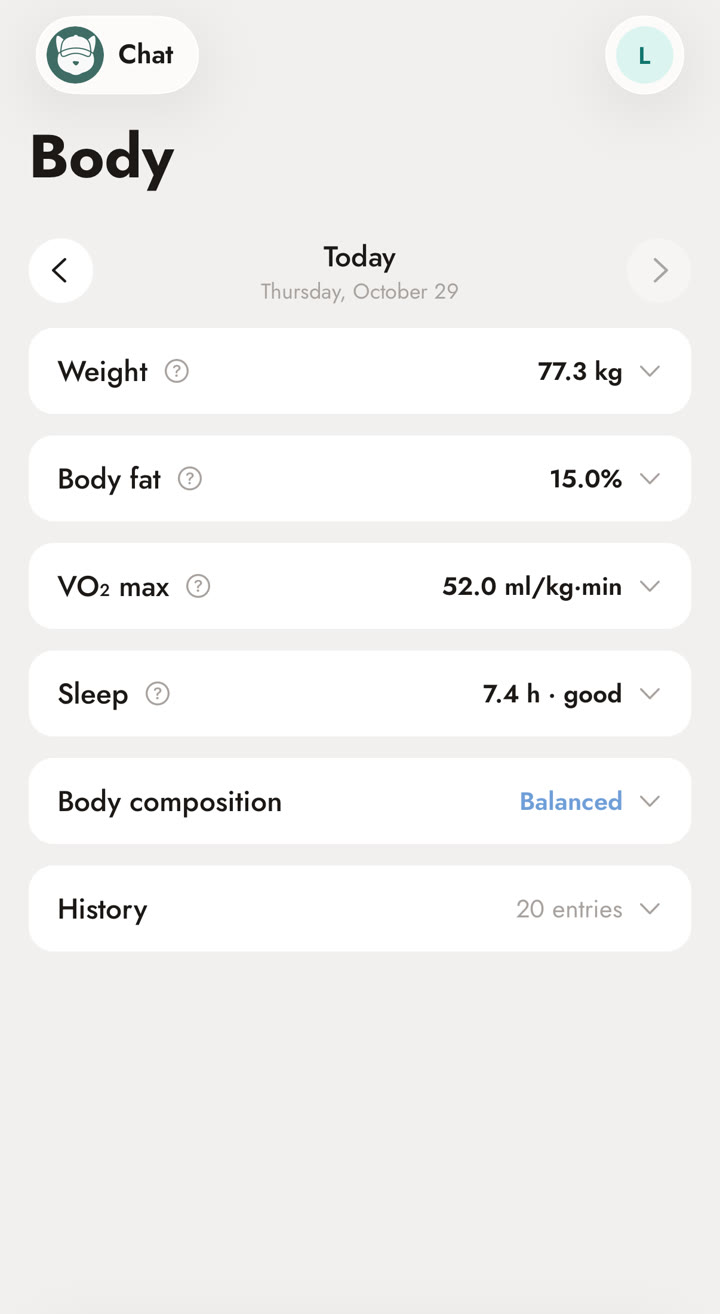
On the Body screen, weight, body fat percentage and body composition appear in one place. In the example below, 77.3 kg with 15.0% body fat results in the Balanced profile. With measurements logged over the weeks, it is easier to bring your doctor the trend in weight together with the trend in fat, not just the number on the scale.
When to see a professional
References
- Mozaffarian D, Agarwal M, Aggarwal M, Alexander L, Apovian CM, Bindlish S, et al. Nutritional priorities to support GLP-1 therapy for obesity: a joint Advisory from the American College of Lifestyle Medicine, the American Society for Nutrition, the Obesity Medicine Association, and The Obesity Society. The American journal of clinical nutrition, 2025;122(1):344-367. See the study
- Neeland IJ, Linge J, Birkenfeld AL. Changes in lean body mass with glucagon-like peptide-1-based therapies and mitigation strategies. Diabetes, obesity & metabolism, 2024;26 Suppl 4:16-27. See the study
- Villareal DT, Aguirre L, Gurney AB, Waters DL, Sinacore DR, Colombo E, et al. Aerobic or Resistance Exercise, or Both, in Dieting Obese Older Adults. The New England journal of medicine, 2017;376(20):1943-1955. See the study
- Alawadhi AA, Alroudhan D, Alsaeed DJ, Almarshad BW, Alshehabi DH, Allahou BA, et al. LEAN mass Preservation with Resistance Exercise and Protein during semaglutide and tirzepatide therapy (LEAN-PREP study): a protocol for a randomised controlled trial. BMJ open, 2026;16(4):e116911. See the study
- Wilding JPH, Batterham RL, Davies M, Van Gaal LF, Kandler K, Konakli K, et al. Weight regain and cardiometabolic effects after withdrawal of semaglutide: The STEP 1 trial extension. Diabetes, obesity & metabolism, 2022;24(8):1553-1564. See the study
- Aronne LJ, Sattar N, Horn DB, Bays HE, Wharton S, Lin WY, et al. Continued Treatment With Tirzepatide for Maintenance of Weight Reduction in Adults With Obesity: The SURMOUNT-4 Randomized Clinical Trial. JAMA, 2024;331(1):38-48. See the study
- Polidori D, Sanghvi A, Seeley RJ, Hall KD. How Strongly Does Appetite Counter Weight Loss? Quantification of the Feedback Control of Human Energy Intake. Obesity (Silver Spring, Md.), 2016;24(11):2289-2295. See the study
- Sumithran P, Prendergast LA, Delbridge E, Purcell K, Shulkes A, Kriketos A, et al. Long-term persistence of hormonal adaptations to weight loss. The New England journal of medicine, 2011;365(17):1597-604. See the study
- West S, Scragg J, Aveyard P, Oke JL, Willis L, Haffner SJP, et al. Weight regain after cessation of medication for weight management: systematic review and meta-analysis. BMJ (Clinical research ed.), 2026;392:e085304. See the study
- Jensen SBK, Blond MB, Sandsdal RM, Olsen LM, Juhl CR, Lundgren JR, et al. Healthy weight loss maintenance with exercise, GLP-1 receptor agonist, or both combined followed by one year without treatment: a post-treatment analysis of a randomised placebo-controlled trial. EClinicalMedicine, 2024;69:102475. See the study
- Murphy C, Koehler K. Energy deficiency impairs resistance training gains in lean mass but not strength: A meta-analysis and meta-regression. Scandinavian journal of medicine & science in sports, 2022;32(1):125-137. See the study
- Bellicha A, van Baak MA, Battista F, Beaulieu K, Blundell JE, Busetto L, et al. Effect of exercise training on weight loss, body composition changes, and weight maintenance in adults with overweight or obesity: An overview of 12 systematic reviews and 149 studies. Obesity reviews : an official journal of the International Association for the Study of Obesity, 2021;22 Suppl 4(Suppl 4):e13256. See the study
- Currier BS, D’Souza AC, Singh MAF, Lowisz CV, Rawson ES, Schoenfeld BJ, et al. American College of Sports Medicine Position Stand. Resistance Training Prescription for Muscle Function, Hypertrophy, and Physical Performance in Healthy Adults: An Overview of Reviews. Medicine and science in sports and exercise, 2026;58(4):851-872. See the study
- Spiering BA, Mujika I, Sharp MA, Foulis SA. Maintaining Physical Performance: The Minimal Dose of Exercise Needed to Preserve Endurance and Strength Over Time. Journal of strength and conditioning research, 2021;35(5):1449-1458. See the study
- Bickel CS, Cross JM, Bamman MM. Exercise dosing to retain resistance training adaptations in young and older adults. Medicine and science in sports and exercise, 2011;43(7):1177-87. See the study
- Mechanick JI, Butsch WS, Christensen SM, Hamdy O, Li Z, Prado CM, et al. Strategies for minimizing muscle loss during use of incretin-mimetic drugs for treatment of obesity. Obesity reviews : an official journal of the International Association for the Study of Obesity, 2025;26(1):e13841. See the study
- Wharton S, Calanna S, Davies M, Dicker D, Goldman B, Lingvay I, et al. Gastrointestinal tolerability of once-weekly semaglutide 2.4 mg in adults with overweight or obesity, and the relationship between gastrointestinal adverse events and weight loss. Diabetes, obesity & metabolism, 2022;24(1):94-105. See the study
- Gorgojo-Martínez JJ, Mezquita-Raya P, Carretero-Gómez J, Castro A, Cebrián-Cuenca A, de Torres-Sánchez A, et al. Clinical Recommendations to Manage Gastrointestinal Adverse Events in Patients Treated with Glp-1 Receptor Agonists: A Multidisciplinary Expert Consensus. Journal of clinical medicine, 2022;12(1). See the study
- Zambrano-Villacres R, Campuzano-Donoso M, Reytor-González C, Rossetti G, Cobellis L, Cobellis F, et al. Nutrition-First Support for GLP-1 and Dual Incretin Therapy in Obesity: A Practical Framework for Dietary Management, Symptom Tolerability, and Long-Term Weight Maintenance. Nutrients, 2026;18(11). See the study
- de Paulo RS, Bonifácio DB, de Carvalho MHL, Bressan J. Dietary Strategies and Nutritional Management in Patients Receiving GLP-1 and Dual GIP/GLP-1 Receptor Agonists as Adjuncts to Lifestyle Interventions: A Systematic Review of Randomised Clinical Trials. Diabetes, obesity & metabolism, 2026;28(7):5492-5507. See the study
- Babazadeh D, Therrien S, Fitch AK, Steinberg FM. Changes in food cravings, dietary quality, body composition, and dietary intake during GLP-1 receptor agonist therapy: The CRAVE study. Obesity pillars, 2026;19:100292. See the study
- Tronieri JS, Allison KC, DeRouen K, Amaro A, Collins KG, Roy A, et al. Short- and long-term effects of semaglutide 2.4 mg on energy intake, appetite, and food reward: a 60-week, double-blind randomized controlled trial. The American journal of clinical nutrition, 2026;124(2):101403. See the study
See this math done for you
In CatLena, you log workouts, meals and measurements (or just chat with CatLena) and the app does this math for you, every day, on your computer and phone.
Get started