Running
Before and during your run: warm-up, steps per minute, treadmill and changing shoes
A 5-minute warm-up, the steps-per-minute test, what changes between treadmill and road, and a 6-week plan to switch shoes without a jump in load.
· 11 min read
Key points
- Static stretching before running did not clearly reduce injuries; a moving warm-up prepares the body better.
- There is no right number of steps per minute: runners range from 150 to 210, and changing only makes sense with a reason.
- A treadmill at 1% and the road give similar numbers at moderate paces, but the tests do not always agree.
- Switching shoes gradually, over about 6 weeks, avoids stacking a shoe change on top of other load changes.
A few details of a running routine raise questions for almost every runner: whether to stretch beforehand, how many steps per minute to take, whether the treadmill counts the same as the road and how to switch shoes. This guide brings together what studies show about each one and offers simple routines to apply on your next run.
A 5-minute warm-up before running
Static stretching before running showed no clear protection. Among 1,538 recruits, all doing an active warm-up, the group that also stretched had 158 leg injuries over 12 weeks versus 175 in the other, a difference within chance [1]. Among 2,377 active adults, stretching before and after cut the week’s soreness from 32.3% to 24.6%, but overall injury risk was practically the same [2].
Right after static stretching, performance dropped 1.1% with under 60 seconds per muscle and 4.6% with 60 seconds or more; dynamic stretching gave a small gain of 1.3% [3]. In runners, 15 studies showed no change in the energy cost of running [4]. A review found no direct harm from stretching and better results with warm-ups tailored to each sport [5].
| Time | What to do | How |
|---|---|---|
| 1 min 30 s | Brisk walk | Gradually lengthen your stride |
| 1 min | Forward leg swings | 20 per leg, holding on if needed |
| 30 s | Toe reaches | Leg forward, alternating |
| 30 s | Heel kicks toward the glutes | Alternating, without forcing |
| 1 min 30 s | Easy jog | Start below your pace and build up to it |
If you like stretching beforehand, keep the habit, with under 60 seconds per muscle, and do the routine afterward. Stretching at the end of the run also works.
Steps per minute: the 1-minute test
The figure of 180 steps per minute came from observing competitive runners and was later repeated as a target for everyone; distance runners usually range from 150 to 210 [6]. In watch data from 256 runners, the group’s formula gives about 167 steps per minute at 10 km/h and 170 at 12 km/h, and cadence was not associated with injury or performance [7].
- Run 5 to 10 minutes at your easy pace on a flat stretch.
- Time 1 minute and count how many times your right foot touches the ground; multiply by 2.
- Write it down with your pace and the surface, and repeat on another day under similar conditions.
Without pain and when you feel comfortable, studies show no reason to chase a number: in a review of 37 studies, only 2 looked at injury, and raising cadence increased perceived effort [8]. The topic has been studied mostly in people with knee pain. On a treadmill, 5% and 10% more steps reduced the energy absorbed by the knee by about 20% and 34% [9]; on the road, a 7.3% increase cut peak force by 5.6% [10]. Two weeks with a metronome raised cadence without worsening effort [11], and 12 runners with knee pain reported improvement with 10% more steps, in a study without a comparison group [12].
If there is a reason to change, start from your own number, not 180: multiply by 1.05, set a metronome to that value and use it on parts of a few easy runs for 2 weeks, at your usual speed.
Treadmill or road: the tests side by side
The 1% treadmill incline was designed to make up for the air resistance you face on the road. Tests do not always reach the same result [13][14][15][16]:
| Study | Who ran | Result |
|---|---|---|
| Jones and Doust, 1996 | 9 trained men | At 1%, energy cost matched the road |
| Pind et al., 2019 | 17 athletes | On the treadmill, 2.8% to 7.9% more oxygen |
| Miller et al., 2019 | Review of 34 studies | Similar oxygen below maximum |
| Shahidi et al., 2026 | 12 trained men | On the track, about 3.5% more oxygen |
These are small groups, almost all trained men, and speed, environment and method change the math [17]. In practice, choose an incline of 0% or 1% and keep it to compare workouts; compare treadmill pace with treadmill pace; run at least part of your training outdoors if your race is on the road, especially long runs and those close to race day. On rainy or very hot days, a treadmill run counts.
Changing shoes: a 6-week plan
No study has directly compared switching shoes all at once with switching gradually, but several show that a change in footwear matters. In 99 runners, there were 4 injuries in traditional shoes and 12 in partial minimalist shoes over 12 weeks [18], and a gradual 10-week switch to minimalist shoes still increased bone edema in the foot in 10 of 19 runners [19]. In 848 runners, the firmer shoe had about 52% higher injury risk [20].
Distance also matters: increasing weekly distance by more than 30% led to more injuries in beginners, without statistical confirmation [21]. Using more than one pair in parallel was associated with about 39% lower risk, in an observational study [22], and a review proposes comfort as the selection criterion [23].
| Week | New pair | Old pair |
|---|---|---|
| 1 | 1 short run, about 20% of the week | The rest |
| 2 | 1 to 2 short runs, about 30% | The rest |
| 3 | 2 runs, about 40% | The rest and the long run |
| 4 | About 60% | The long run |
| 5 | About 80%, with the first long run | Whatever is left |
| 6 | Whatever you prefer | Can stay in use |
- If the new pair is very different, with a thinner or firmer sole, repeat each week.
- Avoid increasing weekly distance during the switch.
- If it hurts more than with the old pair, go back a week.
How CatLena uses it
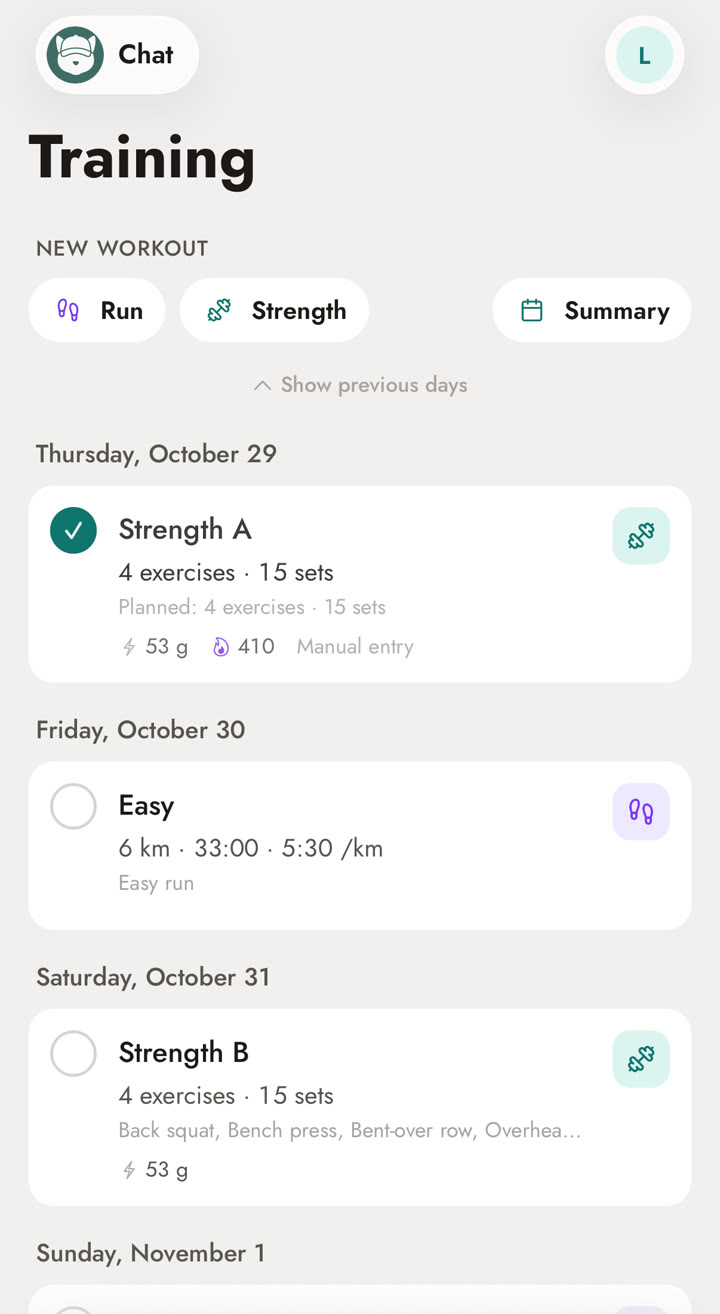
On the Training screen, each run is logged with distance, time and pace. In the example below, the easy 6 km run, in 33 minutes, at 5:30 per kilometer, appears in the same week as the strength workouts. When you switch shoes or alternate between treadmill and road, the log shows whether the week’s pace and distance changed too.
When to see a professional
References
- Pope RP, Herbert RD, Kirwan JD, Graham BJ. A randomized trial of preexercise stretching for prevention of lower-limb injury. Medicine and science in sports and exercise, 2000;32(2):271-7. See the study
- Jamtvedt G, Herbert RD, Flottorp S, Odgaard-Jensen J, Håvelsrud K, Barratt A, et al. A pragmatic randomised trial of stretching before and after physical activity to prevent injury and soreness. British journal of sports medicine, 2010;44(14):1002-9. See the study
- Behm DG, Blazevich AJ, Kay AD, McHugh M. Acute effects of muscle stretching on physical performance, range of motion, and injury incidence in healthy active individuals: a systematic review. Applied physiology, nutrition, and metabolism = Physiologie appliquee, nutrition et metabolisme, 2016;41(1):1-11. See the study
- Warneke K, Zechner M, Siegel SD, Jochum D, Brunssen L, Konrad A. Acute and Chronic Effects of Stretching on Running Economy: A Systematic Review with Meta-Analysis. Sports medicine - open, 2025;11(1):61. See the study
- Lewis J. A systematic literature review of the relationship between stretching and athletic injury prevention. Orthopedic nursing, 2014;33(6):312-20; quiz 321-2. See the study
- Patoz A, Gindre C, Lussiana T, Breine B. The Heel-Strike Fallacy and Cadence Beliefs in Distance Running: A Narrative Review. Sports medicine - open, 2026;12(1). See the study
- Van Oeveren BT, De Ruiter CJ, Hoozemans MJM, Beek PJ, Van Dieën JH. Inter-individual differences in stride frequencies during running obtained from wearable data. Journal of sports sciences, 2019;37(17):1996-2006. See the study
- Anderson LM, Martin JF, Barton CJ, Bonanno DR. What is the Effect of Changing Running Step Rate on Injury, Performance and Biomechanics? A Systematic Review and Meta-analysis. Sports medicine - open, 2022;8(1):112. See the study
- Heiderscheit BC, Chumanov ES, Michalski MP, Wille CM, Ryan MB. Effects of step rate manipulation on joint mechanics during running. Medicine and science in sports and exercise, 2011;43(2):296-302. See the study
- Musgjerd T, Anason J, Rutherford D, Kernozek TW. Effect of Increasing Running Cadence on Peak Impact Force in an Outdoor Environment. International journal of sports physical therapy, 2021;16(4):1076-1083. See the study
- Huber A, Verhoff D. A One Session Gait Retraining Protocol with Metronome Augmentation Increases Cadence in Novice and Recreational Runners. International journal of sports physical therapy, 2024;19(1):1494-1502. See the study
- Bramah C, Preece SJ, Gill N, Herrington L. A 10% Increase in Step Rate Improves Running Kinematics and Clinical Outcomes in Runners With Patellofemoral Pain at 4 Weeks and 3 Months. The American journal of sports medicine, 2019;47(14):3406-3413. See the study
- Jones AM, Doust JH. A 1% treadmill grade most accurately reflects the energetic cost of outdoor running. Journal of sports sciences, 1996;14(4):321-7. See the study
- Pind R, Mooses K, Suvi S, Purge P, Viru M, Pehme A, et al. Better Economy on Indoor Track Compared to Treadmill Running With 1% Inclination. Research quarterly for exercise and sport, 2019;90(4):470-478. See the study
- Miller JR, Van Hooren B, Bishop C, Buckley JD, Willy RW, Fuller JT. A Systematic Review and Meta-Analysis of Crossover Studies Comparing Physiological, Perceptual and Performance Measures Between Treadmill and Overground Running. Sports medicine (Auckland, N.Z.), 2019;49(5):763-782. See the study
- Shahidi SH, Can R, Paça FM, Zengin MD. Overground running incurs a higher energetic cost than treadmill running at a 1% grade: A comparison of running economy, oxygen cost of transport, and energy cost in endurance athletes. PloS one, 2026;21(8):e0355988. See the study
- Bottura R, Fletcher J. Beyond the 1% treadmill rule: 30 years of evidence on treadmill and overground running economy. Applied physiology, nutrition, and metabolism = Physiologie appliquee, nutrition et metabolisme, 2026;51:1-7. See the study
- Ryan M, Elashi M, Newsham-West R, Taunton J. Examining injury risk and pain perception in runners using minimalist footwear. British journal of sports medicine, 2014;48(16):1257-62. See the study
- Ridge ST, Johnson AW, Mitchell UH, Hunter I, Robinson E, Rich BS, et al. Foot bone marrow edema after a 10-wk transition to minimalist running shoes. Medicine and science in sports and exercise, 2013;45(7):1363-8. See the study
- Malisoux L, Delattre N, Urhausen A, Theisen D. Shoe Cushioning Influences the Running Injury Risk According to Body Mass: A Randomized Controlled Trial Involving 848 Recreational Runners. The American journal of sports medicine, 2020;48(2):473-480. See the study
- Nielsen RØ, Parner ET, Nohr EA, Sørensen H, Lind M, Rasmussen S. Excessive progression in weekly running distance and risk of running-related injuries: an association which varies according to type of injury. The Journal of orthopaedic and sports physical therapy, 2014;44(10):739-47. See the study
- Malisoux L, Ramesh J, Mann R, Seil R, Urhausen A, Theisen D. Can parallel use of different running shoes decrease running-related injury risk?. Scandinavian journal of medicine & science in sports, 2015;25(1):110-5. See the study
- Nigg BM, Baltich J, Hoerzer S, Enders H. Running shoes and running injuries: mythbusting and a proposal for two new paradigms: ’preferred movement path’ and ’comfort filter’. British journal of sports medicine, 2015;49(20):1290-4. See the study
See this math done for you
In CatLena, you log workouts, meals and measurements (or just chat with CatLena) and the app does this math for you, every day, on your computer and phone.
Get started