Health
Body signals: a runner’s heart, low energy availability and ice baths
The signs that call for a heart check in runners, how to recognize low energy availability for training and when ice baths help or get in the way.
· 10 min read
Key points
- People who trained more had more calcium in their arteries, yet running was associated with less cardiovascular death over the years.
- Chest pain, unusual shortness of breath, a racing heart, dizziness or fainting call for a medical check before your next workout.
- Eating less than training requires can harm bones, hormones and performance, even with stable weight.
- Ice eases next-day soreness, but right after strength training it may slightly reduce muscle gain.
Some body signals deserve more attention than others. This guide brings together what studies show about the hearts of long-time runners, about low energy when food does not cover training and about ice baths, with questions to bring to your appointment. It does not assess your health: only a professional can do that.
Running and the heart: signs and 6 questions for your appointment
In 284 male athletes around 55 years old, calcium in the heart arteries appeared in 68% of those with the most lifetime training and 43% of those with the least, but among the most trained the plaque was more often purely calcified, a type that may be more stable [1]. In 152 veteran athletes, 60% had normal calcium, similar to non-athletes, although male athletes had more plaques [2].
Over the years, running was associated with a 45% lower risk of cardiovascular death in 55,137 adults [3], and among men with high calcium, the very active did not have higher mortality [4]. Athletes have a 2.46 times higher chance of atrial fibrillation, a type of arrhythmia [5], and among 10.9 million marathon and half-marathon participants there were about 0.54 cardiac arrests per 100,000 [6]. These are observational studies, with many middle-aged men.
- Chest pain, tightness or discomfort.
- Shortness of breath that is unusual for the effort.
- A racing, irregular or skipping heartbeat.
- Dizziness or fainting.
- New, unexplained fatigue.
Any of these signs calls for a check before your next workout. At the appointment, it is worth asking: what is my risk, given age, blood pressure, cholesterol and family history; do these signs call for testing before I continue; does measuring arterial calcium make sense, and what would I do with the result; what changes in my training if it is abnormal; do I need a check before increasing volume or running a long race; and which symptoms should make me stop. Bring notes on your years and hours of training, long races, heart disease in your family and your medications and supplements.
Low energy in runners: signs and questions
Relative energy deficiency in sport, called REDs, happens when food does not cover the cost of training and what the body needs to function [7]. It can be intentional, to change your body, or unnoticed, due to lack of time, appetite changes or a difficult relationship with food, and weight can stay stable even as the body works worse [8].
| Sign to log | Note |
|---|---|
| Training stops paying off | Slower recovery |
| Bone stress injuries | Call for a medical check |
| Frequent illness or injury | Compare with the last 12 months |
| Irregular or missing periods | Not a normal effect of training |
| Low libido in men | Low testosterone on lab tests |
| Fear or guilt around eating | Training used to make up for food |
Carrying extra weight costs energy and time in tests [9][10], but they used weight added externally and short races: they do not show that getting lighter by eating little makes anyone faster. For your appointment, bring 2 weeks of notes on training, sleep and periods and ask: does what I eat cover my training; should we order tests; do I need a bone health check; should I change my training while we investigate; and who else should follow me.
Ice baths: when to go in and when to skip
In 21 men doing 12 weeks of leg strength training, the group that spent 10 minutes in water at about 10 °C after training gained 103 g of front-thigh muscle, versus 309 g in the group that did easy cycling [11]. A cooled leg made less muscle protein than the other over 2 weeks [12], and fast-twitch fibers grew less with cold over 7 weeks, with similar strength [13]. On the other hand, after intense exercise, soreness fell and power improved within 24 hours [14], with the best results at 11 °C to 15 °C for 11 to 15 minutes [15]. A review of 15 reviews rated the certainty as low or very low [16].
| Current goal | Suggestion |
|---|---|
| Build muscle | Skip ice after strength training |
| Compete or repeat hard effort tomorrow | Can use it, knowing strength does not recover faster |
| Endurance over the months | Save it for days when the next performance matters |
| Ease soreness after a one-off session | Your call |
Before going in, ask: what is my goal this month; do I have an important effort in the next 24 hours; has this become a habit after every strength session. It is still unknown how long a gap would avoid the effect on muscle, or whether results are the same in women.
How CatLena uses it
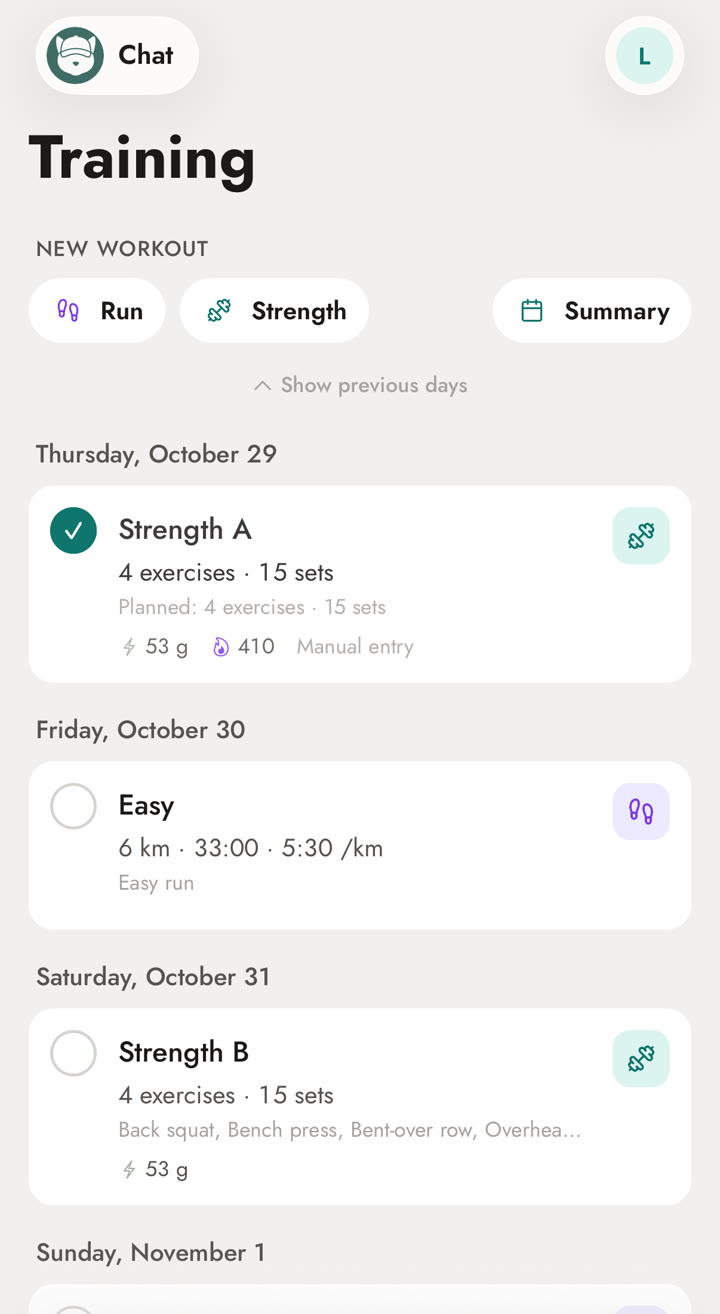
On the Training screen, your history of runs and strength workouts is kept with distance, time, sets and calories. In the example below, the week had 2 strength workouts and a 6 km run. This history helps you answer, at your appointment, how many hours and years you have trained; CatLena does not assess heart health or replace your doctor.
When to see a professional
References
- Aengevaeren VL, Mosterd A, Braber TL, Prakken NHJ, Doevendans PA, Grobbee DE, et al. Relationship Between Lifelong Exercise Volume and Coronary Atherosclerosis in Athletes. Circulation, 2017;136(2):138-148. See the study
- Merghani A, Maestrini V, Rosmini S, Cox AT, Dhutia H, Bastiaenan R, et al. Prevalence of Subclinical Coronary Artery Disease in Masters Endurance Athletes With a Low Atherosclerotic Risk Profile. Circulation, 2017;136(2):126-137. See the study
- Lee DC, Pate RR, Lavie CJ, Sui X, Church TS, Blair SN. Leisure-time running reduces all-cause and cardiovascular mortality risk. Journal of the American College of Cardiology, 2014;64(5):472-81. See the study
- DeFina LF, Radford NB, Barlow CE, Willis BL, Leonard D, Haskell WL, et al. Association of All-Cause and Cardiovascular Mortality With High Levels of Physical Activity and Concurrent Coronary Artery Calcification. JAMA cardiology, 2019;4(2):174-181. See the study
- Newman W, Parry-Williams G, Wiles J, Edwards J, Hulbert S, Kipourou K, et al. Risk of atrial fibrillation in athletes: a systematic review and meta-analysis. British journal of sports medicine, 2021;55(21):1233-1238. See the study
- Kim JH, Malhotra R, Chiampas G, d’Hemecourt P, Troyanos C, Cianca J, et al. Cardiac arrest during long-distance running races. The New England journal of medicine, 2012;366(2):130-40. See the study
- Mountjoy M, Ackerman KE, Bailey DM, Burke LM, Constantini N, Hackney AC, et al. 2023 International Olympic Committee’s (IOC) consensus statement on Relative Energy Deficiency in Sport (REDs). British journal of sports medicine, 2023;57(17):1073-1097. See the study
- Melin AK, Heikura IA, Tenforde A, Mountjoy M. Energy Availability in Athletics: Health, Performance, and Physique. International journal of sport nutrition and exercise metabolism, 2019;29(2):152-164. See the study
- Teunissen LP, Grabowski A, Kram R. Effects of independently altering body weight and body mass on the metabolic cost of running. The Journal of experimental biology, 2007;210(Pt 24):4418-27. See the study
- Hoogkamer W, Kipp S, Spiering BA, Kram R. Altered Running Economy Directly Translates to Altered Distance-Running Performance. Medicine and science in sports and exercise, 2016;48(11):2175-2180. See the study
- Roberts LA, Raastad T, Markworth JF, Figueiredo VC, Egner IM, Shield A, et al. Post-exercise cold water immersion attenuates acute anabolic signalling and long-term adaptations in muscle to strength training. The Journal of physiology, 2015;593(18):4285-301. See the study
- Fuchs CJ, Kouw IWK, Churchward-Venne TA, Smeets JSJ, Senden JM, Lichtenbelt WDVM, et al. Postexercise cooling impairs muscle protein synthesis rates in recreational athletes. The Journal of physiology, 2020;598(4):755-772. See the study
- Fyfe JJ, Broatch JR, Trewin AJ, Hanson ED, Argus CK, Garnham AP, et al. Cold water immersion attenuates anabolic signaling and skeletal muscle fiber hypertrophy, but not strength gain, following whole-body resistance training. Journal of applied physiology (Bethesda, Md. : 1985), 2019;127(5):1403-1418. See the study
- Moore E, Fuller JT, Buckley JD, Saunders S, Halson SL, Broatch JR, et al. Impact of Cold-Water Immersion Compared with Passive Recovery Following a Single Bout of Strenuous Exercise on Athletic Performance in Physically Active Participants: A Systematic Review with Meta-analysis and Meta-regression. Sports medicine (Auckland, N.Z.), 2022;52(7):1667-1688. See the study
- Machado AF, Ferreira PH, Micheletti JK, de Almeida AC, Lemes ÍR, Vanderlei FM, et al. Can Water Temperature and Immersion Time Influence the Effect of Cold Water Immersion on Muscle Soreness? A Systematic Review and Meta-Analysis. Sports medicine (Auckland, N.Z.), 2016;46(4):503-14. See the study
- Berjisian E, Miraftabi H, Ihsan M, Homer KA, Kendall K, Roberts L, et al. Strategic Application of Post-exercise Cold-Water Immersion to Enhance Performance Recovery and Adaptation: An Umbrella Review of 15 Published Systematic Reviews with Meta-analysis. Sports medicine - open, 2026;12(1). See the study
See this math done for you
In CatLena, you log workouts, meals and measurements (or just chat with CatLena) and the app does this math for you, every day, on your computer and phone.
Get started