Supplements
Supplements and gadgets: creatine, collagen, testosterone boosters and electrical stimulation
Common questions about creatine, what studies measured for each collagen and testosterone booster claim, and questions to ask before paying for electrical muscle stimulation.
· 12 min read
Key points
- Creatine has no best time of day and, after stopping, muscle levels return to baseline in about 4 to 6 weeks.
- Collagen showed its best results for joint pain; for skin, the effect disappeared in independent studies, and it does not count as a complete protein.
- Most testosterone booster ingredients have no studies or did not change lab results in people with normal levels.
- Electrical stimulation contracts the muscle, but results depend on the device, how long it is used and what it was compared with.
Labels and ads promise muscle, firm skin, more testosterone and training without effort. This guide shows what studies measured for each claim, who took part and who paid when that is known. It does not recommend any product or dose: it is meant to help you decide calmly and make the most of your conversation with a doctor or dietitian.
Creatine: the most common questions
After stopping, creatine stored in muscle returns to its previous level without dropping below it: in 31 men, this took about 30 days [1], and the International Society of Sports Nutrition review mentions 4 to 6 weeks [2]. No time of day makes a clear long-term difference: before and after training seemed equally effective, and regular use matters most [3].
| Question | What studies show |
|---|---|
| Does it work without training? | Some benefit, especially in people who eat little meat; in older adults, gains came with strength training |
| Does it make you fat? | No fat gain in studies lasting a week to two years; weight rises from water and lean mass |
| Does it cause cramps or dehydration? | Pooled studies do not confirm this; creatine does not seem to increase urine volume |
| Can women use it? | There are studies across life stages, with few side effects |
| During pregnancy? | There are no controlled studies in pregnant women; talk to your doctor |
These answers come from reviews [3][4], some with authors linked to companies that sell creatine. The hair loss study lasted 12 weeks and ended with 38 men, with no replication in other groups [5]. Creatine can raise creatinine on blood tests, which is used to assess the kidneys: tell whoever ordered the test.
Collagen labels, claim by claim
For skin, 23 studies with 1,474 people showed improvement overall, but studies without pharmaceutical company funding and those of higher quality found no effect on hydration, elasticity or wrinkles [6]. The best result was for joint pain, in 15 studies of collagen with exercise, 13 of them with commercial funding [7].
| Claim | What was measured | Caution |
|---|---|---|
| Skin | 23 studies: effect gone in independent ones | Results change with funding |
| Joints | 15 studies, 5 g to 15 g a day: less pain | 13 of 15 commercially funded |
| Collagen production | 8 men, 15 g of gelatin before exercise: marker doubled | A blood marker is not a stronger tendon |
| Tendon | 40 men, 5 g a day for 14 weeks: area 11.0% vs 4.7% | Strength and injury unchanged or not measured |
| Muscle | 22 older women: whey raised muscle building, collagen did not | Small, short study |
Details are in the gelatin [8], tendon [9] and muscle [10] studies; other studies with strength training found more lean mass with collagen, which is not only muscle [11][12]. Collagen lacks tryptophan, an essential amino acid, so it does not do the job of chicken, eggs, beans, milk or fish in your daily protein count [13].
- Which claim made me want to buy it: skin, joints or muscle?
- Does that claim have good independent studies?
- Is the amount on the label the same as in the studies?
- Was the study the brand cites paid for by the brand?
- Is my daily protein already covered without counting collagen?
Testosterone boosters: ingredient by ingredient
| Ingredient | Who was tested | Result |
|---|---|---|
| D-aspartic acid | 22 trained men, 12 weeks | No change in testosterone or strength |
| Zinc with magnesium | 14 active men without zinc deficiency | No change in testosterone |
| Tribulus | 10 studies, 483 people | 8 with no change; small rise in men with low levels |
| Vitamin D | 94 men with low testosterone | No change in lab results |
| Fenugreek | 7 studies, 449 people | Small effect; strength not confirmed |
| Ashwagandha | 57 men aged 40 to 70 | 14.7% more testosterone; energy unchanged |
The studies are cited in order: D-aspartic acid [14], with a higher dose lowering testosterone in another test [15]; zinc and magnesium [16]; tribulus [17]; vitamin D [18]; fenugreek [19]; and ashwagandha, in a study funded by an extract company [20], with a review of 20 studies showing more strength only in active people [21].
Overall, across 50 supplements, 61.5% of 109 ingredients had no testosterone studies, and 13 products exceeded the upper intake limit for zinc, vitamin B3 or magnesium [22]. A review of 52 studies concluded that most ingredients do not raise total testosterone [23], and positive reviews in online stores fell 93% after filtering out unreliable comments [24]. In men, the guideline calls for a morning, fasting test, repeated to confirm [25].
- What explains my fatigue, besides testosterone?
- Does measuring testosterone make sense in my case? How and when?
- Does any ingredient on the label conflict with what I already take or with my health?
- Adding up everything I take, do I exceed the limit for any mineral or vitamin?
- What in my sleep, diet and training is worth looking at first?
Electrical stimulation: 6 questions before you pay
Electrical stimulation contracts the muscle; results are what vary. In 27 young adults, a device used as the manual directed had no effect on weight, fat, measurements or strength [26]. An abdominal belt, 5 days a week for 8 weeks, increased abdominal strength by 58% and reduced the waist by 3.5 cm, without changing weight, in a manufacturer-funded study [27]. In 46 men, a full-body suit with an instructor produced lean mass and strength gains similar to strength training over 16 weeks [28].
A pooled analysis of 26 studies with 1,183 people found small to moderate gains in muscle and strength compared with no training, without answering whether it beats strength training [29]. There are reports of rhabdomyolysis, a serious muscle injury, after full-body sessions [30], and researchers have reviewed situations in which use is not advised [31].
- What was it tested against: people who did nothing or another type of training?
- Was the test done with this type of device, a belt or a suit with an instructor?
- How much use was needed, in sessions per week, minutes and weeks?
- Who paid for the study?
- What was measured: strength, lean mass, waist or how people felt?
- Who adjusts the intensity, and should I talk to a doctor first?
How CatLena uses it
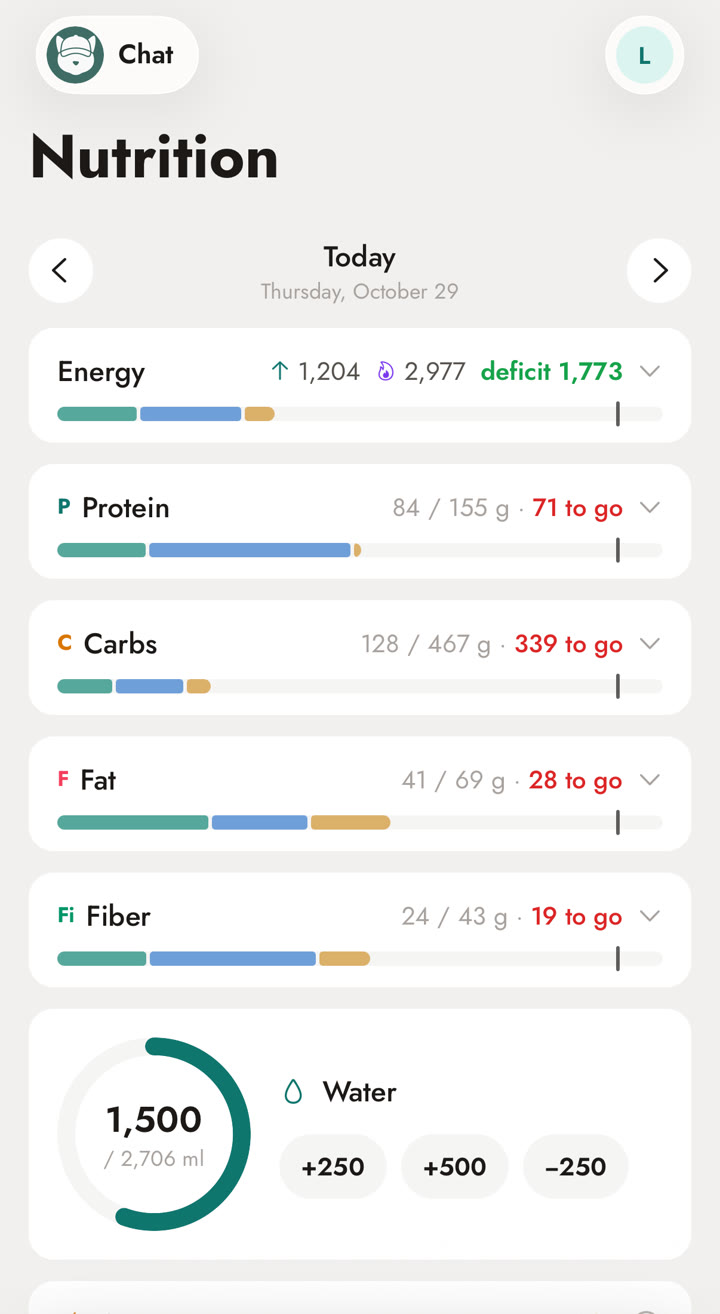
On the Nutrition screen, the day’s protein appears with its target and how much is left, together with fiber and the other nutrients. In the example below, it was 84 g of a 155 g target. Seeing that number before buying a supplement helps you know whether food can close the gap.
When to see a professional
References
- Hultman E, Söderlund K, Timmons JA, Cederblad G, Greenhaff PL. Muscle creatine loading in men. Journal of applied physiology (Bethesda, Md. : 1985), 1996;81(1):232-7. See the study
- Kreider RB, Kalman DS, Antonio J, Ziegenfuss TN, Wildman R, Collins R, et al. International Society of Sports Nutrition position stand: safety and efficacy of creatine supplementation in exercise, sport, and medicine. Journal of the International Society of Sports Nutrition, 2017;14:18. See the study
- Antonio J, Brown AF, Candow DG, Chilibeck PD, Ellery SJ, Forbes SC, et al. Part II. Common questions and misconceptions about creatine supplementation: what does the scientific evidence really show?. Journal of the International Society of Sports Nutrition, 2025;22(1):2441760. See the study
- Antonio J, Candow DG, Forbes SC, Gualano B, Jagim AR, Kreider RB, et al. Common questions and misconceptions about creatine supplementation: what does the scientific evidence really show?. Journal of the International Society of Sports Nutrition, 2021;18(1):13. See the study
- Lak M, Forbes SC, Ashtary-Larky D, Dadkhahfar S, Robati RM, Nezakati F, et al. Does creatine cause hair loss? A 12-week randomized controlled trial. Journal of the International Society of Sports Nutrition, 2025;22(sup1):2495229. See the study
- Myung SK, Park Y. Effects of Collagen Supplements on Skin Aging: A Systematic Review and Meta-Analysis of Randomized Controlled Trials. The American journal of medicine, 2025;138(9):1264-1277. See the study
- Khatri M, Naughton RJ, Clifford T, Harper LD, Corr L. The effects of collagen peptide supplementation on body composition, collagen synthesis, and recovery from joint injury and exercise: a systematic review. Amino acids, 2021;53(10):1493-1506. See the study
- Shaw G, Lee-Barthel A, Ross ML, Wang B, Baar K. Vitamin C-enriched gelatin supplementation before intermittent activity augments collagen synthesis. The American journal of clinical nutrition, 2017;105(1):136-143. See the study
- Jerger S, Centner C, Lauber B, Seynnes O, Sohnius T, Jendricke P, et al. Effects of specific collagen peptide supplementation combined with resistance training on Achilles tendon properties. Scandinavian journal of medicine & science in sports, 2022;32(7):1131-1141. See the study
- Oikawa SY, Kamal MJ, Webb EK, McGlory C, Baker SK, Phillips SM. Whey protein but not collagen peptides stimulate acute and longer-term muscle protein synthesis with and without resistance exercise in healthy older women: a randomized controlled trial. The American journal of clinical nutrition, 2020;111(3):708-718. See the study
- Jendricke P, Centner C, Zdzieblik D, Gollhofer A, König D. Specific Collagen Peptides in Combination with Resistance Training Improve Body Composition and Regional Muscle Strength in Premenopausal Women: A Randomized Controlled Trial. Nutrients, 2019;11(4). See the study
- Zdzieblik D, Jendricke P, Oesser S, Gollhofer A, König D. The Influence of Specific Bioactive Collagen Peptides on Body Composition and Muscle Strength in Middle-Aged, Untrained Men: A Randomized Controlled Trial. International journal of environmental research and public health, 2021;18(9). See the study
- Paul C, Leser S, Oesser S. Significant Amounts of Functional Collagen Peptides Can Be Incorporated in the Diet While Maintaining Indispensable Amino Acid Balance. Nutrients, 2019;11(5). See the study
- Melville GW, Siegler JC, Marshall PWM. The effects of d-aspartic acid supplementation in resistance-trained men over a three month training period: A randomised controlled trial. PloS one, 2017;12(8):e0182630. See the study
- Melville GW, Siegler JC, Marshall PW. Three and six grams supplementation of d-aspartic acid in resistance trained men. Journal of the International Society of Sports Nutrition, 2015;12:15. See the study
- Koehler K, Parr MK, Geyer H, Mester J, Schänzer W. Serum testosterone and urinary excretion of steroid hormone metabolites after administration of a high-dose zinc supplement. European journal of clinical nutrition, 2009;63(1):65-70. See the study
- Vilar Neto JO, de Moraes WMAM, Pinto DV, da Silva CA, Caminha JSR, Nunes Filho JCC, et al. Effects of Tribulus (Tribulus terrestris L.) Supplementation on Erectile Dysfunction and Testosterone Levels in Men-A Systematic Review of Clinical Trials. Nutrients, 2025;17(7). See the study
- Lerchbaum E, Trummer C, Theiler-Schwetz V, Kollmann M, Wölfler M, Heijboer AC, et al. Effects of vitamin D supplementation on androgens in men with low testosterone levels: a randomized controlled trial. European journal of nutrition, 2019;58(8):3135-3146. See the study
- Isenmann E, Alisauskas P, Flenker U, Schalla J, Diel P. The Anabolic Effect of Fenugreek: A Systematic Review with Meta-analysis. International journal of sports medicine, 2023;44(10):692-703. See the study
- Lopresti AL, Drummond PD, Smith SJ. A Randomized, Double-Blind, Placebo-Controlled, Crossover Study Examining the Hormonal and Vitality Effects of Ashwagandha ( Withania somnifera) in Aging, Overweight Males. American journal of men’s health, 2019;13(2):1557988319835985. See the study
- Zhu X, Zeng Q, Lei Y, Xu D. Effects of Withania somnifera (L.) Dunal (Ashwagandha) on cognitive and physical function in adults: a systematic review and meta-analysis. Frontiers in pharmacology, 2026;17:1799467. See the study
- Clemesha CG, Thaker H, Samplaski MK. ’Testosterone Boosting’ Supplements Composition and Claims Are not Supported by the Academic Literature. The world journal of men’s health, 2020;38(1):115-122. See the study
- Morgado A, Tsampoukas G, Sokolakis I, Schoentgen N, Urkmez A, Sarikaya S. Do "testosterone boosters" really increase serum total testosterone? A systematic review. International journal of impotence research, 2024;36(4):348-364. See the study
- Balasubramanian A, Thirumavalavan N, Srivatsav A, Yu J, Lipshultz LI, Pastuszak AW. Testosterone Imposters: An Analysis of Popular Online Testosterone Boosting Supplements. The journal of sexual medicine, 2019;16(2):203-212. See the study
- Bhasin S, Brito JP, Cunningham GR, Hayes FJ, Hodis HN, Matsumoto AM, et al. Testosterone Therapy in Men With Hypogonadism: An Endocrine Society Clinical Practice Guideline. The Journal of clinical endocrinology and metabolism, 2018;103(5):1715-1744. See the study
- Porcari JP, McLean KP, Foster C, Kernozek T, Crenshaw B, Swenson C. Effects of electrical muscle stimulation on body composition, muscle strength, and physical appearance. Journal of strength and conditioning research, 2002;16(2):165-72. See the study
- Porcari JP, Miller J, Cornwell K, Foster C, Gibson M, McLean K, et al. The effects of neuromuscular electrical stimulation training on abdominal strength, endurance, and selected anthropometric measures. Journal of sports science & medicine, 2005;4(1):66-75. See the study
- Kemmler W, Teschler M, Weißenfels A, Bebenek M, Fröhlich M, Kohl M, et al. Effects of Whole-Body Electromyostimulation versus High-Intensity Resistance Exercise on Body Composition and Strength: A Randomized Controlled Study. Evidence-based complementary and alternative medicine : eCAM, 2016;2016:9236809. See the study
- Rodrigues-Santana L, Hugo L, Pérez-Gómez J, Hernández-Mocholí MA, Carlos-Vivas J, Saldaña-Cortés P, et al. The effects of whole-body muscle stimulation on body composition and strength parameters: A PRISMA systematic review and meta-analysis. Medicine, 2023;102(8):e32668. See the study
- Stöllberger C, Finsterer J. Side effects of and contraindications for whole-body electro-myo-stimulation: a viewpoint. BMJ open sport & exercise medicine, 2019;5(1):e000619. See the study
- von Stengel S, Fröhlich M, Ludwig O, Eifler C, Berger J, Kleinöder H, et al. Revised contraindications for the use of non-medical WB-electromyostimulation. Evidence-based German consensus recommendations. Frontiers in sports and active living, 2024;6:1371723. See the study
See this math done for you
In CatLena, you log workouts, meals and measurements (or just chat with CatLena) and the app does this math for you, every day, on your computer and phone.
Get started