Running
Running workouts: easy pace, intervals, weekly volume and a training log
The talk test to find your easy pace, a first interval workout, how many kilometers to run per week for each race and what to log after each run.
· 11 min read
Key points
- World-class runners ran 87% of their kilometers at an easy pace; the talk test finds that pace without a watch.
- 4-minute hard intervals with 3 easy minutes improved aerobic fitness, and continuous running works too.
- Amateur marathoners ran around 40 km per week; one run far above the month’s longest was linked to more injuries.
- Logging time, distance, effort and sleep for each run helps you see what works in your week.
A well-built running week mixes different paces, increases volume gradually and leaves a record of what was done. This guide brings together what studies show about easy pace, interval training, weekly volume for each race and the habit of logging your runs, with templates to use starting next week.
Easy running: the talk test and a sample week
When researchers followed 7 world-class runners for 50 weeks, 87% of the kilometers were at an easy pace [1]. The talk test helps you recognize that pace without a watch: in 16 active people who ran 30 minutes guided only by speech, all finished the run at the level where they spoke comfortably, 13 at the level of doubt and only 2 at the level where they could no longer speak [2].
- After 5 to 10 minutes of running, say a whole sentence out loud, two or three lines long.
- If you can speak comfortably, the pace is easy. If you are unsure, it is already moderate. If you cannot, it is hard.
- Repeat midway and near the end; it is normal to slow down as time goes on, especially in the heat.
| Run | How to do it |
|---|---|
| 1, easy | 30 to 40 min, speaking comfortably from start to finish |
| 2, with hard segments | 10 min easy, 4 × 2 min hard with 3 min of jogging, 10 min easy |
| 3, easy and longer | Run 1’s time plus 10 to 15 min |
The 80/20 split is a nickname, not an exact rule: in 8 high-level runners, about 71% of the time was easy [3]. In amateurs, 77% or 46% of time at an easy pace improved 10 km times by 5% and 3.6%, a difference that may have been chance [4], and an analysis of 13 studies with 348 athletes found no difference in race time between splits [5]. Beginners can do all 3 runs easy for a few weeks, alternating running and walking.
Your first interval workout: 4 sets of 4 minutes
In 40 trained men, 8 weeks of 4 hard 4-minute sets with 3 easy minutes between them, 3 times a week, increased maximum oxygen uptake more than continuous training with the same energy cost [6]. A review of 28 studies with 723 adults found large gains with both types of training, with a small advantage for intervals [7]. Both approaches work, and most of the week can stay easy [4].
| Part | Duration | Pace |
|---|---|---|
| Warm-up | 10 min | Walking or easy jog |
| Set | 4 min | Hard: only a few words |
| Recovery | 3 min | Jog or walk |
| Repeat | Up to 4 sets | Start with 2 |
| Cool-down | 5 min | Walking or easy jog |
Before adding hard sets, build a base of 30 minutes of continuous running. At first, do 1 interval session per week and keep the other runs easy. The original study used 90% to 95% of maximum heart rate; the suggestion for starting out is more modest.
How much to run per week for each race
World-class runners do 11 to 14 sessions per week mid-preparation, with at least 80% of volume at low intensity [8]. Among 997 Dutch amateurs, training about 3 times a week, the typical half-marathoner ran 26 km and the typical marathoner 40 km. More volume was associated with better times, and a long run under 25 km was associated with a slower marathon [9]. At the Boston Marathon, the average was 64 to 68 km per week [10].
| Race | Amateurs | Elite |
|---|---|---|
| 5 km | 15 to 25 km (suggestion) | 130 to 190 km |
| 10 km | 20 to 35 km (suggestion) | 130 to 190 km |
| Half marathon | 26 km (20 to 40 km) | No specific data |
| Marathon | 40 km (30 to 50 km) | 160 to 220 km |
The 5 km and 10 km ranges for amateurs are our starting point and do not come from a study. To build up, the well-known 10% weekly rule did not reduce injuries in 532 beginners [11], and increases above 30% over two weeks had more injuries in an exploratory study [12]. What mattered most was a single run that was too long: among 5,205 runners, running 10% to 30% beyond the longest run of the past 30 days was associated with 64% more injuries, and more than double that distance with 128% more [13]. Evidence on sudden load changes is still limited [14].
- Add up the kilometers of the last 4 weeks and divide by 4: that is your starting point.
- Note the longest run of the last 30 days and avoid a run far beyond it.
- If pain changes the way you run, cut back and see a health professional.
Training log: what to write down and how to read it
Eliud Kipchoge has kept training logs since 2003, writing down time, kilometers, massage, exercises, the shoes used and how he felt [15]. The habit does not depend on his pace: a sheet and a minute after training are enough. In a survey of 1,022 amateur marathoners, the median time was 3:28 for men and 3:54 for women, with about 64 km of training per week [16]; having your own numbers written down is what lets you compare one week with the next.
A sample logged week:
| Day | Workout | Effort (0 to 10) | Sleep |
|---|---|---|---|
| Tue | Easy, 6 km in 33 min | 3 | 7 h |
| Thu | 4 × 4 min hard | 8 | 6 h |
| Sat | Easy long run, 10 km | 5 | 8 h |
- At the end of the week, add up the kilometers or the time.
- Check whether hard and easy days alternated.
- Look for patterns: pain always with the same shoes, a bad run after a short night.
- Change only one thing the following week.
How CatLena uses it
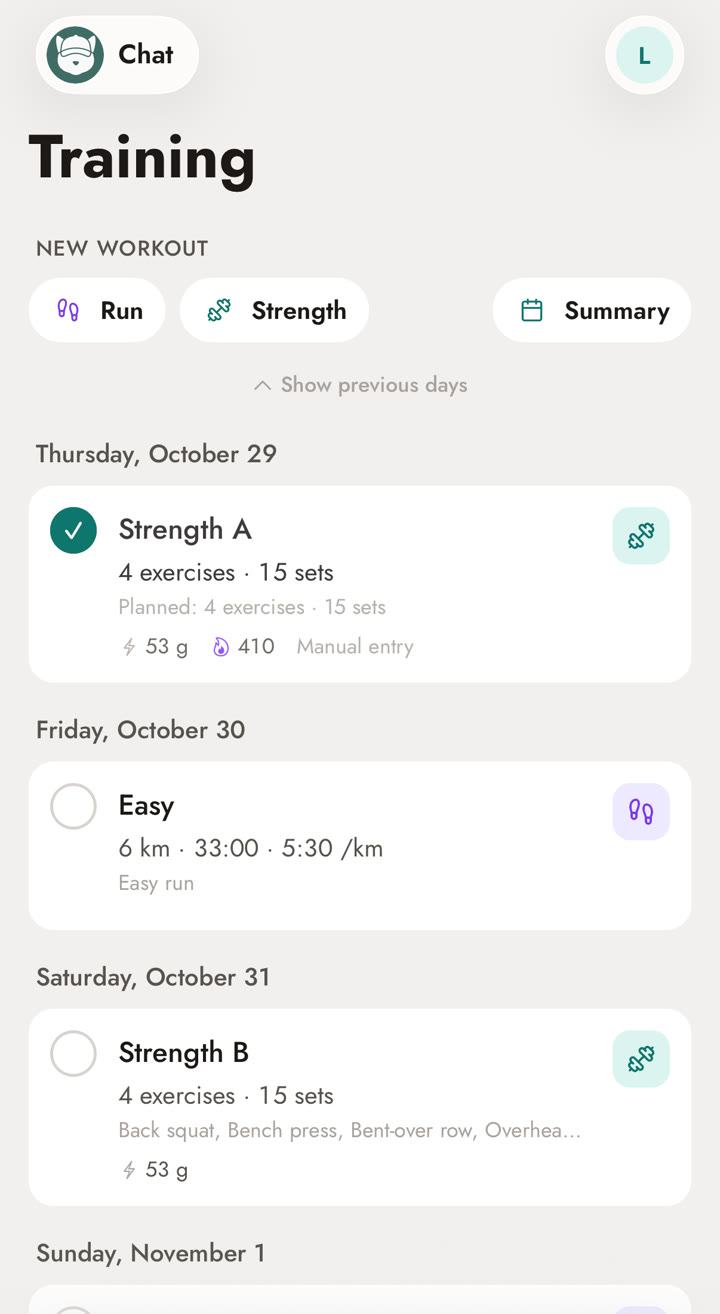
On the Training screen, each run is logged with distance, time and pace, next to your strength workouts. In the example below, Friday’s easy run covered 6 km in 33 minutes, at 5:30 per kilometer. With your runs logged, the week’s total and the longest run of the last 30 days are in view, which helps you apply the volume rules above.
When to see a professional
References
- Kenneally M, Casado A, Gomez-Ezeiza J, Santos-Concejero J. Training intensity distribution analysis by race pace vs. physiological approach in world-class middle- and long-distance runners. European journal of sport science, 2021;21(6):819-826. See the study
- Woltmann ML, Foster C, Porcari JP, Camic CL, Dodge C, Haible S, et al. Evidence that the talk test can be used to regulate exercise intensity. Journal of strength and conditioning research, 2015;29(5):1248-54. See the study
- Esteve-Lanao J, San Juan AF, Earnest CP, Foster C, Lucia A. How do endurance runners actually train? Relationship with competition performance. Medicine and science in sports and exercise, 2005;37(3):496-504. See the study
- Muñoz I, Seiler S, Bautista J, España J, Larumbe E, Esteve-Lanao J. Does polarized training improve performance in recreational runners?. International journal of sports physiology and performance, 2014;9(2):265-72. See the study
- Rosenblat MA, Watt JA, Arnold JI, Treff G, Sandbakk ØB, Esteve-Lanao J, et al. Which Training Intensity Distribution Intervention will Produce the Greatest Improvements in Maximal Oxygen Uptake and Time-Trial Performance in Endurance Athletes? A Systematic Review and Network Meta-analysis of Individual Participant Data. Sports medicine (Auckland, N.Z.), 2025;55(3):655-673. See the study
- Helgerud J, Høydal K, Wang E, Karlsen T, Berg P, Bjerkaas M, et al. Aerobic high-intensity intervals improve VO2max more than moderate training. Medicine and science in sports and exercise, 2007;39(4):665-71. See the study
- Milanović Z, Sporiš G, Weston M. Effectiveness of High-Intensity Interval Training (HIT) and Continuous Endurance Training for VO2max Improvements: A Systematic Review and Meta-Analysis of Controlled Trials. Sports medicine (Auckland, N.Z.), 2015;45(10):1469-81. See the study
- Haugen T, Sandbakk Ø, Seiler S, Tønnessen E. The Training Characteristics of World-Class Distance Runners: An Integration of Scientific Literature and Results-Proven Practice. Sports medicine - open, 2022;8(1):46. See the study
- Fokkema T, van Damme AADN, Fornerod MWJ, de Vos RJ, Bierma-Zeinstra SMA, van Middelkoop M. Training for a (half-)marathon: Training volume and longest endurance run related to performance and running injuries. Scandinavian journal of medicine & science in sports, 2020;30(9):1692-1704. See the study
- DeJong Lempke AF, Ackerman KE, Stellingwerff T, Burke LM, Baggish AL, d’Hemecourt PA, et al. Training Volume and Training Frequency Changes Associated with Boston Marathon Race Performance. Sports medicine (Auckland, N.Z.), 2026;56(1):243-256. See the study
- Buist I, Bredeweg SW, van Mechelen W, Lemmink KA, Pepping GJ, Diercks RL. No effect of a graded training program on the number of running-related injuries in novice runners: a randomized controlled trial. The American journal of sports medicine, 2008;36(1):33-9. See the study
- Nielsen RØ, Parner ET, Nohr EA, Sørensen H, Lind M, Rasmussen S. Excessive progression in weekly running distance and risk of running-related injuries: an association which varies according to type of injury. The Journal of orthopaedic and sports physical therapy, 2014;44(10):739-47. See the study
- Schuster Brandt Frandsen J, Hulme A, Parner ET, Møller M, Lindman I, Abrahamson J, et al. How much running is too much? Identifying high-risk running sessions in a 5200-person cohort study. British journal of sports medicine, 2025;59(17):1203-1210. See the study
- Damsted C, Glad S, Nielsen RO, Sørensen H, Malisoux L. IS THERE EVIDENCE FOR AN ASSOCIATION BETWEEN CHANGES IN TRAINING LOAD AND RUNNING-RELATED INJURIES? A SYSTEMATIC REVIEW. International journal of sports physical therapy, 2018;13(6):931-942. See the study
- Outside. Eliud Kipchoge’s marathon workout and training principles. Outside Online, 2021. See the study
- Vickers AJ, Vertosick EA. An empirical study of race times in recreational endurance runners. BMC sports science, medicine & rehabilitation, 2016;8(1):26. See the study
See this math done for you
In CatLena, you log workouts, meals and measurements (or just chat with CatLena) and the app does this math for you, every day, on your computer and phone.
Get started